
EPC F rating: what now? Your options explained

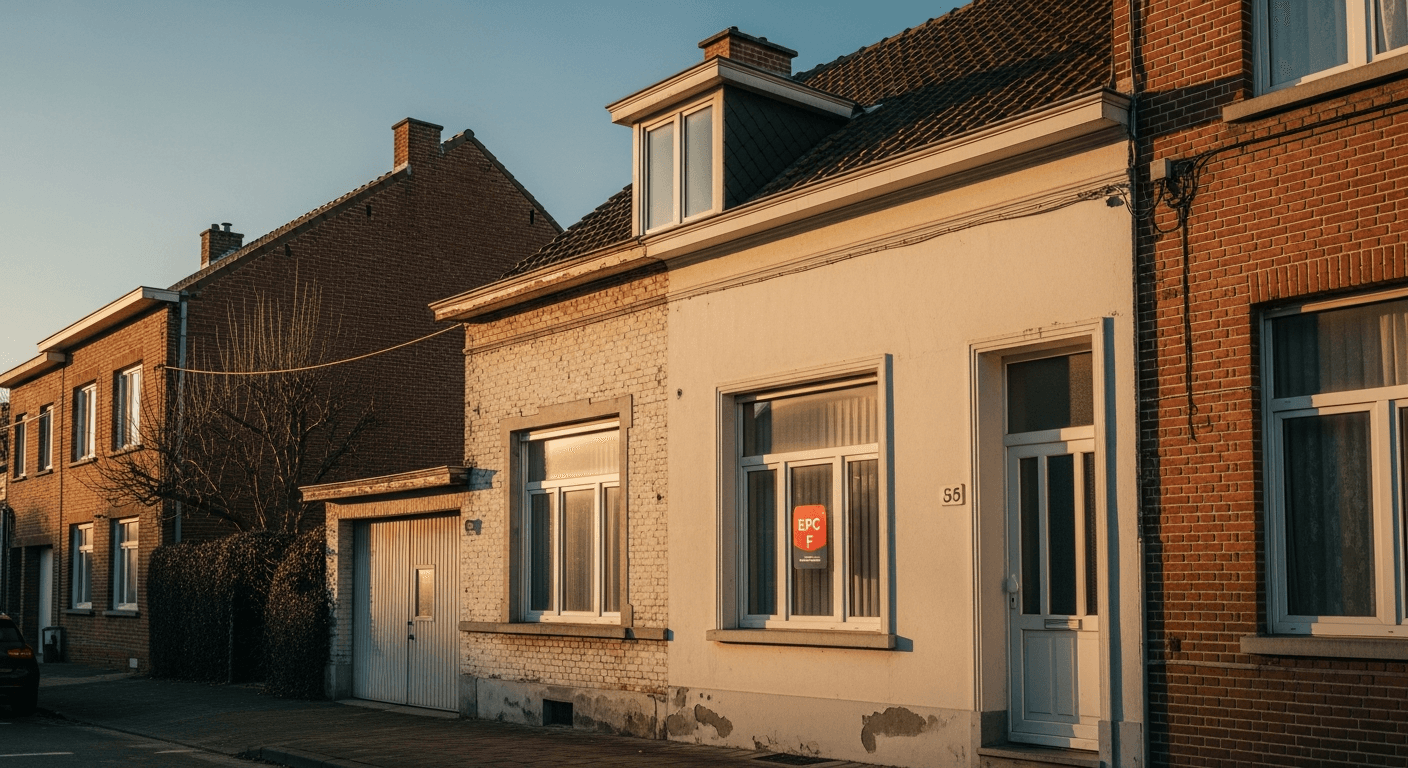
EPC F home: what should you do now?
If your home has an EPC F label, you are facing a concrete decision. An F rating means a primary energy consumption of more than 500 kWh per m² per year in Flanders, and between 425 and 510 kWh in Wallonia. That is high, and the Belgian authorities are imposing increasingly strict obligations on owners of such properties. There are, however, several options, depending on your situation.
What exactly does an EPC F label mean?
The Energy Performance Certificate (EPC) indicates how energy-efficient a building is on a scale from A+ to F in Flanders, where F is the worst label. In Wallonia and Brussels the PEB scale runs down to G, so F is the second-worst label there, just above G. Homes with this label are typically poorly insulated, have outdated heating systems and consume significantly more energy than average.
In Flanders, a renovation obligation has applied since 1 January 2023 when purchasing a home with an E or F label. The buyer must renovate the property to at least a D label within six years of signing the deed. That deadline was extended from five to six years in 2025. Wallonia and Brussels have no such obligation for buyers today. A Walloon draft plan provides one for purchases from 2028, but that calendar still has to be confirmed in legislation. In Brussels, every private home must reach PEB 275 (currently class E or better) by 1 January 2033, whether or not it is sold.
For sellers, this matters: the label has a direct impact on the attractiveness and the sale price of your property.
What are the consequences for the sale price?
Studies by Statbel and KU Leuven, among others, show that homes with a poor energy label fetch on average 10 to 20% less than comparable properties with a better label. In 2025 and 2026, that price gap has widened further, as buyers are well aware of the renovation costs they will face.
✦ 100% free & No obligation
Sell your property with the best agent
Compare the top 3 agents in your region for free and save on commission.
Compare agents →This does not mean you cannot sell your home. It does mean that buyers will deduct the expected renovation costs from their offer. A realistic asking price is therefore the starting point for a successful sale.
Want to know what your home is worth today? Use our free valuation tool to get a first indication based on current market data in your municipality.
Renovating before selling: is it worth it?
It depends on the scale of the works and the expected added value in your area. Smaller interventions such as roof insulation or replacing a few windows can already noticeably improve the score and increase the property's saleability. Larger renovations - such as a heat pump or full exterior wall insulation - require more investment and time.
As a rule of thumb: if a renovation brings the EPC score from F to C or better, the market value generally rises by more than the cost of the works. Going from F to D is already an improvement, but the return on investment is lower. A certified estate agent with knowledge of your local market can help you assess whether renovating before selling makes financial sense.
Compare local estate agents who can advise you via our comparison tool, completely free and without obligation.
Selling without renovating: is that possible?
Yes, it is legally possible. As a seller, you are not required to renovate before selling. You are, however, obliged to provide a valid EPC certificate at the time of sale. The renovation obligation then passes to the buyer.
In practice, this means you need to be transparent about the energy condition of the property. Buyers will factor this into their offer. Some buyers are willing to purchase an F-rated home, particularly if the location, plot size or other features are attractive. Others will walk away or negotiate hard.
A good estate agent will guide you through those negotiations and help you set a fair market price that accounts for the label without undervaluing the property. Via ImmoMakelaarVergelijker, you can compare up to three certified agents in your area on their approach, commission and experience.
What grants and subsidies are available?
In Wallonia, regional support for energy renovation depends on household income. In Brussels, no Renolution grants are open for new works: the scheme only covered works with a final invoice dated 2024 and that filing period is closed, and no new support has been decided. In Flanders, the Mijn VerbouwPremie applies - an income-dependent grant that combines various earlier subsidies covering roof insulation, wall insulation, floor insulation, windows and heating systems.
In addition to regional grants, you can also benefit from the federal tax reduction for energy-saving investments and from green loans at favourable interest rates. In 2026, those rates are on average slightly higher than a few years ago, but several banks still offer preferential rates specifically for energy renovation.
Always seek combined advice from an energy specialist and your estate agent before deciding. The combination of grants, tax benefits and expected added value determines whether renovating is worth it for you.
What is the fastest step you can take right now?
If you are not sure what to do with your EPC F home, the most practical first step is a conversation with a local estate agent who is experienced in energy-related property matters. Based on your specific situation, your time horizon and the market in your municipality, they can give you concrete advice.
IMV connects you free of charge with up to three certified estate agents in your area. You compare, you choose, and you decide for yourself whether and when to take the next step. With no obligation whatsoever.
Frequently asked questions about EPC F homes
As a seller, am I required to renovate my EPC F home before selling?
No, you are not legally required to renovate before you sell. You must, however, be able to provide a valid EPC certificate. The renovation obligation transfers to the buyer after the deed is signed.
How much less does an EPC F home sell for?
Research shows that homes with an F label fetch on average 10 to 20% less than comparable properties with a better energy label. The exact difference depends on the location, the type of property and the condition of the building.
Which renovations improve the EPC score most quickly?
Roof insulation generally has the greatest impact on the energy score, followed by wall insulation and replacing single glazing with high-performance glazing. A new, efficient heating installation such as a heat pump also helps significantly. A certified energy specialist will determine which combination yields the best results for your home in a renovation advisory report.
Can I rent out an EPC F home?
In Flanders, rented homes must meet a minimum EPC label from 1 January 2030: label D for terraced houses and apartments and label E for detached and semi-detached houses, with stricter labels later. An F-rated home does not meet that standard and may then no longer be rented out. In Brussels, every private home, rented or not, must reach PEB 275 (currently class E or better) by 1 January 2033. A Walloon draft plan sets minimum labels for all existing homes from 2031, but these are not law yet. If you are considering renting out your property rather than selling it, it is advisable to check the current rules with a certified adviser or estate agent in good time.
Are you weighing up what to do with your EPC F home? An experienced estate agent knows the local market and can help you make the right decision. Request a free comparison today via ImmoMakelaarVergelijker and receive up to three no-obligation proposals from certified agents in your municipality.
Frequently asked questions
Do I have to renovate my home before selling it if it has an EPC F label?
No, you are not legally required to renovate before selling. You must provide a valid EPC certificate, and the renovation obligation transfers to the buyer after the deed is signed.
How much less can I expect to get for my EPC F home compared to a better-rated property?
Research by Statbel and KU Leuven shows that homes with an F label sell for an average of 10 to 20% less than comparable properties with a better energy label. That gap has widened further in 2025 and 2026 as buyers are increasingly aware of the renovation costs involved.
Which renovations have the biggest impact on improving an EPC F score?
Roof insulation generally has the greatest impact, followed by wall insulation and replacing single glazing with high-performance glazing. A new efficient heating system such as a heat pump also contributes significantly.
What grants are available in Belgium for energy renovation of an F-rated home?
In Flanders, the Mijn VerbouwPremie covers insulation and heating works on an income-dependent basis. Brussels has no grants open for new works and Wallonia has its own regional support, and there is also a federal tax reduction for energy-saving investments plus green loans at preferential rates from several banks.
Can I still rent out my home if it has an EPC F label?
In Flanders, rented homes must meet a minimum EPC label from 1 January 2030 (label D for terraced houses and apartments, label E for detached and semi-detached houses), so an F-rated home can no longer be rented out from then unless it is renovated. In Brussels, every private home must reach PEB 275 (currently class E or better) by 1 January 2033. Wallonia plans minimum labels for existing homes from 2031, but these are not law yet, so it is worth checking the current rules with a certified adviser.
"Tech entrepreneur and strategist focused on digital transformation in the real estate sector."