
EPC label for your home explained: what does each label mean?

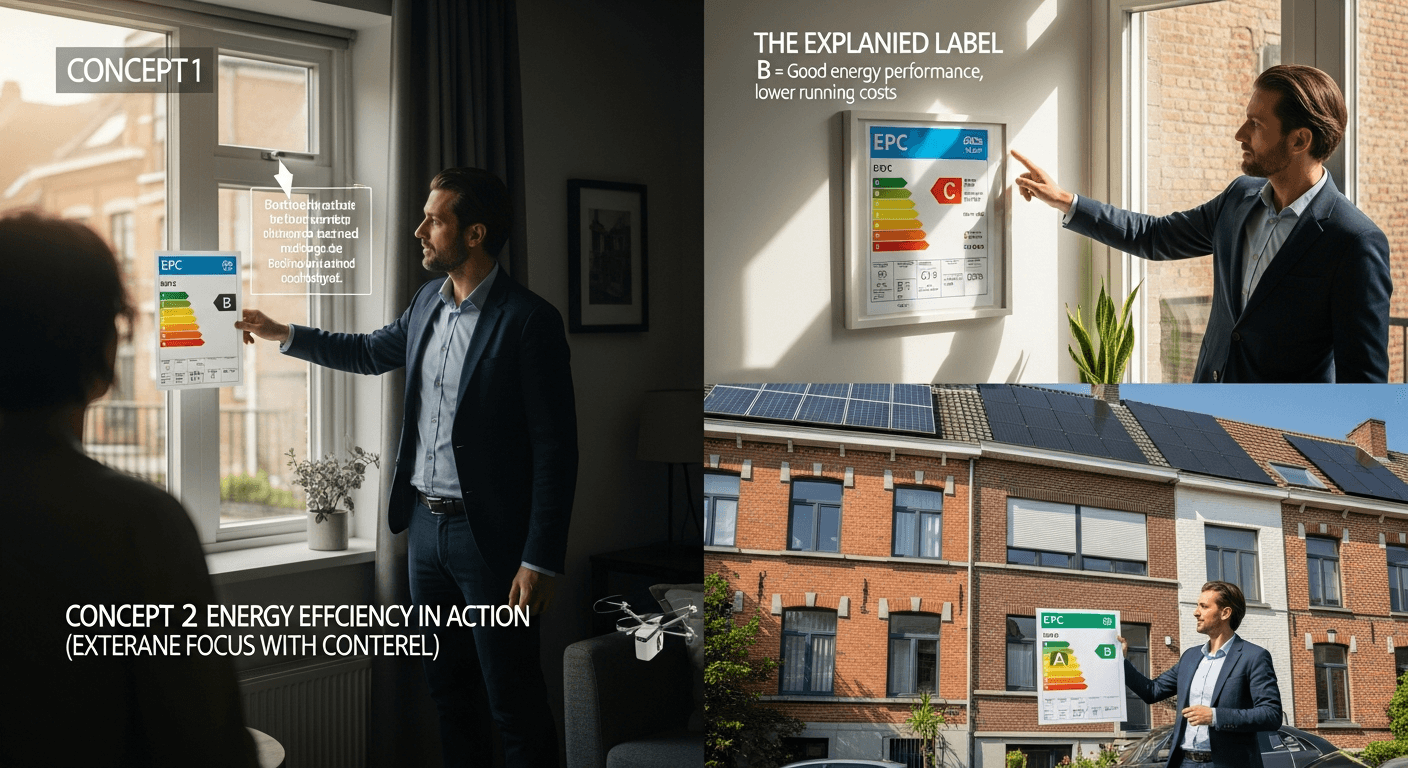
EPC label for your home explained: what does each label mean?
Your home's EPC label shows at a glance how energy-efficient your property is. From the highly efficient A labels to the energy-hungry F labels: every label has consequences for your energy bills, the value of your home and your position on the property market. In this article you will find out exactly what each label means and why it carries so much weight when selling.
What is an EPC certificate?
EPC stands for Energy Performance Certificate. It is an official document drawn up by a certified energy expert following an inspection of your home. The certificate describes how energy-efficient the building is, based on characteristics such as insulation, heating system, glazing and ventilation.
In Flanders, an EPC is mandatory for every sale or rental of a residential property. The certificate is valid for ten years. The score is expressed in kWh per m² per year and translated into a label ranging from A+ to F. The lower the figure, the better the label and the less energy the property consumes.
Overview of EPC labels: from A+ to F
Each label represents a specific energy performance class. Below is a brief overview of what each label means in the Flemish context (2026):
- A+ and A: very energy-efficient homes with consumption below 100 kWh/m²/year. Think of new-build properties with solar panels, a heat pump and excellent insulation.
- B: well-insulated home with a modern heating system. Consumption between 100 and 200 kWh/m²/year.
- C: reasonably energy-efficient. Consumption between 200 and 300 kWh/m²/year. Often homes that have been partially renovated.
- D: average performance, consumption between 300 and 400 kWh/m²/year. Further investment in insulation or heating is worthwhile.
- E: below average. Consumption between 400 and 500 kWh/m²/year. Buyers already factor renovation costs into their offer.
- F: very poor energy performance. Consumption above 500 kWh/m²/year. From 1 January 2030, Flanders sets a minimum EPC label for rental homes. There is no label G in Flanders; only Wallonia and Brussels use it, each on its own scale.
According to the Flemish long-term renovation strategy, about half of all Flemish homes had an EPC in February 2020, with an average score of 418 kWh/m² per year for a single-family home (label E) and 248 kWh/m² for an apartment (label C). Many homes built before 1980 score a D, E or lower.
✦ 100% free & No obligation
Sell your property with the best agent
Compare the top 3 agents in your region for free and save on commission.
Compare agents →What does the EPC label mean for the sale price?
The influence of the EPC label on the sale price has grown considerably in recent years. Research by property experts shows that homes with a label A or B achieve on average 10 to 15% more than comparable homes with a label E or F in the same neighbourhood.
Buyers are aware of rising energy prices and factor renovation costs into their offer. A home with label F can quickly end up 20,000 to 40,000 euros lower during negotiations than a comparable home with label C, depending on the location and the condition of the property.
Moreover, the EPC label acts as a signal to the bank. Mortgage lenders in Belgium are increasingly taking energy performance into account when assessing an application. A green label increases the chance of more favourable loan conditions for the buyer, which indirectly benefits your chances of selling as well.
Would you like to know what your home is worth in the current market? Request a free valuation through IMV and compare estate agents who will give you a realistic assessment of your property's value.
EPC label and the renovation obligation in Flanders
In Flanders, a renovation obligation has been in place since 2023 for homes with an EPC label E or F. Anyone who purchases such a property is required to renovate it to at least label D within six years of the deed of sale.
This has a direct impact on the saleability of poorly rated homes. Prospective buyers are more hesitant, knowing that they will be obliged to invest after purchase. As a seller, it is therefore wise to know your EPC label before going to market, so that you can set a realistic asking price and gauge the room for negotiation.
An experienced estate agent knows the local market and can guide you in determining the right strategy. Compare certified estate agents for free in your area through IMV and receive up to three no-obligation proposals.
How do you improve your home's EPC label?
A better EPC label starts with the most impactful measures. The energy expert who draws up the certificate will also provide recommendations. The most common improvement works are:
- Roof insulation: this is generally the most cost-effective measure. A well-insulated roof can improve the energy score by one or two labels.
- Wall insulation: cavity wall insulation or external facade insulation significantly reduces heat loss.
- High-performance glazing: double or triple glazing replaces single panes and improves both comfort and score.
- Modern heating system: a condensing boiler or heat pump replaces an outdated heating installation.
- Solar panels and solar boiler: renewable energy contributes to a higher energy performance rating.
Grants from the Flemish government and grid operators make part of these investments financially feasible. Make sure to get proper advice from a certified energy expert or renovation adviser before you start.
EPC label when selling: what you need to know
When selling your home, the EPC certificate must be available from the moment you put the property on the market. The label must be stated in all advertisements, both online and in print. The notary requires the certificate when drawing up the deed of sale.
Do you not yet have a valid EPC? Have one drawn up in good time by a certified type A energy expert (for residential properties). The cost is generally between 150 and 300 euros, depending on the size of the property and the region.
An estate agent who brings your home to market will also use the EPC label as a selling point or as a price-determining factor. Would you like to know how estate agents in your area handle homes in your energy class? Compare certified estate agents through IMV and receive targeted advice tailored to your situation.
Frequently asked questions about EPC labels
What is a good EPC label for a home in Belgium?
A label A or B is considered excellent. Label C already scores better than the average certified home in Flanders, Wallonia and Brussels, and is sufficient in most cases for a smooth sale without a price reduction. From label E onwards, buyers become more hesitant and expect a lower asking price to compensate for the renovation costs.
Is an EPC certificate mandatory when selling?
Yes. In the Flemish Region, an EPC is mandatory for every transfer of a residential property. It must already be in place at the start of the sale and is included in the deed of sale drawn up by the notary. Without a valid EPC, you risk a fine and administrative complications during the sale.
How long is an EPC certificate valid?
An EPC certificate for a residential property is valid for ten years. If you have carried out renovation works that improve the energy performance, it is worth having a new certificate drawn up sooner so that the improved label is visible when you come to sell.
Does the EPC label affect the sale price?
Yes, the influence has become noticeably greater in recent years. Homes with a label A or B achieve a higher price on average than comparable properties with a lower label. Buyers take future energy costs and any renovation obligations into account when making their offer.
Your home's EPC label is more than an administrative document. It plays a part in determining how quickly you sell, at what price and with how much room to negotiate. A certified estate agent with local knowledge can help you position your property to best advantage, regardless of the label. Compare for free and without obligation today via ImmoMakelaarVergelijker and take the first step towards a successful sale.
Frequently asked questions
Is an EPC certificate mandatory when selling a home in Flanders?
Yes, an EPC is mandatory for every transfer of a residential property in the Flemish Region. It must be available from the start of the sale and is included in the deed drawn up by the notary - without it, you risk a fine and administrative complications.
How long is an EPC certificate valid?
An EPC certificate is valid for ten years. If you carry out renovation works that improve the energy performance, it is worth having a new certificate drawn up sooner so the improved label is visible when you sell.
What is considered a good EPC label in Belgium?
A label A or B is considered excellent. Label C already scores better than the average certified home in Flanders, Wallonia and Brussels, and is generally sufficient for a smooth sale without a price reduction.
Does the EPC label affect the sale price of a home?
Yes, the influence has grown considerably in recent years. Homes with a label A or B achieve on average 10 to 15% more than comparable homes with a label E or F, and a label F home can end up 20,000 to 40,000 euros lower during negotiations.
What is the renovation obligation for homes with a low EPC label in Flanders?
Since 2023, anyone who purchases a home with label E or F is required to renovate it to at least label D within six years of the deed of sale.
"Tech entrepreneur and strategist focused on digital transformation in the real estate sector."