
How much does it cost to build a house in Belgium?

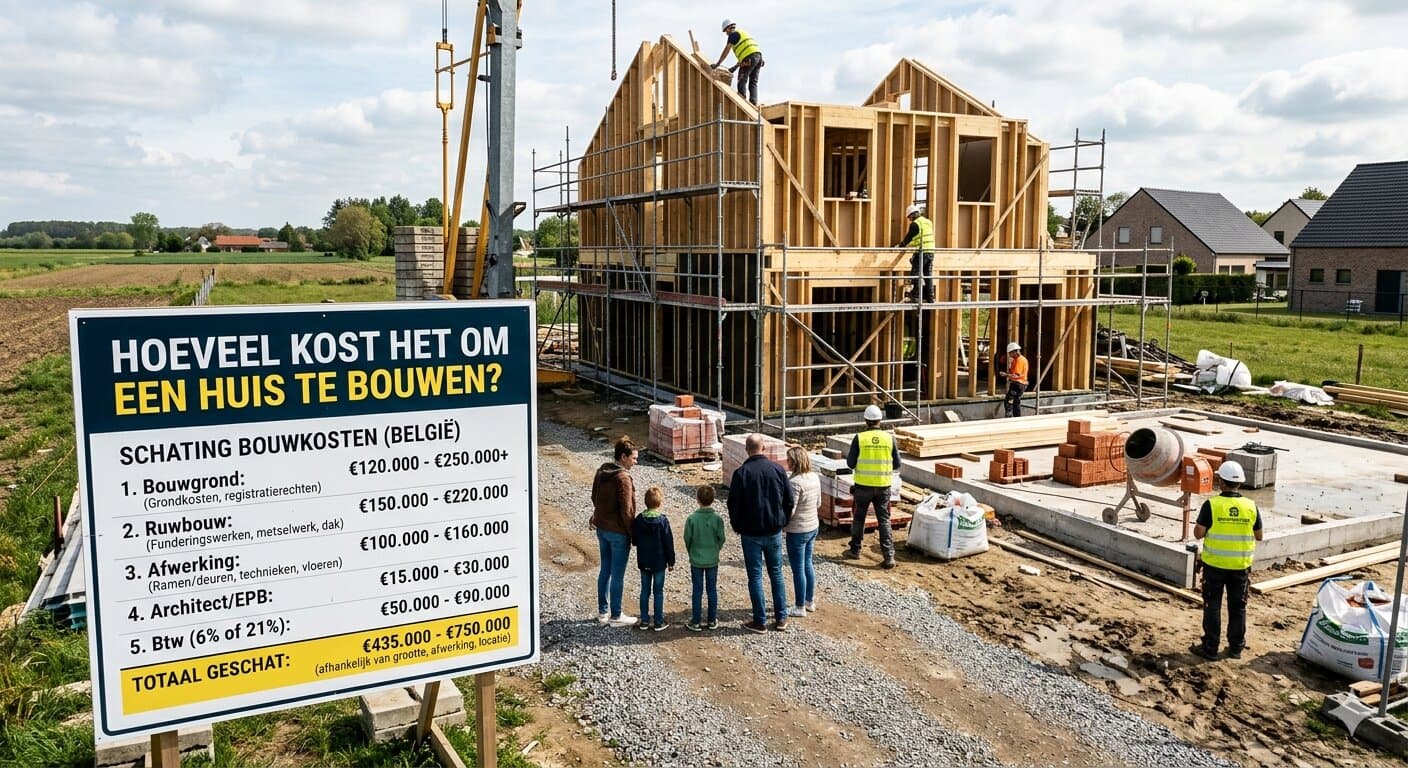
The question how much does it cost to build a house is one of the trickiest in the Belgian property world. Answers like "it depends" get you nowhere. Fortunately, recent figures give a clear range: for a standard new-build home in Belgium, you should currently budget around 2,150 to 2,700 euros per m², fully finished, including VAT and architect fees, but excluding the plot and additional costs. That means an average family home of 150 m² will quickly cost 320,000 to 400,000 euros to build, before you factor in the land, the notary and the garden.
This guide gives you a clear overview: benchmark prices per m², sample budgets and all the extras that are often forgotten.
Benchmark price per m²: what does the market say in 2025-2026?
Several recent sources - architects, construction groups and building portals - land remarkably close to one another in their estimates of the construction cost per m²:
- Architects and building websites: ± 2,150 - 2,688 euros/m² as an average for 2025.
- Livios (2026): uses a benchmark of ± 2,400 euros/m² for a standard new-build home, VAT and architect included.
- Various property developers quote 1,800 - 2,500 euros/m² for a basic to comfortable finish, with 2,400 euros/m² being a realistic middle ground.
- Developer listings (e.g. TeamConstruct, mid-2026) show finished plot-plus-house packages priced between roughly 387,000 and 490,000 euros including VAT for homes in the 130-160 m² range, which is broadly consistent with the per-m² benchmarks above.
These amounts cover:
- shell construction and roof;
- technical installations (heating, electricity, plumbing, ventilation);
- interior finishes (floors, interior doors, standard kitchen and bathroom);
- architect fees and VAT.
They do not include: the building plot, notary fees on the land, utility connections, landscaping, the driveway, a possible carport/garage, or your contingency reserve.
✦ 100% free & No obligation
Sell your property with the best agent
Compare the top 3 agents in your region for free and save on commission.
Compare agents →It is also worth noting that the range between a basic and a high-end finish is wider than many people expect. A builder who opts for a standard kitchen, vinyl flooring and a basic bathroom suite can often stay comfortably below 2,200 euros/m². Someone who specifies a designer kitchen, natural stone floors, a walk-in shower and bespoke joinery throughout can easily push past 2,800 euros/m² before any structural upgrades. The benchmark figures in this guide assume a comfortable but not luxury finish.
Example: construction cost by house type
Based on a benchmark of around 2,150-2,688 euros/m², here are the broad figures:
| House type | Habitable surface area | Indicative build cost (VAT & architect included, land excluded) |
|---|---|---|
| Compact terraced house | 100 m² | approx. 215,000 - 270,000 euros |
| Semi-detached house | 130 m² | approx. 280,000 - 350,000 euros |
| Detached family home | 150 m² | approx. 322,500 - 403,000 euros |
| Spacious detached home | 180 m² | approx. 387,000 - 485,000 euros |
Livios illustrates it this way: a 150 m² home at 2,400 euros/m² works out at roughly 360,000 euros in build budget, a 200 m² home at around 480,000 euros, still excluding the land.
One nuance worth understanding: the cost per m² does not fall in a straight line as you add floor area. A larger home does spread fixed costs (foundations, roof, utility connections) across more square metres, which can marginally lower the per-m² figure. However, a larger home also tends to come with higher specification expectations, which pushes the per-m² figure back up. In practice, the benchmarks above hold reasonably well across the 100-200 m² range.
What comes on top of the construction cost?
The question how much does it cost to build a house is only fully answered once you also account for the additional costs. The main items:
- Building plot
- Prices vary considerably by region: in some rural municipalities you can still find plots around 100-150 euros/m², while in popular areas and the outskirts of cities you are more likely looking at 250-400 euros/m² or more.
- KBC notes that the average Belgian plot price is around 105 euros per m² nationally, which means a 10-are (1,000 m²) plot costs at least 105,000 euros on average - though that national average is heavily pulled down by cheaper rural land and does not reflect conditions in and around the major cities.
- For a 500 m² plot, that quickly adds up to 75,000 - 200,000 euros, depending on the location.
- Notary and registration duties on the land
- Registration duties on building plots vary by region, on top of which come the notary fees and deed costs.
- As a rough rule, budget an extra 10-15% on top of the land price for acquisition costs, depending on your situation.
- Studies and regulatory requirements
- Energy performance (EPB/PEB) reporter, safety coordinator, structural engineer, soil survey, possible ground investigations.
- Together these can easily reach 3,000 - 7,000 euros, depending on the complexity.
- If your plot requires a soil investigation (bodemonderzoek/étude de sol) - increasingly common on former agricultural or industrial land - budget an additional 1,500 - 3,000 euros for the study alone, and potentially far more if remediation is required.
- Utility connections
- Water, electricity, gas (or an alternative), sewage, telecoms.
- Often 5,000 - 10,000 euros in total.
- For plots that are not yet serviced (verkaveling zonder nutsaansluitingen), this figure can be higher, particularly if the main road is more than 30-40 metres away. Always ask the seller whether connections are already present at the plot boundary.
- Landscaping, driveway, terrace, fencing
- Many self-builders overlook this at the start; budget at least 5-15% of your build cost, depending on the finish.
- For a standard project, that quickly comes to 15,000 - 40,000 euros.
- Some buyers phase this work over the first few years after moving in, doing the bare minimum at handover to free up budget for the house itself. This is a legitimate approach, provided your mortgage conditions do not require the plot to be fully finished before final drawdown.
- Contingency and additional works
- Building specialists recommend setting aside a 10-15% contingency on your build budget to cover price increases, additional works or changes during construction.
- In practice, most self-build projects involve at least some changes after the works have started - a revised bathroom layout, an added socket circuit, upgraded insulation. Having a contingency fund means you can make these decisions without financial stress.
Total budget: a concrete example
Take a detached family home of 150 m², in 2025-2026:
- House construction cost
- 150 m² × 2,400 euros/m² ≈ 360,000 euros.
- Building plot
- 500 m² at 250 euros/m² ≈ 125,000 euros.
- Land acquisition costs (notary + registration duties + deed)
- Rough estimate: 15,000 - 20,000 euros.
- Studies, connections, energy performance report, safety coordination
- Between 8,000 and 15,000 euros.
- Landscaping, driveway, fencing (basic)
- For example 20,000 - 30,000 euros, depending on choices.
- 10-15% contingency on the build cost
- 10% of 360,000 euros ≈ 36,000 euros.
Overall total budget:
360,000 + 125,000 + 20,000 + 12,000 + 25,000 + 36,000
→ somewhere between ± 578,000 and 600,000 euros, depending on the exact land price and the choices you make.
That explains why the answer to how much does it cost to build a house so often heads towards half a million euros or more in practice for a detached new-build, especially in pricier areas. New-build homes in Belgium broadly range from around 250,000 to 650,000 euros all-in once the land is included, with the wide spread driven primarily by location, size and finish level.
The main cost drivers
Why does one person pay 2,000 euros/m² while another pays 2,800 euros/m²? A few determining factors:
- House type: terraced vs. semi-detached vs. detached (more exterior walls = higher cost).
- Size and compactness: a compact, well-thought-out home = lower cost per m².
- Finish level: standard vs. designer kitchen, bathrooms, parquet flooring, bespoke furniture.
- Technical systems: choosing a heat pump, underfloor heating, mechanical ventilation with heat recovery, or solar panels pushes the build cost up, but reduces the energy bill.
- Construction method: traditional masonry, timber frame, prefabricated or system-built homes each have different price profiles. Timber-frame construction can be faster and sometimes cheaper to erect, but the total cost difference narrows once insulation, cladding and interior finishing are included.
- Energy performance level: building to BEN (Bijna-EnergieNeutraal / Quasi-Zéro Énergie) standards is now legally required for new builds in Belgium, but the level of ambition above that minimum varies. Each step up in insulation values, window quality or renewable energy systems adds to the upfront cost.
- Self-build work: doing your own painting, floor-laying or landscaping can save tens of thousands of euros.
- Location and choice of contractor: contractor prices differ by region; a local contractor with a full order book will charge more than one still looking for capacity.
Building new vs. buying an existing home: a financial comparison
Once you have a realistic picture of what a new build costs, it is worth setting that figure against the alternative: buying an existing home and renovating it. The comparison is not straightforward, but a few points are worth keeping in mind.
Advantages of building new:
- You get exactly the layout and finish you want, with no compromises imposed by an existing floor plan.
- New builds in Belgium must meet current BEN energy standards, which means low heating bills from day one.
- Maintenance costs in the first 10-15 years are typically low: everything is new and under warranty.
- The Ten-Year Warranty (tienjarige aansprakelijkheid/responsabilité décennale) of your contractor and architect covers structural defects for a decade.
Potential financial advantages of buying existing:
- Buying an existing home can be cheaper in the short term, particularly if renovation works are spread over time.
- In some regions and under certain conditions, reduced VAT rates apply to demolition-and-rebuild projects or to renovation of older properties, which can partially close the cost gap.
- An existing home in a well-served location may be hard to replicate with a new build, where suitable plots are increasingly scarce.
The right answer depends on your personal situation, your borrowing capacity and the specific market in your target municipality. In some areas, finding a suitable building plot at a reasonable price is actually the hardest part of the equation.
Rules of thumb for a quick budget estimate
Want a rough ballpark figure for how much it will cost to build your home? Use this approach:
- Determine the habitable surface area you actually need (e.g. 120, 150 or 180 m²).
- Multiply by a benchmark price per m², e.g. 2,300-2,500 euros/m² as an average.
- Add the cost of the building plot (land price + ± 10-15% in acquisition costs).
- Add a 10-15% contingency and extras (connections, garden, additional works).
Example (semi-detached, 130 m², compact):
- Build: 130 × 2,350 euros/m² ≈ 305,500 euros.
- Land: 350 m² at 220 euros/m² ≈ 77,000 euros + ± 10,000 euros in costs.
- Extras and contingency: e.g. 35,000 - 45,000 euros.
→ Total: roughly 430,000 - 450,000 euros.
On that basis, you can discuss with your bank and architect:
- whether this budget fits your borrowing capacity;
- where you can cut back or optimise (reduce the floor area, adjust the finish);
- whether an alternative route - buying an existing home and renovating it - might be more financially attractive.
Frequently asked questions: building a house in Belgium
How much does a house in Belgium cost in total?
A new-build house in Belgium (construction only, land excluded) currently costs roughly 2,150 to 2,700 euros per m² including VAT and architect fees. For a typical detached family home of 150 m², that is between 322,500 and 400,000 euros to build. Once you add a building plot, acquisition costs, utility connections, landscaping and a contingency reserve, the all-in budget for a detached new build in a reasonably priced location quickly reaches 500,000 to 600,000 euros. In and around the major cities, where land prices are higher, the total can exceed that figure comfortably. New-build homes in Belgium broadly range from around 250,000 to 650,000 euros all-in, depending on size, location and finish level.
Why are houses so expensive in Belgium?
Several factors combine to push Belgian housing costs higher than in many neighbouring countries. Land is scarce relative to demand, particularly in Flanders, where strict spatial planning rules limit the supply of new building plots. Construction material and labour costs have risen sharply since 2021-2022 and have not fully retreated. Energy performance requirements for new builds (the BEN standard) add meaningful upfront cost, even if they reduce running costs over time. Registration duties and notary fees add roughly 4-5% to the purchase price of an existing home bought as an only own home, and around 14% at the standard rate. And Belgium's high density of owner-occupiers - one of the highest in Europe - keeps demand structurally elevated. Together, these factors mean that Belgian property rarely offers the kind of price corrections seen in some other markets.
Can a foreigner buy or build a house in Belgium?
Yes. Belgium places no legal restrictions on foreigners purchasing or building property. EU citizens face no specific hurdles. Non-EU nationals can also buy and build freely, provided they can secure financing - some Belgian banks may require a larger deposit or additional documentation for non-residents, but the right to purchase itself is not restricted. Practically speaking, the main challenges for foreigners are navigating the planning permission process (in Dutch or French depending on the region), understanding the regional registration duty rules, and finding contractors who are comfortable working with clients who may not be fluent in the local language.
What is the cheapest way to build a house in Belgium?
The most effective levers for reducing the build cost per m² are: keeping the floor area compact and the floor plan efficient (fewer corners and a simple roof shape reduce costs significantly); choosing a terraced or semi-detached format rather than a fully detached home; opting for a standard rather than bespoke finish; doing some work yourself (painting, landscaping, tiling); and getting at least three detailed quotes from contractors before committing. Prefabricated and timber-frame systems can also offer cost and speed advantages, though the total savings depend heavily on the specification. Building in a rural area where land prices are low is another obvious factor, though this needs to be weighed against commuting costs and resale value.
How long does it take to build a house in Belgium?
From obtaining a building permit to moving in, a typical Belgian new build takes between 12 and 24 months. The permit process alone can take 60 to 90 days for a standard application, and longer if objections are filed or if the design requires a deviation from the local planning regulations. Construction of a traditional masonry home typically takes 12 to 18 months once work starts on site. Timber-frame and prefabricated systems can reduce the on-site construction phase to 6-10 months, though the preparation and permit stages are the same. Delays are common: material supply issues, contractor availability and unexpected site conditions (poor soil, groundwater) all add time in practice.
Do I pay VAT when building a house in Belgium, and at what rate?
Yes. The standard VAT rate on new residential construction in Belgium is 21%. However, a reduced rate of 6% VAT applies in a number of specific situations, most notably for the demolition and reconstruction of a private dwelling (subject to conditions on surface area and the owner-occupier requirement), for social housing construction, and in certain designated urban renewal zones. The 6% rate for demolition-rebuild projects has been extended and broadened in recent years and is now available across Belgium (not just in specific zones), provided the rebuilt home does not exceed 200 m² of habitable surface and serves as the owner's primary residence. Always verify the current conditions with your architect or tax adviser, as the rules and thresholds are updated periodically.
Are architect fees included in the per-m² build cost figures quoted above?
The benchmark figures of 2,150 to 2,700 euros/m² quoted in this article are intended to include architect fees and VAT. However, this is not always the case with every quote you will encounter in the market. Some contractors quote a net construction price excluding architect fees, EPB reporter costs and VAT. Architect fees in Belgium typically range from 8% to 12% of the construction cost for full service (design, permit application, site supervision), though some architects work on a fixed fee. Always clarify exactly what is and is not included when comparing quotes or published benchmarks.
Frequently asked questions
How much does a house in Belgium cost in total?
A new-build house in Belgium (construction only, land excluded) currently costs roughly 2,150 to 2,700 euros per m² including VAT and architect fees. For a typical detached family home of 150 m², that is between 322,500 and 400,000 euros to build. Once you add a building plot, acquisition costs, utility connections, landscaping and a contingency reserve, the all-in budget for a detached new build in a reasonably priced location quickly reaches 500,000 to 600,000 euros. New-build homes in Belgium broadly range from around 250,000 to 650,000 euros all-in, depending on size, location and finish level.
Why are houses so expensive in Belgium?
Several factors combine to push Belgian housing costs higher than in many neighbouring countries. Land is scarce relative to demand, particularly in Flanders, where strict spatial planning rules limit the supply of new building plots. Construction material and labour costs have risen sharply since 2021-2022 and have not fully retreated. Energy performance requirements for new builds (the BEN standard) add meaningful upfront cost. Registration duties and notary fees add roughly 4-5% to the purchase price of an existing home bought as an only own home, and around 14% at the standard rate. And Belgium's high density of owner-occupiers keeps demand structurally elevated.
Can a foreigner buy or build a house in Belgium?
Yes. Belgium places no legal restrictions on foreigners purchasing or building property. EU citizens face no specific hurdles. Non-EU nationals can also buy and build freely, provided they can secure financing. Some Belgian banks may require a larger deposit or additional documentation for non-residents, but the right to purchase itself is not restricted.
What is the cheapest way to build a house in Belgium?
The most effective levers for reducing the build cost per m² are: keeping the floor area compact with an efficient floor plan; choosing a terraced or semi-detached format rather than fully detached; opting for a standard rather than bespoke finish; doing some work yourself (painting, landscaping, tiling); and getting at least three detailed quotes from contractors. Prefabricated and timber-frame systems can also offer cost and speed advantages. Building in a rural area where land prices are lower is another significant factor.
How long does it take to build a house in Belgium?
From obtaining a building permit to moving in, a typical Belgian new build takes between 12 and 24 months. The permit process alone can take 60 to 90 days for a standard application. Construction of a traditional masonry home typically takes 12 to 18 months once work starts on site. Timber-frame and prefabricated systems can reduce the on-site construction phase to 6-10 months, though the preparation and permit stages are the same.
Do I pay VAT when building a house in Belgium, and at what rate?
Yes. The standard VAT rate on new residential construction in Belgium is 21%. However, a reduced rate of 6% VAT applies in specific situations, most notably for the demolition and reconstruction of a private dwelling (subject to conditions on surface area and the owner-occupier requirement). The 6% rate is available across Belgium provided the rebuilt home does not exceed 200 m² of habitable surface and serves as the owner's primary residence. Always verify current conditions with your architect or tax adviser, as rules and thresholds are updated periodically.
Are architect fees included in the per-m² build cost figures?
The benchmark figures of 2,150 to 2,700 euros/m² quoted in this article are intended to include architect fees and VAT. However, some contractors quote a net construction price excluding architect fees, EPB reporter costs and VAT. Architect fees in Belgium typically range from 8% to 12% of the construction cost for full service. Always clarify exactly what is and is not included when comparing quotes or published benchmarks.
"Real estate expert focused on quality control and strategic partnerships."