
Can the mother sell the house after the father's death?

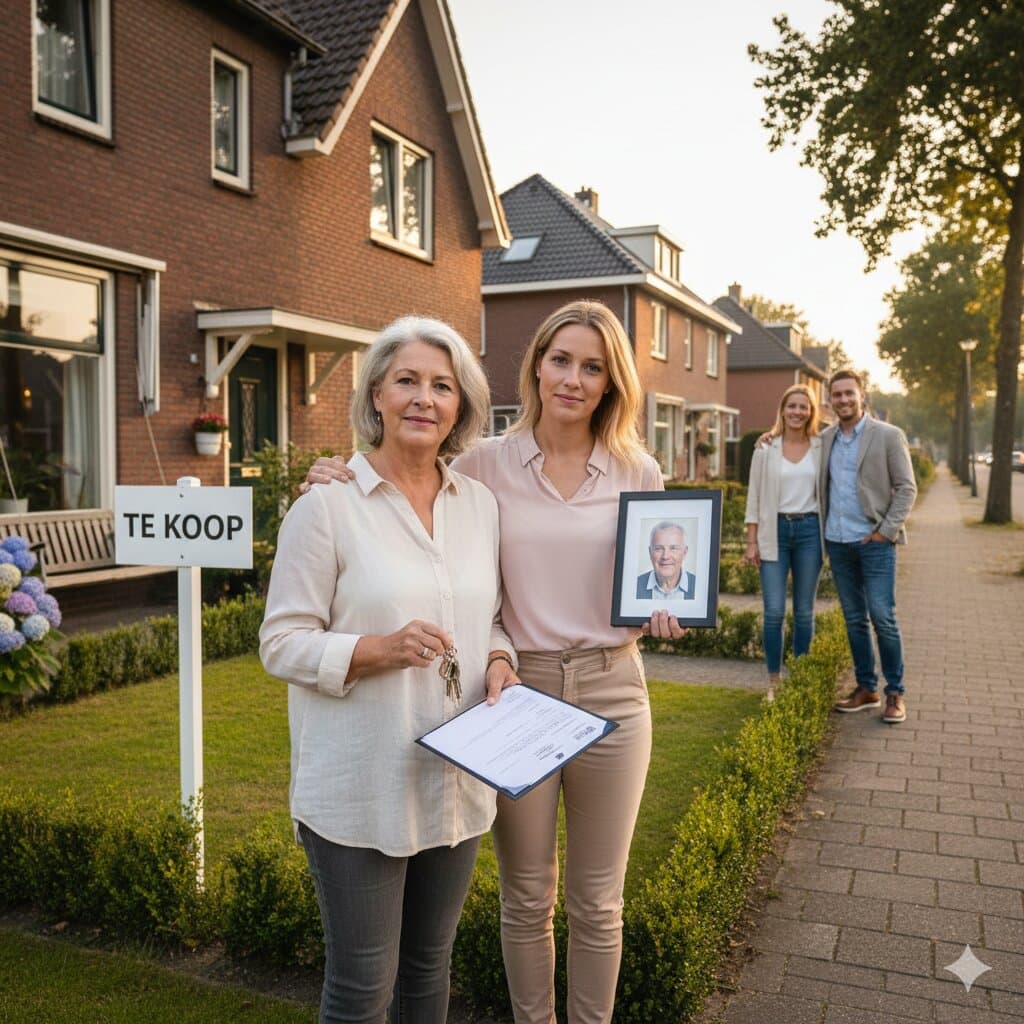
After the father's death, children often ask: can the mother sell the house and what happens to our share of the inheritance? The answer depends on the matrimonial regime, the ownership structure and any testamentary clauses. In most cases the mother can indeed sell the house, but children usually have a right to a portion of the proceeds through usufruct and bare ownership. This article explains step by step how things work legally and practically in Belgium, so you know exactly where you stand.
The ownership situation after the father's death
When the father passes away, the ownership situation of the family home changes depending on the matrimonial regime under which the couple was married:
1. Legal community of property regime (most common)
The property belonged to the marital community. After the father's death:
- The mother becomes owner of one half (her share of the community).
- The other half (the father's share of the community) passes to the children as bare ownership.
- The mother automatically receives usufruct over the father's half. Her own half is already hers in full ownership.
Result: the mother holds usufruct and is co-owner; the children are bare owners of the father's half.
2. Marriage contract with special clauses
Many couples include specific provisions in their marriage contract. These are the most common.
✦ 100% free & No obligation
Sell your property with the best agent
Compare the top 3 agents in your region for free and save on commission.
Compare agents →- Option clause: the father's share passes to the mother upon his death.
- Allocation clause for the survivor (such as survivor takes all): more than half, up to all, of the common property passes to the surviving spouse in full ownership. This is only possible under a community regime. How it affects the children's rights, for example children from another relationship, should be checked with the notary.
- Usufruct clause: the mother receives usufruct over everything.
Result: the mother may be the full owner and can sell freely.
Can the mother sell the house?
The answer to the question of the mother selling the house after the father's death depends on the situation:
Situation 1: The mother is the full owner
With an option clause or a survivor-takes-all clause, the mother may:
- sell the house on her own;
- retain the full proceeds;
- the children have no say at this point.
Situation 2: The mother holds usufruct, children hold bare ownership
This is the classic situation under the legal community regime:
- The mother cannot decide alone to sell.
- All children (as bare owners) must give their consent.
- Everyone signs at the notary's office (or grants a power of attorney).
When the property is sold, the proceeds are divided as follows:
- For a jointly owned house, the mother receives her own half.
- On the father's half, the value of the mother's usufruct is calculated (age-based table).
- The remainder of the father's half goes to the children according to their share of the estate.
Example (jointly owned house worth €300,000, legal community regime):
- The mother's own half in full ownership: €150,000
- Usufruct on the father's half: €150,000 × the coefficient for the mother's age, for the mother
- Bare ownership of the father's half: €150,000 minus the value of that usufruct, for the children (divided according to their number)
The mother and the children can agree on the value of the usufruct, taking into account her age and sex among other things. If they cannot agree, the conversion tables set by the Minister of Justice apply. These tables are based on life expectancy, exist in a version for men and one for women, and are updated regularly. Notaries use them. The older the mother, the lower the value of her usufruct. The notary calculates the exact percentage with the current table.
Step-by-step plan for the sale
Step 1: Check the ownership structure
- Arrange a deed of immovable succession. It is required when the estate includes real estate and an inheritance tax return must be filed, and it is needed to sell the house. A notary draws it up. In simple cases (no will or marriage contract, no minor or legally incapable heirs, death after 1 April 2023) FPS Finance can issue it free of charge.
- Check the marriage contract and the will.
- Request planning and urban extracts and certificates (energy performance certificate, electrical inspection report, soil certificate).
Step 2: Have a valuation carried out
A realistic market value is essential:
- The mother wants to receive a fair amount for her usufruct.
- The children want maximum value for their bare ownership.
- A professional valuation prevents disputes.
Step 3: Agreement of all parties
- The mother and all children must agree in writing.
- Powers of attorney are arranged if not everyone can sign in person.
- The notary verifies all formalities.
Step 4: The sale process
- Choose an estate agent (jointly or through the preliminary agreement).
- Sign the preliminary sale agreement with suspensive conditions.
- Notarial deed: everyone (or their representative) signs.
Step 5: Distributing the proceeds
The notary calculates:
textTotal sale price
- Sale costs (notary fees, registration duties, certificates)
- Any outstanding mortgage
= Net proceeds
Then:
textMother's half + (father's half × usufruct coefficient) = Mother's share
Remainder = Children's share (divided according to their share of the estate)
Tax considerations
For the mother:
- Whether selling her usufruct has tax consequences depends on the situation. Ask the notary.
- Donating her share to the children: gift tax applies.
For the children:
- Sale of bare ownership: ask your notary whether any tax on a capital gain is due.
- If the mother later gives money without registering the gift, it is added back to her own estate for inheritance tax if she dies within five years of the gift (Flanders: gifts from 2025, Brussels: from 2026, Wallonia: from 2022).
Registration duties: paid by the buyer, at a rate that depends on the region. In Flanders 12%, or 2% for the buyer's only own home. In Wallonia 12.5%, or 3% for an only own home. In Brussels 12.5%, with the first €200,000 exempt for an only own home with a taxable base of at most €600,000.
What if the children do not agree?
When the mother sells the house after the father's death, conflict can arise:
- Mediation: the notary or a family mediator organises a discussion.
- Court: one child can apply for a judicial partition if the sale is deadlocked.
- Buyout: one child buys out the others (the mother retains her usufruct).
Practical tips for families
- Communicate openly: discuss the mother's future plans and everyone's interests.
- Document everything: put agreements on the distribution of proceeds in writing.
- Get a valuation early: avoid disputes over the property's value.
- Involve a notary: a neutral party for the legal settlement.
When selling makes sense
For the mother:
- The house is too large or the upkeep too demanding.
- Moving to a flat or assisted-living residence.
- Liquidity needed for care or support.
For the children:
- No interest in keeping the house.
- Avoiding a double housing cost.
- A simpler settlement of the estate.
When it is better to wait
- The market is still expected to rise.
- The mother still wants to live there.
- The children may want to buy in.
Next step: a valuation
Whether you sell or not, an objective valuation gives clarity on:
- what the mother receives for her usufruct;
- what the children receive for their bare ownership;
- which sales strategy is realistic.
Would you like to find out, together with your mother and siblings, what the property is actually worth and how a sale would pan out? Request a free valuation. A local estate agent will analyse the market value and advise on timing and approach, so that everyone can make an informed decision about the mother selling the house after the father's death.
Frequently asked questions
Can the mother sell the house on her own after the father's death?
It depends on the ownership situation. If the mother is the full owner due to a special marriage clause, she can sell freely. In the most common situation - where children hold bare ownership - all children must give their consent before the house can be sold.
How are the proceeds divided when the house is sold?
For a jointly owned house under the legal community regime, the mother first receives her own half. On the father's half, she receives the value of her usufruct, and the remainder of that half goes to the children according to their share of the estate. The mother and the children can agree on that value; if they cannot, the conversion tables set by the Minister of Justice apply, which take age and sex into account and are used by notaries. For example, if the house sells for 300,000 euros, the mother keeps 150,000 euros plus the value of her usufruct on the other 150,000 euros, and the children share the rest of that half.
Do the children have to pay capital gains tax when the house is sold?
Ask the notary whether the children owe any tax on a capital gain when the bare ownership is sold. However, if the mother later gives money without registering the gift, it counts for inheritance tax if she dies within five years of the gift.
What happens if one of the children refuses to agree to the sale?
If the sale is deadlocked, a family mediator or notary can organise a discussion between all parties. If no agreement is reached, one child can apply to the court for a judicial partition, or one child can choose to buy out the others instead.
What documents are needed before the house can be sold?
You will need the deed of immovable succession (required when the estate includes real estate and an inheritance tax return must be filed), the marriage contract, and any will, as well as practical certificates such as the energy performance certificate, electrical inspection report, and soil certificate. A notary can help you request and verify all of these documents.
"Tech entrepreneur and strategist focused on digital transformation in the real estate sector."