
Where are houses cheap in Europe?

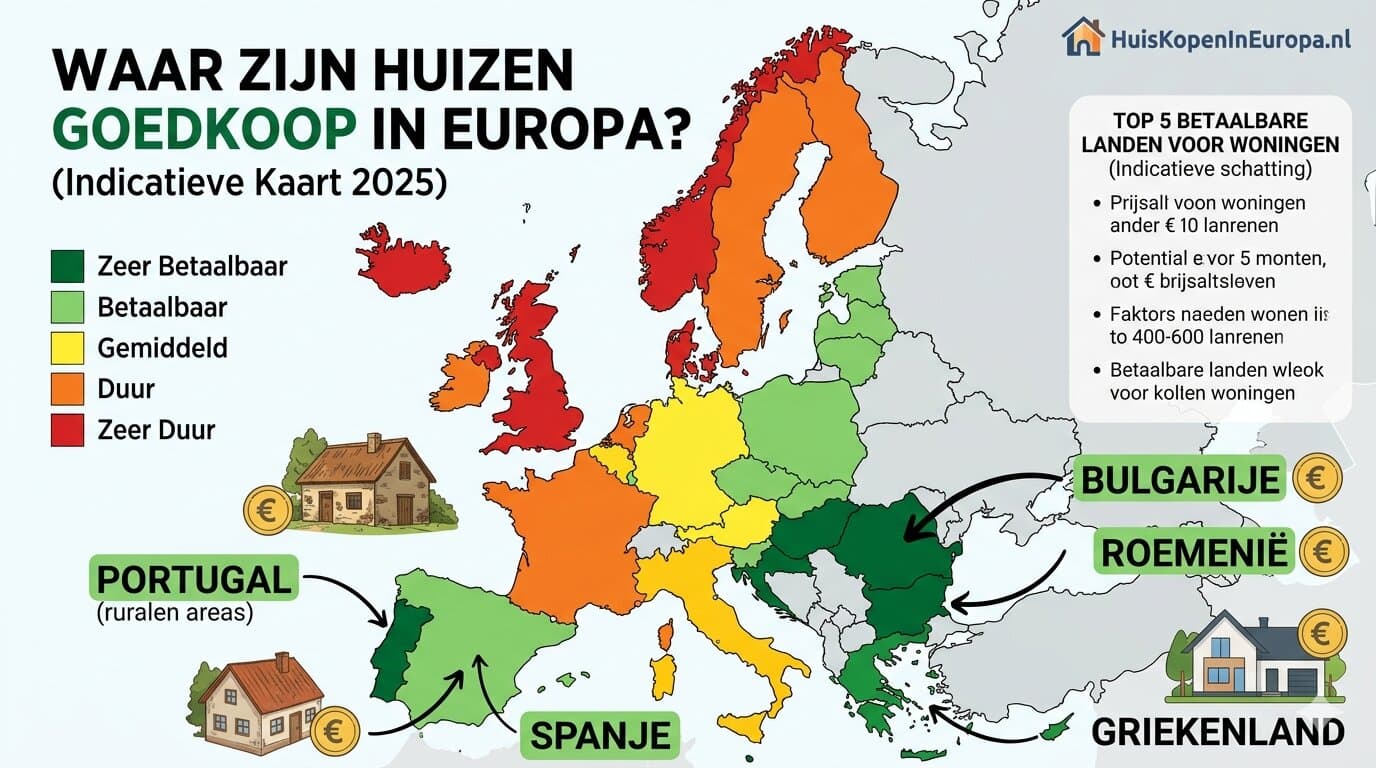
Many buyers wonder: where are houses cheap in Europe? Over the years, prices in many Western European countries have risen sharply, but there are still regions where you can buy a property at a relatively affordable price. It is particularly in parts of Eastern and South-Eastern Europe that average property prices remain well below those seen in countries such as Belgium, the Netherlands, Germany or France.
Affordable countries for property in Europe
Several recent analyses and rankings consistently highlight the same countries as relatively cheap for real estate. As of mid-2026, the picture looks like this:
- Bulgaria is year after year cited as the EU's most affordable property market. Average prices per square metre remain a fraction of what you would pay in Belgium or Germany. Even in Sofia, the capital, prices per m² are generally well below €2,000 for a typical apartment, and in smaller cities or rural areas you can find habitable properties for under €30,000 in total.
- Romania also features low average purchase prices, particularly outside the main urban centres. Bucharest has seen notable price growth since 2020, but secondary cities such as Craiova, Deva or Drobeta-Turnu Severin still offer detached houses at prices that would be unimaginable in Western Europe.
- Bosnia and Herzegovina appears in reports as the country with the lowest average transaction prices for new residential properties in Europe, though buyers should be aware that the legal and administrative framework is more complex than in EU member states.
- Albania has attracted growing attention since roughly 2022, with coastal towns such as Saranda and Vlora offering sea-view apartments at prices still considerably below comparable spots in Greece or Croatia. Prices have risen, but the market remains accessible.
- Montenegro sits in a middle range: coastal areas around Budva or Kotor have become expensive by regional standards, but inland towns and the Bay of Kotor's quieter corners still offer value. Montenegro's EU accession process (ongoing as of 2026) adds a longer-term legal stabilisation angle.
- Poland deserves a mention here too. While Warsaw and Krakow have seen strong price growth, smaller Polish cities - think Lublin, Rzeszow or Bialystok - still offer prices per m² that are low by Western European standards, combined with solid infrastructure and an EU legal framework.
- Greece and certain regions of Portugal, Spain and Italy are also regularly mentioned. In Greece, inland areas of Thessaly or the Peloponnese remain genuinely affordable. In Italy, the much-publicised €1 house schemes in Molise, Calabria and Sicily have given way to more conventional but still low-priced rural markets, where habitable properties can be found for €30,000-€60,000, though renovation costs must always be factored in.
An important caveat: "cheap" here primarily refers to a lower purchase price per m² compared with Western Europe - it does not mean that every area within those countries is rock-bottom affordable, and it does not say anything about rental yields, resale liquidity or quality of life.
Within a single country, differences can be enormous
Price gaps can be substantial not only between countries, but also within a single country. In almost every country:
- capital cities and popular tourist destinations are the most expensive;
- smaller towns and rural regions are noticeably cheaper;
- emerging regions are temporarily affordable, until investors discover them.
In a country like Bulgaria or Romania, prices in the capital and prime regions can be considerably higher than in rural areas, while those rural regions still offer houses or apartments at prices that would be hard to imagine in Western Europe. A concrete example: in Sofia, a renovated apartment in a central neighbourhood can cost €1,500-€2,000 per m², while a habitable village house three hours away might sell for €15,000-€25,000 in total. Both figures are still low by Belgian standards, but the gap within Bulgaria itself is already very wide.
✦ 100% free & No obligation
Sell your property with the best agent
Compare the top 3 agents in your region for free and save on commission.
Compare agents →The same applies to Greece. A villa on Mykonos or Santorini is in an entirely different league from a stone house in rural Epirus or a flat in a mid-sized mainland city like Ioannina or Larissa. Portugal similarly splits neatly between Lisbon and the Algarve on the one hand - which have experienced very strong price growth since 2015 - and the interior Alentejo or northern Trás-os-Montes region on the other, where prices remain modest.
Buying cheap does not always mean living cheaply
A low purchase price does not automatically mean that everyday life there is also affordable or convenient. When asking "where are houses cheap in Europe?", you should also ask:
- what are the local wages and purchasing power - housing affordability for locals is a different story from affordability for a foreign buyer with Western savings;
- what is the quality of infrastructure, healthcare and education;
- how accessible is the location by plane, train or car;
- how stable is the legal and tax framework, and does the country operate within EU rules;
- what are the rental opportunities and the depth of demand for rental properties.
Some countries do have cheap housing, yet it remains hard to afford for local residents, or the markets are less stable. Albania is a good illustration: purchase prices are low in absolute terms, but local incomes are also very low, meaning the market is partly driven by diaspora buyers and foreign investors rather than organic domestic demand. That can create a market that behaves differently from a mature Western European one.
The cost of living index is a separate but related consideration. According to Eurostat data, Bulgaria and Romania consistently rank as the countries with the lowest price levels in the EU, meaning that beyond the purchase price, day-to-day expenses - food, utilities, transport - are also notably lower than in Belgium or the Netherlands. Countries outside the EU, such as Albania or Bosnia and Herzegovina, tend to be cheaper still on everyday costs, though without the consumer and legal protections that come with EU membership.
Who benefits from cheap houses in Europe?
More affordable property markets in Europe can be interesting for:
- Second homes in a sunny or green country, where the purchase price is still within reach for a middle-income household that could not afford a holiday home in France or Spain's coastal hotspots.
- Investors looking for long-term capital appreciation in emerging markets. Bulgaria, for instance, has seen consistent but not spectacular price growth over the past decade, and parts of Romania have outperformed significantly since 2018.
- People who want to relocate to a country with a lower cost of living, whether for retirement or lifestyle reasons.
- Digital nomads or remote workers who earn their income elsewhere and benefit from lower local costs. Countries such as Georgia (occasionally discussed in the same breath as Southern Europe) and Albania have attracted significant communities of remote workers in recent years.
- Renovation project buyers, particularly in rural Italy, Greece or Portugal, who are willing to invest time and money to restore a property and either live in it or let it as a holiday rental.
Nevertheless, it remains important to look at the full picture - not just the purchase price.
Risks and points to watch
Anyone looking to buy property in a "cheap" country should pay close attention to:
- Legal certainty regarding property rights and registration. In some Balkan countries, land registries are still incomplete, and title disputes are not uncommon. Always use a local notary and an independent lawyer - not just the seller's agent.
- The quality of construction and infrastructure. Soviet-era apartment blocks in Bulgaria or Romania may look cheap but can require substantial investment to meet modern energy efficiency or structural standards.
- Any restrictions that may apply to foreign buyers. EU citizens generally have full property rights across the EU, but some non-EU countries restrict foreign land ownership. Albania, for instance, has historically had rules around agricultural land purchases by foreigners.
- Market liquidity - how easy will it be to resell the property later. Rural markets in Eastern Europe can be thinly traded, meaning finding a buyer can take a long time.
- Currency exchange risks and applicable tax rules. Countries outside the eurozone, such as Romania (leu), Bulgaria (lev - though Bulgaria is aiming for euro adoption) and Serbia (dinar), introduce an exchange rate dimension that can work for or against you.
- Hidden costs of purchase: notary fees, property transfer tax, agency commission and registration costs can add 5-10% or more to the headline price in some markets.
- Rental income regulations, especially if you intend to let the property short-term via platforms such as Airbnb. Several European countries have tightened short-term rental rules since 2023.
In some markets, entry prices are low, but it can be harder to sell at a profit later, or additional administrative steps may be required for foreign buyers.
Summary
If you are wondering where houses are cheap in Europe, you will most often find yourself looking at parts of Eastern and South-Eastern Europe - countries such as Bulgaria, Romania, Bosnia and Herzegovina, Albania and Montenegro - as well as certain rural regions of Greece, Portugal, Spain and Italy. Poland's secondary cities also deserve consideration for buyers who value EU legal security alongside lower prices. But the lowest price does not automatically mean the best choice. Anyone seriously considering buying property in one of these regions would be wise to look beyond the purchase price and also consider quality of life, legal security, infrastructure and ease of resale.
Frequently Asked Questions
Which EU country has the cheapest houses?
Bulgaria consistently holds the title for the cheapest property in the EU, both in terms of average price per square metre and average total transaction value. Romania is the next most affordable EU member state. Both countries also rank at the bottom of Eurostat's price level indices, meaning everyday costs are lower there too.
Which European country has the lowest cost of living?
Within the EU, Bulgaria and Romania have the lowest price levels according to Eurostat data. Outside the EU, countries such as Albania, Bosnia and Herzegovina and Moldova have an even lower cost of living in absolute terms, though they lack the consumer and legal protections of EU membership.
Where is the best place to buy a house in Europe for value?
"Best value" depends on your purpose. For a holiday home with rental potential, coastal Albania or inland Greece offers good value in 2026. For long-term capital growth within the EU, secondary cities in Romania or Poland have shown strong price trends. For pure affordability and a complete lifestyle relocation, rural Bulgaria or the interior of Portugal can still deliver very low entry prices. The key is to match the market to your specific goal rather than chasing the lowest price alone.
Which European country is the cheapest and safest to live in?
Safety is a broad concept, but if you combine low cost of living with relatively low crime rates and EU legal stability, Slovenia, Slovakia and the Czech Republic often score well - though they are not the cheapest on purchase price. Among the genuinely cheap markets, Bulgaria and Poland tend to score reasonably well on safety indicators compared with some other low-cost destinations. Non-EU countries that are popular for affordability, such as Albania or Bosnia and Herzegovina, have improved significantly on safety in recent years, but are still generally ranked lower than EU member states.
Can you still find houses in Europe for under €50,000?
Yes, though the options have narrowed compared to five years ago. Rural Bulgaria, inland Romania, parts of rural Greece, and certain areas of Hungary still offer habitable properties below €50,000. Italy's much-discussed €1 house schemes have largely wound down, but rural Sicily, Calabria and Molise still have properties in the €20,000-€60,000 range - though renovation costs need to be added. In all cases, it is important to verify the legal title carefully and budget for purchase costs on top of the headline price.
Is it safe to buy property in Bulgaria or Romania as a foreigner?
Both Bulgaria and Romania are EU member states, which means EU citizens have the same property rights as local nationals. The legal frameworks are EU-compliant, though administrative processes can still be slower and less transparent than in Western Europe. Using an independent local lawyer, checking the land registry carefully, and working with a reputable notary are standard precautions that will protect most buyers. Non-EU buyers should check whether any specific restrictions apply to their nationality, particularly regarding agricultural land.
How do property prices in Eastern Europe compare to Belgium?
The contrast is significant. In Belgium, the average house price was around €330,000-€340,000 in recent years (Statbel data), and average prices per m² in major cities are typically above €2,500-€3,000. In Bulgaria or Romania, average prices per m² in the capital cities are broadly in the €1,200-€2,000 range, and in smaller cities or rural areas they drop to €300-€800 per m². Total purchase prices for a modest family home in a smaller Eastern European town can be as low as €30,000-€80,000, which is simply not comparable to anything available in Belgium at that budget.
Frequently asked questions
Which EU country has the cheapest houses?
Bulgaria consistently holds the title for the cheapest property in the EU, both in terms of average price per square metre and average total transaction value. Romania is the next most affordable EU member state. Both countries also rank at the bottom of Eurostat's price level indices, meaning everyday costs are lower there too.
Which European country has the lowest cost of living?
Within the EU, Bulgaria and Romania have the lowest price levels according to Eurostat data. Outside the EU, countries such as Albania, Bosnia and Herzegovina and Moldova have an even lower cost of living in absolute terms, though they lack the consumer and legal protections of EU membership.
Where is the best place to buy a house in Europe for value?
'Best value' depends on your purpose. For a holiday home with rental potential, coastal Albania or inland Greece offers good value in 2026. For long-term capital growth within the EU, secondary cities in Romania or Poland have shown strong price trends. For pure affordability and a complete lifestyle relocation, rural Bulgaria or the interior of Portugal can still deliver very low entry prices. The key is to match the market to your specific goal rather than chasing the lowest price alone.
Which European country is the cheapest and safest to live in?
If you combine low cost of living with relatively low crime rates and EU legal stability, Slovenia, Slovakia and the Czech Republic often score well, though they are not the cheapest on purchase price. Among the genuinely cheap markets, Bulgaria and Poland tend to score reasonably well on safety indicators compared with some other low-cost destinations. Non-EU countries popular for affordability, such as Albania or Bosnia and Herzegovina, have improved significantly on safety in recent years but are still generally ranked lower than EU member states.
Can you still find houses in Europe for under €50,000?
Yes, though the options have narrowed compared to five years ago. Rural Bulgaria, inland Romania, parts of rural Greece, and certain areas of Hungary still offer habitable properties below €50,000. Rural areas of Sicily, Calabria and Molise in Italy also have properties in the €20,000-€60,000 range, though renovation costs need to be added. In all cases, it is important to verify the legal title carefully and budget for purchase costs on top of the headline price.
Is it safe to buy property in Bulgaria or Romania as a foreigner?
Both Bulgaria and Romania are EU member states, which means EU citizens have the same property rights as local nationals. The legal frameworks are EU-compliant, though administrative processes can still be slower than in Western Europe. Using an independent local lawyer, checking the land registry carefully, and working with a reputable notary are standard precautions that will protect most buyers. Non-EU buyers should check whether specific restrictions apply to their nationality, particularly regarding agricultural land.
How do property prices in Eastern Europe compare to Belgium?
The contrast is significant. In Belgium, the average house price was around €330,000-€340,000 in recent years (Statbel data), with average prices per m² in major cities typically above €2,500-€3,000. In Bulgaria or Romania, average prices per m² in capital cities are broadly in the €1,200-€2,000 range, and in smaller cities or rural areas they drop to €300-€800 per m². Total purchase prices for a modest family home in a smaller Eastern European town can be as low as €30,000-€80,000 - a figure with no equivalent in the Belgian market.
"Tech entrepreneur and strategist focused on digital transformation in the real estate sector."