
1 square metre is how many metres? Here's the real answer

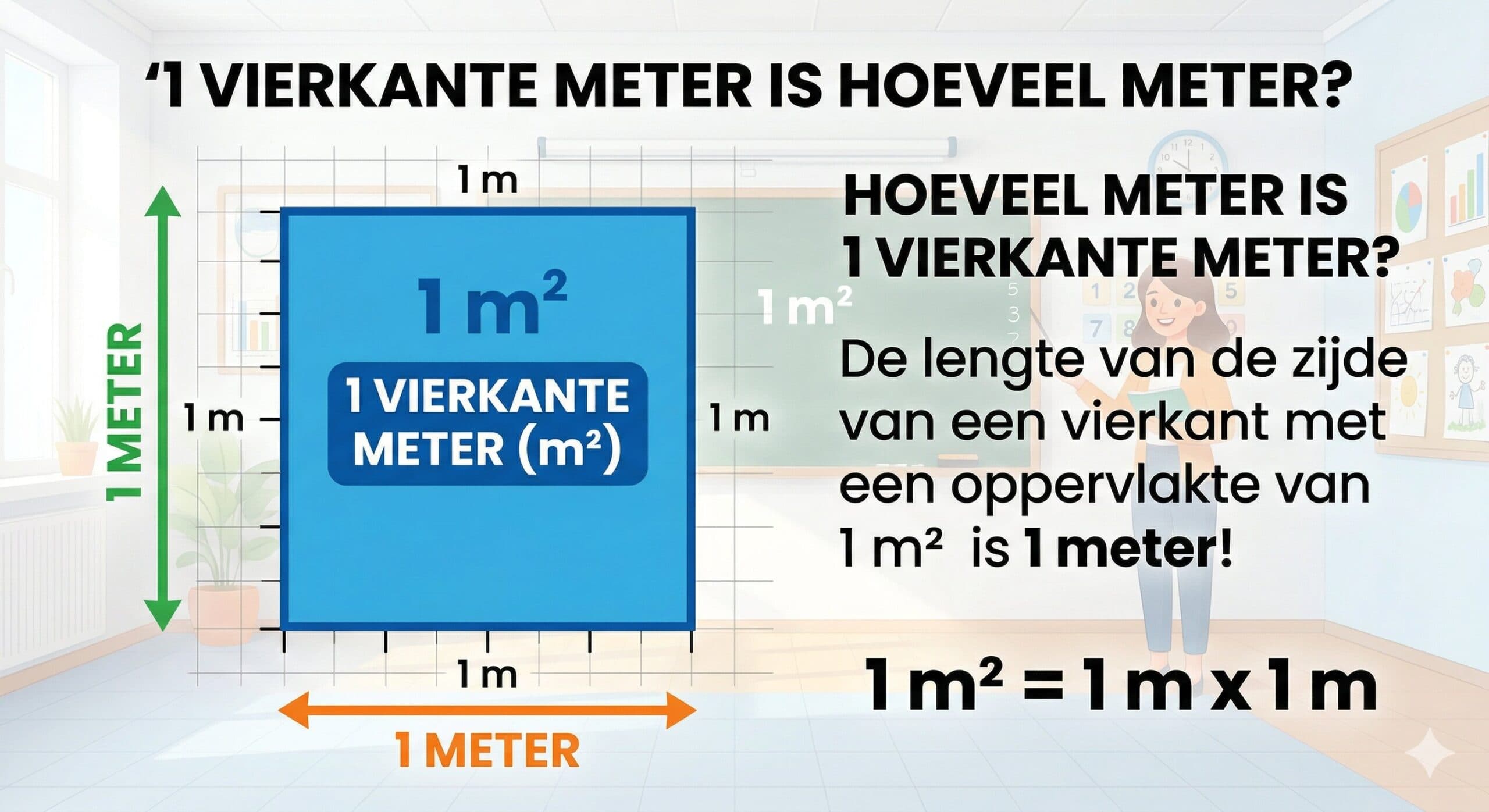
The question 1 square metre is how many metres seems simple, but it causes a great deal of confusion in practice. That is because people mix up length (metre) and area (square metre, m²). A metre is a length, while a square metre is an area. You cannot simply convert 1 m² into "so many metres" without additional information. What you can do is explain which lengths in metres, when combined, produce an area of 1 m².
Metre vs. square metre: the difference
- Metre (m):
- expresses a length (e.g. the width of a room: 4 m).
- Square metre (m²):
- expresses an area (e.g. the floor area of a room: 12 m²).
Think of it this way: a metre lives on a line, while a square metre lives on a flat surface. They belong to completely different dimensions of measurement - one is one-dimensional, the other is two-dimensional. That is why no simple multiplication factor can bridge the two.
A useful analogy: asking how many metres are in a square metre is a bit like asking how many hours are in a kilogram. The units describe fundamentally different things, so the question cannot have a straight numerical answer.
When someone asks 1 square metre is how many metres, the correct answer is: you cannot express it as a single number, because you need at least two lengths (length × width) to arrive at an area.
What exactly is 1 m²?
An area of 1 m² means the following.
✦ 100% free & No obligation
Sell your property with the best agent
Compare the top 3 agents in your region for free and save on commission.
Compare agents →- a square in which every side is 1 metre long,
- or more generally: any combination of length × width in metres whose product equals 1.
To picture the actual size of 1 m²: imagine a square tile measuring 1 metre on each side. That is roughly the footprint of a large kitchen floor tile, or about the space taken up by a standard single bed headboard. It is a useful mental reference when measuring rooms or buying materials.
Another way to think about it: stand with your feet together and stretch both arms out to the sides. That arm span is close to 1 metre for many adults. Now imagine a square on the floor with those same dimensions on every side - that flat surface is approximately 1 m².
Examples of areas that equal 1 m²:
- 1.00 m × 1.00 m = 1 m²
- 0.50 m × 2.00 m = 1 m²
- 0.25 m × 4.00 m = 1 m²
- 0.10 m × 10.00 m = 1 m²
The perimeter in metres of those shapes differs in every case, but the area remains exactly 1 m². This shows clearly that knowing only the area tells you nothing definitive about the individual side lengths.
In metric terms, 1 m² is equal to:
- 10,000 cm² (since 100 cm × 100 cm = 10,000 cm²)
- 1,000,000 mm² (since 1,000 mm × 1,000 mm = 1,000,000 mm²)
- approximately 10.764 square feet (useful when comparing with UK or US property listings)
So yes, 1 m is equal to 100 cm, but 1 m² is not equal to 100 cm² - it is equal to 10,000 cm². That is one of the most common errors people make when converting between units of area.
Why you cannot convert 1 m² into "so many metres"
A common mistake is to think you can "express 1 m² in metres", for example:
"1 m² is 4 metres" - that is not correct.
The reason:
- Metre (m) and square metre (m²) are different units of measurement.
- It is like asking: "1 litre is how many metres?" - you cannot convert them directly.
A helpful way to remember this: the notation m² literally means "metre × metre". So 1 m² = 1 m × 1 m. Once you multiply two lengths together, you have left the world of simple length and entered the world of area. There is no way back without extra information about at least one of those two lengths.
What you can say is:
- A square with an area of 1 m² has sides of 1 metre.
- The perimeter of that square is 4 metres (4 × 1 m).
But "1 m² = 4 m" only holds if you explicitly state that you are talking about the perimeter of a 1 m² square, not a general conversion.
Is 1 metre by 1 metre the same as 1 m²?
Yes - and this is one of the most frequently asked follow-up questions. A rectangle (or square) measuring exactly 1 metre by 1 metre has an area of 1 × 1 = 1 m². So 1 m × 1 m is indeed 1 m².
This is actually the formal definition of one square metre according to the International System of Units (SI): it is the area of a square whose sides are each one metre in length. Wikipedia's entry on the square metre confirms this straightforwardly - it is the SI derived unit of area.
However, the reverse is not automatically true. Just because something has an area of 1 m² does not mean it measures 1 metre on each side. As shown in the examples above, a strip of floor 0.50 m wide and 2.00 m long also covers exactly 1 m².
How to measure 1 square metre
This is a question many people have in practice - not just in theory. Here is how to do it accurately:
- Get a tape measure. A standard 3 m or 5 m tape is more than enough.
- Mark out a straight line of exactly 1 metre on the floor or surface you want to measure.
- From one end of that line, mark a second line at a right angle (90°), also exactly 1 metre long.
- Complete the square by marking the remaining two sides, each 1 metre long, so all four corners are right angles.
- The enclosed surface is exactly 1 m².
In practice, when measuring rooms or plots of land, you will rarely measure out a single 1 m² square. Instead, you measure the full length and full width of the space in metres, then multiply those two numbers together. The result is the area in m².
For example: a hallway that is 1.2 m wide and 3.5 m long has an area of 1.2 × 3.5 = 4.2 m². That tells you how many "1 m² tiles" would be needed to cover it (at least 5 tiles, since you cannot buy 0.2 of a tile).
Practical examples around the home
A few situations where the question 1 square metre is how many metres comes up:
- Laying a floor:
- You know the floor is 20 m².
- You cannot work out the length from 20 m² alone; you need both dimensions, e.g. 4 m × 5 m = 20 m².
- When buying flooring, always measure the room in metres (length and width separately), then multiply to get m². Add around 10% extra for cutting waste.
- Calculating paint:
- Paint is often sold by m² (e.g. 10 m² per litre).
- You measure walls in metres (height × width) and convert to m² to find out how many litres of paint you need.
- For a room with four walls each 2.5 m high and 3 m wide: 4 × (2.5 × 3) = 30 m². At 10 m² per litre, you need 3 litres per coat.
- Remember to subtract the area of doors and windows, which typically reduces the total by 2-4 m² in an average Belgian living room.
- Garden fencing:
- Your garden may have an area of 200 m².
- To find the length of fencing needed (in metres) you need the perimeter, not the area - those are different calculations.
- A square garden of 200 m² has sides of roughly 14.14 m each (√200 ≈ 14.14 m), giving a perimeter of about 56.6 m of fencing. This is a case where the square root calculation is useful.
- Buying wall tiles:
- Tiles are sold per m². Measure the wall area (height × width) in metres, multiply to get m², then check the coverage stated on the tile packaging.
- Again, allow 10-15% extra for cuts and breakages.
- Laying artificial grass or turf:
- Turf rolls are usually sold in metres of length but priced per m². If a roll is 2 m wide and you need to cover a 6 m × 4 m lawn (24 m²), you would need 12 metres of a 2 m-wide roll. Confusing width (metres) with area (m²) here leads to either over-ordering or running short.
- Real estate and property listings:
- Belgian property listings always quote floor area in m² (e.g. "appartement 85 m²"). Knowing the m² does not tell you the shape of the apartment - only the total area.
- To understand the actual layout, you need the floor plan with individual room dimensions in metres.
- This matters when comparing properties: an 85 m² apartment that is long and narrow can feel very different from an 85 m² apartment with a square layout, even though both have exactly the same area on paper.
The square root shortcut for square-shaped areas
There is one situation where you can derive a single length in metres from an area in m²: when the shape is a perfect square. In that case, the side length equals the square root of the area.
- Area = 1 m² → side = √1 = 1 m
- Area = 4 m² → side = √4 = 2 m
- Area = 9 m² → side = √9 = 3 m
- Area = 25 m² → side = √25 = 5 m
- Area = 100 m² → side = √100 = 10 m
For non-perfect-square values, the square root gives a decimal. For instance:
- Area = 50 m² → side = √50 ≈ 7.07 m
- Area = 200 m² → side = √200 ≈ 14.14 m
- Area = 85 m² → side = √85 ≈ 9.22 m
This shortcut only works if you already know (or assume) the shape is square. For any other rectangle, you still need one of the two dimensions before you can find the other. Assuming a square when the shape is actually rectangular will always give you a wrong answer for the individual sides.
Simple rules to remember
- 1 metre (m) = length (one dimension)
- 1 square metre (m²) = length × length (two dimensions)
- To go from metres to m²: multiply two lengths together.
- To go from m² back to metres, you need extra information: at least one of the two sides, or the assumption that the shape is square (then use the square root).
- 1 m² = 10,000 cm² (not 100 cm² - a very common mistake).
- 1 m² ≈ 10.764 sq ft (useful when dealing with non-metric property listings).
Example:
- Room: 3 m wide and 4 m long → 3 m × 4 m = 12 m².
- You cannot say: 12 m² is "so many metres" without further context.
- If you assume it is a square room: √12 ≈ 3.46 m per side. But the actual room is 3 m × 4 m, so that assumption would be wrong.
Frequently asked questions
Is 1 meter by 1 meter a square meter?
Yes, exactly. A surface that measures 1 metre in length and 1 metre in width has an area of 1 × 1 = 1 m². This is in fact the formal SI definition of a square metre: the area of a square whose sides are each one metre long. So "1 metre by 1 metre" and "1 square metre" describe the same area - they are equivalent.
What is 1 square metre equal to?
One square metre is equal to the area of a square with sides of exactly 1 metre. In other units:
- 10,000 cm² (100 cm × 100 cm)
- 1,000,000 mm² (1,000 mm × 1,000 mm)
- approximately 10.764 square feet
- approximately 1.196 square yards
In everyday terms, 1 m² is roughly the size of a large floor tile, the footprint of a standard armchair, or the area of a typical shower tray.
Is 1 m square equal to 100 cm?
This question has two parts. In terms of length: yes, 1 metre equals 100 centimetres. But in terms of area: 1 m² does not equal 100 cm². It equals 10,000 cm², because you have to square the conversion factor (100² = 10,000). This catches a lot of people out. The rule is: when converting area units, always square the linear conversion factor. So 1 m² = 100 × 100 cm² = 10,000 cm².
How do I measure 1 square metre?
The simplest method is to mark out a square on the surface you want to measure, with each side exactly 1 metre long. Use a tape measure and a set square (or the corner of a room) to keep the angles at 90°. The area enclosed is 1 m². In practice, when measuring a full room or garden, you measure the total length and total width separately in metres, then multiply them together to find the total area in m². You do not need to count individual 1 m² squares - that multiplication does it for you automatically.
How many metres is 1 square metre?
There is no single answer, because metres (length) and square metres (area) measure different things. If the area forms a perfect square, each side is 1 metre long (√1 = 1). For any other shape with an area of 1 m², the individual side lengths can be anything as long as they multiply to give 1 - for example 0.5 m × 2 m, or 0.25 m × 4 m.
How much is 1 sq metre?
One square metre is the area covered by a square with sides of exactly 1 metre. To picture it: it is roughly the size of a large floor tile, or the footprint of a standard armchair. In everyday terms, a single parking space is about 12-15 m², and an average Belgian apartment bedroom is around 10-14 m².
Can you convert square metres to metres?
Not directly. To convert an area in m² into a length in metres, you need at least one additional piece of information - either one side of the shape, or the knowledge that the shape is a square (in which case you take the square root of the area). Without that, an area of, say, 20 m² could belong to a 4 m × 5 m room, a 2 m × 10 m corridor, or countless other rectangles.
What is the perimeter of a 1 m² square in metres?
A square with an area of 1 m² has sides of 1 metre each. Its perimeter is therefore 4 × 1 m = 4 metres. Note that this only applies to a square shape. A rectangle of 0.5 m × 2 m also has an area of 1 m², but its perimeter is 2 × (0.5 + 2) = 5 metres.
Frequently asked questions
Is 1 meter by 1 meter a square meter?
Yes, exactly. A surface that measures 1 metre in length and 1 metre in width has an area of 1 × 1 = 1 m². This is the formal SI definition of a square metre: the area of a square whose sides are each one metre long. So '1 metre by 1 metre' and '1 square metre' describe the same area.
What is 1 square metre equal to?
One square metre equals the area of a square with sides of exactly 1 metre. In other units: 10,000 cm², 1,000,000 mm², approximately 10.764 square feet, and approximately 1.196 square yards. In everyday terms, 1 m² is roughly the size of a large floor tile or the footprint of a standard armchair.
Is 1 m square equal to 100 cm?
In terms of length, 1 metre equals 100 centimetres. But in terms of area, 1 m² does not equal 100 cm² - it equals 10,000 cm², because you must square the conversion factor (100 × 100 = 10,000). This is a very common mistake. When converting area units, always square the linear conversion factor.
How do I measure 1 square metre?
Mark out a square on the surface with each side exactly 1 metre long, keeping all four corners at 90°. The enclosed area is 1 m². When measuring a full room, measure the total length and total width separately in metres, then multiply them together. That multiplication gives you the total area in m² without needing to count individual squares.
How many metres is 1 square metre?
There is no single answer, because metres (length) and square metres (area) measure different things. If the shape is a perfect square, each side is 1 metre long (√1 = 1). For any other shape with an area of 1 m², the side lengths can be anything that multiplies to 1 - for example 0.5 m × 2 m, or 0.25 m × 4 m.
Can you convert square metres to metres?
Not directly. You need at least one additional piece of information - either one side of the shape, or confirmation that the shape is a square (in which case take the square root of the area). Without that, an area of 20 m² could belong to a 4 m × 5 m room, a 2 m × 10 m corridor, or countless other rectangles.
What is the perimeter of a 1 m² square in metres?
A square with an area of 1 m² has sides of 1 metre each, so its perimeter is 4 × 1 m = 4 metres. This only applies to a square shape. A rectangle of 0.5 m × 2 m also has an area of 1 m², but its perimeter is 2 × (0.5 + 2) = 5 metres.
"Real estate expert focused on quality control and strategic partnerships."