
How many litres of paint per m² do you need?

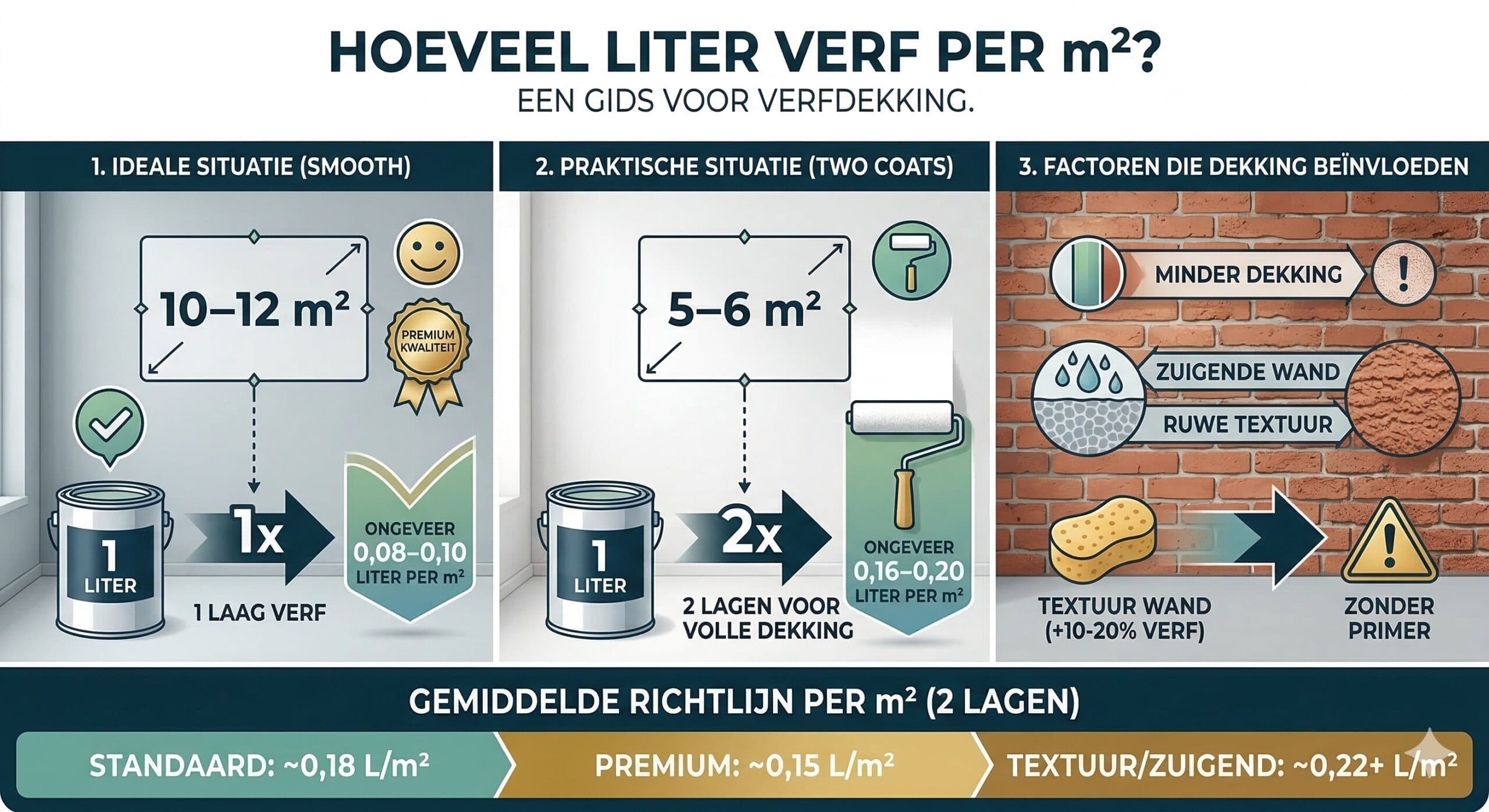
When planning a painting project, the first practical question is often: how many litres of paint per m² do you need? Too little is frustrating, too much is a waste of money. On average, 1 litre of paint covers around 6 to 10 m², depending on the type of paint and the surface. A useful rule of thumb from paint professionals is that you need roughly 100 ml of paint per m² per coat - that is, one litre handles about 10 m² in a single coat on a smooth, already-painted surface. Wall paint and ceiling paint consume more (lower coverage) than primer or gloss paint. With a simple formula and a few rules of thumb, you can estimate fairly accurately how much paint you need.
Average consumption by paint type
Per litre of paint, you can roughly cover the following surfaces (per coat):
- Wall and ceiling paint: approx. 6-10 m² per litre (smooth surfaces lean towards 10 m²/l; textured or older walls typically fall closer to 6-7 m²/l)
- Undercoat / primer: approx. 8-12 m² per litre
- Gloss paint (doors, windows, skirting boards): approx. 10-14 m² per litre
- Wood stain: approx. 11-16 m² per litre
- Masonry paint (exterior walls): approx. 4-8 m² per litre - exterior surfaces are rougher and more absorbent, so coverage drops noticeably.
- Specialist floor paint: approx. 5-8 m² per litre - concrete and screed floors are extremely thirsty on the first coat.
- Enamel paint: approx. 6-6.5 m² per litre on smooth walls - enamel is denser than standard emulsion and spreads at a lower rate, though it builds an extremely durable film.
Many manufacturers indicate a range on their tins, for example 8-10 m²/l for wall paint. In practice, it is safer to use the lower end of the range (e.g. 8 m²/l) so you do not run short. Independent testing by paint specialists consistently confirms that real-world coverage on textured or porous surfaces sits 15-20% below the figure printed on the tin, so erring on the side of caution pays off.
Key factors that affect consumption
The actual number of litres of paint per m² depends on several variables working together. Understanding each one helps you buy the right quantity the first time.
- Type of paint: wall paint, gloss or primer all behave differently in terms of viscosity and spreading rate. Thicker, high-build paints cover better per coat but use more volume per litre applied.
- The surface texture and condition:
- A highly absorbent surface (new plaster, bare plasterboard, raw brick) soaks up considerably more paint - sometimes requiring a diluted first coat just to seal the pores before the proper coats go on.
- A smooth, already-painted surface in good condition uses noticeably less.
- Heavily textured surfaces such as roughcast render or Artex can consume up to twice the amount of paint compared with a flat surface of the same m² area, simply because the paint has to fill all the peaks and troughs.
- Surfaces with hairline cracks or filled patches absorb paint unevenly, so those spots often need a localised extra coat before the main application.
- Covering power (opacity): more expensive paints often carry a higher pigment load and cover better in fewer coats, which can actually save money overall even though the cost per litre is higher. Paints rated Class 1 opacity (the highest rating under EN 13300) can sometimes deliver full coverage in a single coat on a mid-tone surface.
- Colour change: going from a dark colour to a light one (or vice versa) almost always requires an extra coat. Switching from deep red or navy to white, for instance, may take three or even four coats without a specialist high-opacity primer underneath.
- Application method: a roller applies paint more evenly and uses less than a brush on large flat areas. A spray gun is the most efficient for large surfaces but requires careful masking and can waste paint through overspray if conditions are not ideal. For reference, a standard 9-inch roller with a 10 mm nap typically holds around 150-200 ml of paint per loaded pass - useful to know when judging how much paint to pour into the tray at a time.
- Temperature and humidity: paint applied in very cold or very humid conditions (below 10 °C or above 80% relative humidity) spreads less evenly and may need an additional coat to achieve full opacity. In summer, very high temperatures (above 30 °C) can cause water-based paints to dry too quickly, leaving lap marks and reducing how far each roller-load spreads.
- Paint dilution: some painters dilute the first coat slightly with water (5-10%) to aid penetration and adhesion. This reduces coverage per litre further, so factor in an extra 5-10% volume if you plan to do this.
That is why the coverage indicated on the tin (m² per litre) is always the starting point, not the final answer.
✦ 100% free & No obligation
Sell your property with the best agent
Compare the top 3 agents in your region for free and save on commission.
Compare agents →The formula: how to calculate how much paint you need
You can do it in four steps:
- Calculate the surface area to be painted in m²
- Walls: height × width of each wall, added together.
- Subtract windows, doors and any areas not to be painted. A standard interior door is roughly 1.8-2 m² and a typical window is 1-2 m².
- For ceilings: simply length × width of the room.
- Determine the number of coats
- Already-painted surface in good condition: usually 2 coats.
- Bare, new walls: usually 1 coat of primer + 2 coats of wall paint.
- Dark-to-light colour change: allow for 3 coats of topcoat, or use a tinted primer matched to your final colour.
- Calculate the total m² per paint type
- Total m² × number of coats = the figure you divide by the coverage rate.
- Divide by the coverage rate (m² per litre)
- Found on the paint tin; if in doubt, always use the lower figure from the stated range.
- Add a 10% buffer to your result to account for wastage, touch-ups and any uneven application.
Basic formula:
Or in plain text: Litres of paint = (Surface area in m² × Number of coats) ÷ Coverage rate (m²/l)
You can also flip this around if you already have a fixed quantity of paint and want to know what it will cover: multiply the number of litres by the coverage rate, then divide by the number of coats planned. This is handy when you have leftover paint from a previous job and want to check whether it is enough.
Example calculation
You want to paint one wall with wall paint.
- Wall: 4 m wide × 2.5 m high = 10 m²
- There is a window of 2 m² → 10 - 2 = 8 m² to be painted
- You plan 2 coats of wall paint
- Coverage shown on the tin: 8 m²/l
Calculation:
- Total m²: 8 m² × 2 coats = 16 m²
- Litres needed: 16 m² ÷ 8 m²/l = 2 litres of wall paint
- Adding a 10% buffer: 2 × 1.10 = 2.2 litres
To be safe, round up and buy a 2.5-litre tin, especially if the surface is quite absorbent or the colour being covered is darker than the new one.
Second example: a full room
You want to paint all four walls of a bedroom (no ceiling this time). The room is 4 m × 3.5 m, with a ceiling height of 2.6 m. There are two windows (1.2 m² each) and one door (1.9 m²).
- Total wall area: 2 × (4 + 3.5) × 2.6 = 2 × 7.5 × 2.6 = 39 m²
- Subtract openings: 2 × 1.2 + 1.9 = 4.3 m² → 39 - 4.3 = 34.7 m²
- 2 coats of wall paint at 8 m²/l: (34.7 × 2) ÷ 8 = 69.4 ÷ 8 = 8.7 litres
- With 10% buffer: approx. 9.5 litres - so two 5-litre tins is the sensible buy.
Third example: using the 100 ml rule for a quick estimate
If you do not have the tin in front of you and just need a ballpark figure, the 100 ml per m² per coat rule is a fast shortcut. For the bedroom above (34.7 m², 2 coats):
- 34.7 m² × 2 coats × 0.1 litre = 6.94 litres
- This assumes a smooth surface and full-coverage paint; add 20-30% for textured walls or absorbent plaster, bringing the estimate to 8.4-9 litres - closely matching the formula-based result above.
The 100 ml rule works best as a sanity check rather than a precise guide, but it is quick enough to do in your head while standing in the paint shop.
Rules of thumb per room
- Bedroom (20-25 m² floor area):
- Walls only in 2 coats: often 5-7.5 litres of wall paint.
- If adding the ceiling: budget an extra 2-3 litres of ceiling paint (ceilings are usually a flat white applied in 2 coats).
- Living room (30-40 m² floor area):
- Walls + ceiling: more like 10-15 litres of wall and ceiling paint.
- Feature wall in a different colour: a single accent wall of roughly 10-12 m² typically needs 1.5-2 litres for 2 coats.
- Bathroom (8-12 m² floor area):
- Walls in 2 coats with moisture-resistant paint: roughly 3-5 litres. Bathrooms have a lot of tiling that reduces the paintable area, but the remaining wall surface often needs three coats for a clean finish on older tile surrounds.
- Kitchen (10-15 m² floor area):
- Above-cabinet and exposed wall areas (much of the wall space is taken up by units and splashbacks): allow roughly 2-4 litres of washable or kitchen-specific emulsion in 2 coats.
- Doors and frames in a standard home:
- 2.5 litres of gloss paint will often cover 4-6 doors including frames in 2 coats, depending on the complexity of the panelling.
- Skirting boards and architraves (whole house):
- Allow roughly 1 litre per 20-25 linear metres of skirting board in 2 coats of gloss or satinwood.
For a complete home (walls + ceilings) in a typical new-build, you will quickly be looking at 40-80 litres of wall and ceiling paint, depending on the size and number of coats. A larger detached house with multiple reception rooms and 5 or more bedrooms can easily exceed 100 litres for a full repaint.
Is 2.5 litres enough to paint a room?
This is one of the most common questions when people are standing in the paint aisle. The short answer is: rarely for a full room, but sometimes for a single accent wall.
Using the figures above, a small bedroom with roughly 30-35 m² of paintable wall surface (after subtracting doors and windows) needs around 7-9 litres for two coats. A 2.5-litre tin covers approximately 20 m² in one coat on a smooth surface - so at best it handles one coat on a small room or two coats on a single wall. For anything larger, buy a 5-litre or 10-litre tin. The cost per litre is almost always lower in larger tins, and you avoid the risk of a visible colour difference if you have to open a second tin mid-wall from a different batch.
Where a 2.5-litre tin genuinely makes sense:
- A single feature wall (around 8-12 m²) in a bold colour, in 2 coats.
- Touch-up and repair work after a full repaint.
- Painting a small hallway with minimal wall area exposed above a dado rail.
- A first test colour that you may change your mind about.
New plaster versus already-painted walls: why it matters
New plaster and bare plasterboard are particularly thirsty surfaces. Fresh plaster contains moisture that is still working its way out, and its surface is full of tiny pores. Paint applied directly will be sucked in unevenly, leaving a patchy result and consuming far more paint than the tin's stated coverage would suggest.
The standard approach for new plaster is:
- Mist coat: dilute your wall paint 10-20% with water and apply one thin coat. This seals the surface without blocking it completely, allowing any remaining moisture to continue escaping. Some professionals prefer a dedicated plaster primer for this step.
- First full coat of wall paint once the mist coat is fully dry (usually 24 hours).
- Second full coat after the first has dried.
When calculating paint for new plaster, add 20-30% extra volume compared with a normal re-paint job. For a 30 m² room that might mean buying an extra litre or two on top of your calculated quantity.
Bare plasterboard (e.g. after a stud wall has been built or a ceiling boarded) behaves similarly but is even more sensitive. The paper face of plasterboard raises when wet paint is applied, which can leave a rough texture after drying. Applying a plasterboard primer or PVA-diluted coat (1 part PVA to 4 parts water) first eliminates this problem and reduces overall paint consumption on subsequent coats.
Exterior walls: what changes outdoors
Painting exterior walls follows the same basic formula, but several factors push consumption higher compared with interior work.
- Surface roughness: brick, rendered block, or rough-cast concrete all have a far greater real surface area than a smooth flat wall of the same m². This is the single biggest reason exterior masonry paint covers only 4-8 m²/l instead of the 6-10 m²/l typical indoors.
- Weathering and porosity: older exterior walls that have not been painted in several years absorb the first coat heavily, sometimes achieving only 3-4 m²/l on the initial pass. A masonry stabilising solution or primer coat applied first reduces this significantly.
- Number of coats: most exterior masonry paint systems call for a minimum of 2 coats; on bare or previously bare walls, a primer plus 2 topcoats is more realistic.
- Typical quantities for exterior projects: a semi-detached house with around 80-100 m² of paintable exterior wall area needs roughly 20-30 litres for 2 coats of masonry paint, excluding gables. A detached house can easily require 40-50 litres or more, depending on the surface texture and condition.
Always use a brush to work the first coat firmly into the surface on rough masonry - a roller alone tends to sit on the peaks of the texture rather than filling the troughs, leaving undercoated voids that show up as dark spots once the paint dries.
Practical tips to avoid buying too little - or too much
- Always check the m²/l on the tin and use the lower value in your calculation.
- Add a 10% buffer to your calculated quantity before choosing a tin size. It is almost always cheaper to buy one slightly larger tin than to buy a second small tin later - and you avoid the batch-number mismatch problem.
- Buy slightly too much rather than too little: leftovers come in handy for touch-ups, especially in the months after decorating when small knocks and scuffs appear.
- Note down the brand, colour code and batch number on a piece of masking tape inside a cupboard near the room. Future touch-ups with a different batch can look slightly different even with the same colour code, so keeping the original tin (even if nearly empty) is useful.
- Paint a test patch first: if one coat already covers well, you may manage with less, but always plan for 2 coats when estimating. A single coat almost always looks uneven when the light catches it at an angle.
- Use the right roller nap: a 10 mm nap roller is ideal for smooth walls; a 15-18 mm nap works better on textured surfaces but holds more paint and delivers it faster, which can reduce the number of trips to the tray and slightly reduce waste.
- Seal the tin properly between coats and store it upside-down for a short time to create an airtight seal at the lid. Leftover paint stored this way stays usable for touch-ups for much longer.
- Check whether tins from the same batch are available: if you are buying more than one tin of the same colour, check that the batch numbers match. Mix the contents of two tins together in a larger bucket before starting - this is called "boxing" the paint - to eliminate any subtle shade variation between tins.
That way, the question of how many litres of paint per m² becomes a straightforward calculation rather than guesswork, and you can start your painting project with exactly the right amount of paint to hand.
Frequently asked questions
How many litres of paint do I need per m²?
One litre of standard wall paint typically covers 6-10 m² per coat on a smooth, already-painted surface. A practical shortcut is to allow 100 ml of paint per m² per coat. To find your total quantity, divide the paintable surface area (in m²) by the coverage rate printed on the tin, then multiply by the number of coats. Always use the lower end of the coverage range and add a 10% buffer for wastage.
How many litres of paint do I need for 1 m²?
For a single coat on 1 m² of smooth wall, you need approximately 0.1 litres (100 ml) of standard emulsion paint. On a rough or porous surface such as bare plaster or textured render, this rises to around 0.15-0.17 litres (150-170 ml) per m² per coat. Most rooms need at least 2 coats, so double these figures for your minimum quantity.
Is 2.5 litres of paint enough to paint a room?
For most rooms, no. A 2.5-litre tin covers around 15-20 m² in a single coat on a smooth surface. An average bedroom has 30-35 m² of paintable wall area, and you will need at least two coats, which means you need 60-70 m² worth of coverage - roughly 7-9 litres. A 2.5-litre tin is generally only sufficient for a single accent wall, a small bathroom section, or touch-up work.
How much paint do I need for a 12 m² room (floor area)?
A room with a 12 m² floor area is roughly 3 m × 4 m. With a 2.5 m ceiling height, the four walls give you approximately 35 m² of total wall surface before subtracting doors and windows. After deductions, you are looking at around 28-30 m² of paintable area. At 8 m²/l coverage and 2 coats, that works out to roughly 7-7.5 litres. Buy two 5-litre tins to be safe.
How do I calculate paint for walls and ceiling together?
Calculate walls and ceiling separately, as they often use different products. For walls: add up the area of each wall (height × width) and subtract openings. For the ceiling: multiply the room length by the room width. Then apply the formula (area × coats ÷ coverage rate) to each surface independently, because ceiling paint and wall paint usually have different spreading rates. Add the two quantities together for your shopping list.
Does colour affect how much paint I need?
Yes, significantly. Covering a dark colour with a lighter one (or vice versa) almost always requires an extra coat. Going from deep navy or dark grey to white can require three or even four coats without a specialist tinted primer. If you are making a big colour change, budget for at least one extra coat in your calculations. A tinted primer matched to your topcoat colour is often the most efficient solution - it reduces the number of topcoats needed from three to two.
How much extra paint should I buy for touch-ups?
As a rule of thumb, add 10% to your calculated quantity before choosing your tin size. After the project, keep whatever is left in a sealed tin with the colour code and batch number noted. Small scuffs and marks on walls are very common in the months after decorating, and having the original paint on hand saves you from having to buy a full new tin.
Why does my paint not cover as well as the tin says it should?
There are several common reasons: the surface is more absorbent than average (new plaster, bare plasterboard), the surface is textured rather than smooth, you are covering a significantly darker colour, the paint was applied too thinly, or conditions were too cold or humid. Using the lower end of the stated coverage range in your calculation, applying a sealing mist coat on bare plaster, and painting in temperatures between 10 °C and 25 °C solves most of these problems before they arise.
How many litres of paint do I need for exterior walls?
Exterior masonry paint typically covers only 4-8 m² per litre, compared with 6-10 m²/l for interior wall paint. Exterior surfaces are rougher, more porous and often in poorer condition, all of which increase consumption. For a typical semi-detached house with around 80-100 m² of exterior wall area to paint, expect to need 20-30 litres for two coats, plus a separate masonry primer coat on any bare or repaired areas. On particularly rough or weathered surfaces, plan closer to 25-35 litres to be safe.
What is the spreading rate of paint, and where do I find it?
The spreading rate (also called the coverage rate) is the number of square metres one litre of paint covers in a single coat under normal conditions. It is printed on every tin - usually near the application instructions. Most interior wall paints state a range such as 8-10 m²/l or 10-12 m²/l. Always use the lower figure in your calculations, as the higher figure assumes ideal conditions: a perfectly smooth, non-porous, previously painted surface applied by an experienced decorator.
Frequently asked questions
How many litres of paint do I need per m²?
One litre of standard wall paint typically covers 6-10 m² per coat on a smooth, already-painted surface. A practical shortcut is to allow 100 ml of paint per m² per coat. To find your total quantity, divide the paintable surface area (in m²) by the coverage rate on the tin, then multiply by the number of coats. Always use the lower end of the coverage range and add a 10% buffer for wastage.
How many litres of paint do I need for 1 m²?
For a single coat on 1 m² of smooth wall, you need approximately 0.1 litres (100 ml) of standard emulsion paint. On a rough or porous surface such as bare plaster or textured render, this rises to around 0.15-0.17 litres (150-170 ml) per m² per coat. Most rooms need at least 2 coats, so double these figures for your minimum quantity.
Is 2.5 litres of paint enough to paint a room?
For most rooms, no. A 2.5-litre tin covers around 15-20 m² in a single coat on a smooth surface. An average bedroom has 30-35 m² of paintable wall area and needs at least two coats, which means roughly 7-9 litres in total. A 2.5-litre tin is generally only sufficient for a single accent wall, a small bathroom section, or touch-up work.
How much paint do I need for a 12 m² room?
A room with a 12 m² floor area is roughly 3 m × 4 m. With a 2.5 m ceiling height, the four walls give approximately 35 m² of total wall surface before subtracting doors and windows. After deductions, you are looking at around 28-30 m² of paintable area. At 8 m²/l coverage and 2 coats, that works out to roughly 7-7.5 litres. Two 5-litre tins is the sensible purchase.
How do I calculate paint for walls and ceiling together?
Calculate walls and ceiling separately, as they often use different products. For walls: add up the area of each wall (height × width) and subtract openings. For the ceiling: multiply room length by room width. Apply the formula (area × coats ÷ coverage rate) to each surface independently, then add the two quantities together for your shopping list.
Does colour affect how much paint I need?
Yes, significantly. Covering a dark colour with a lighter one (or vice versa) almost always requires an extra coat. Going from deep navy or dark grey to white can require three or four coats without a specialist tinted primer. If you are making a big colour change, budget for at least one extra coat. A tinted primer matched to your topcoat colour is often the most efficient solution, reducing the number of topcoats needed from three to two.
How much extra paint should I buy for touch-ups?
Add 10% to your calculated quantity before choosing your tin size. After the project, keep leftover paint in a sealed tin with the colour code and batch number noted. Small scuffs on walls are common in the months after decorating, and having the original paint on hand saves you from buying a full new tin.
Why does my paint not cover as well as the tin says it should?
Common reasons include: an absorbent surface (new plaster, bare plasterboard), textured rather than smooth walls, covering a significantly darker colour, paint applied too thinly, or unsuitable temperature and humidity conditions. Using the lower end of the stated coverage range, applying a sealing mist coat on bare plaster, and painting in temperatures between 10 °C and 25 °C solves most of these problems.
How many litres of paint do I need for exterior walls?
Exterior masonry paint typically covers only 4-8 m² per litre, compared with 6-10 m²/l for interior wall paint. For a typical semi-detached house with around 80-100 m² of exterior wall area, expect to need 20-30 litres for two coats, plus a separate masonry primer on any bare or repaired areas. On particularly rough or weathered surfaces, plan closer to 25-35 litres to be safe.
What is the spreading rate of paint, and where do I find it?
The spreading rate is the number of square metres one litre of paint covers in a single coat under normal conditions. It is printed on every tin, usually near the application instructions. Most interior wall paints state a range such as 8-10 m²/l or 10-12 m²/l. Always use the lower figure in your calculations, as the higher figure assumes ideal conditions on a perfectly smooth, previously painted surface.
"Real estate expert focused on quality control and strategic partnerships."