
The best time to sell your home: season, market and your own planning

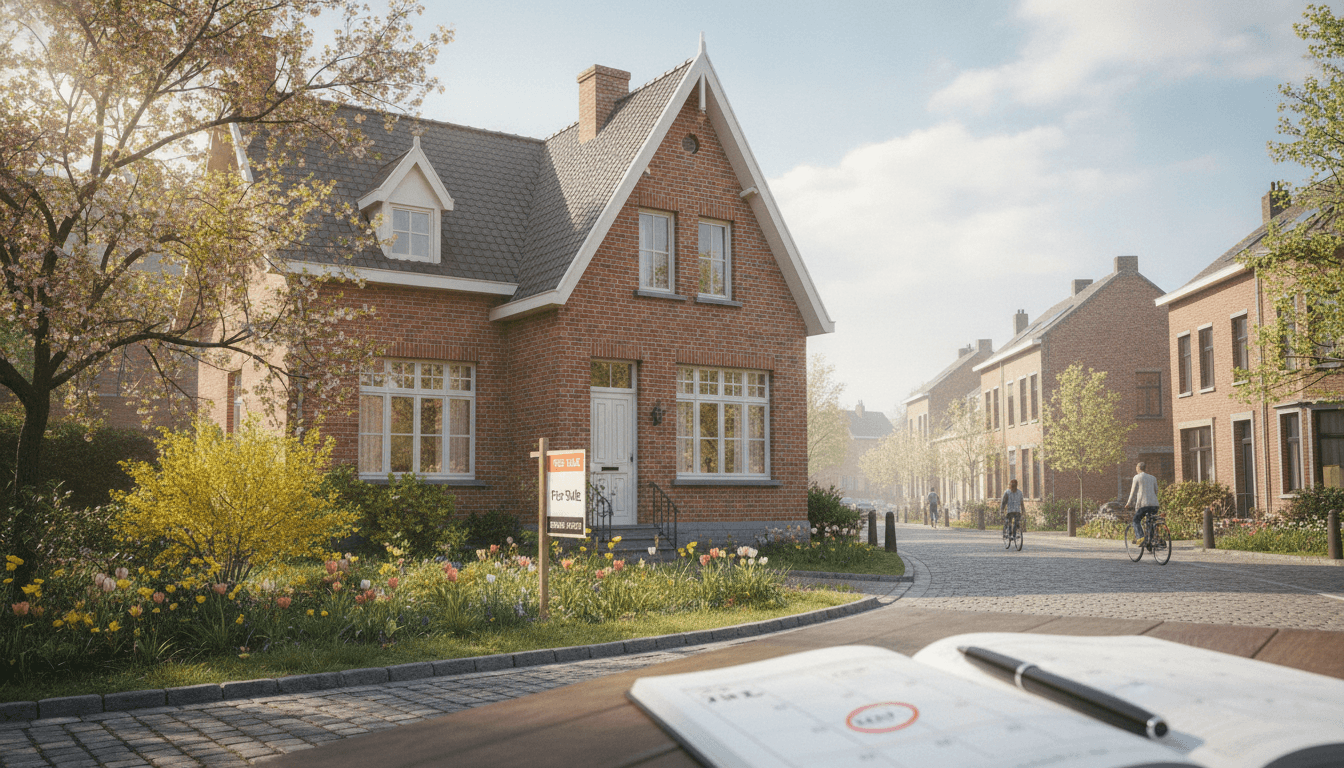
There is no fixed date on the calendar that counts as the best time to sell your home. It is the point where three things line up: a market that gives buyers room, a property that is ready to be shown, and your own moving plans. Force any one of those three and you usually lose more than the season could ever earn you. Below is what you can actually steer.
Timing matters less than your asking price
Sellers overestimate the effect of the month in which they start. In Flanders, the asking price has a far stronger influence on how quickly a home sells. A property priced too high sits just as long in May as it does in November. Worse still: after six to eight weeks without an offer, a listing loses its news value. Buyers who check every day see the date and assume something is wrong. The price cut that follows rarely brings back the original price.
In practice that means the following. Start by setting a realistic price range based on homes recently sold in your street and your municipality, not on what the neighbours are asking. Asking prices on listing sites are wishes, not transactions. A free valuation of your home gives you a starting point, and three agencies each defending their own range give you the bracket within which the truth sits. Only once that range is on the table does the question of the right moment become interesting.
What the season actually does in Flanders
The classic selling season runs from March to the end of June. The garden looks good, the days are longer and families want to be settled before the new school year. There is more demand in that period, but also more supply. Your home therefore competes with more comparable properties in the same street and price bracket.
Autumn is the second strong period, roughly from the start of September to mid November. People who search in September search with purpose: they have used the summer to think it over, have often already discussed financing with their bank and want to be settled before the holidays. Supply is smaller then, so your home gets more attention. For anyone hesitating now, that autumn window is the next realistic moment.
✦ 100% free & No obligation
Sell your property with the best agent
Compare the top 3 agents in your region for free and save on commission.
Compare agents →December and the first half of January are slow. Viewings get cancelled, notaries and banks work around holiday schedules, and photos of a grey garden do your home no favours. That does not mean you cannot sell in that period. It does mean you need to be better prepared, with photography taken earlier and a price that is right straight away.
Interest rates, supply and your buyer budget
The market ultimately decides how much your buyer can borrow. Every movement in the mortgage rate changes the maximum loan amount for the same monthly payment. If the rate falls, your buyer budget grows and pressure on prices rises. If it climbs, part of the field drops out and the sale takes longer. You cannot predict that movement, but you can react to it: if rates are falling while you hesitate, waiting costs more than starting.
Two Flemish rules steer buyer behaviour on top of that. Anyone buying a sole owner-occupied home has paid a registration duty of 2 percent since 2025, which lowers the entry budget and makes first-time buyers more active. Alongside that runs the renovation obligation: if someone buys a home with an EPC label of E or F, it has to reach label D within six years. Candidates factor that cost into their offer. A home with a weak energy label therefore sells more slowly and with more negotiation, whatever the season. Having an insulation file or a quote for roof insulation ready takes part of that uncertainty away.
Your own situation is what decides
For most sellers the market is not the real trigger. A divorce, an inheritance, a new job or a purchase that has already been signed: those are the moments when a home comes up for sale. In those cases the question is not when you should best sell, but how you get the best price within your deadline.
Look at the order of your own file while you do. If you buy first and sell afterwards, you need bridging finance and there is pressure on the sale date. Buyers feel that pressure in the negotiation. If you sell first, you negotiate more calmly, but you have to arrange something in between. There is no single right answer that holds for everyone. What does hold is that you are best making that choice before you appoint an agency, because it determines the brief you give: speed or price. Anyone who has that conversation with several agencies hears straight away who is realistic about the timeline. By comparing estate agents you put that question to up to three agencies in one go.
Preparation decides whether the moment pays off
A well chosen start date achieves nothing if the file is not complete. In Flanders, count on a number of documents that have to be there in any case: the EPC, the soil certificate, the town planning extract, the inspection of the electrical installation and, where applicable, the post-intervention file and the inspection of the private wastewater drainage. Some of those take weeks to come through at the municipality. If you want to start in September, you apply for them in July.
The state in which visitors see the home counts as well. Clearing out, touching up the paintwork, replacing a lamp and tidying the garden costs little and changes the first impression. Have the photography taken on a bright day, even if you only go online two weeks later. A home that goes online complete and well presented on day one collects the most viewing requests in the first weekend. In practice that first weekend is the real moment everything turns on.
In short
The best time to sell your home is the moment when your file is complete, your price is right and your own planning allows it. The season gives that a nudge at most: spring and early autumn draw the most active buyers, December asks for extra preparation. Do not wait for an ideal market you cannot predict anyway. Make sure you are ready, have your home valued and put the same question to several agencies. At ImmoMakelaarVergelijker.be you compare up to three BIV-recognised estate agents from your municipality, free and without obligation, so you can see who really knows your street before you sign. Start by comparing agencies in your area and only then decide on your start date.
Frequently asked questions
When is the best time to sell a home in Flanders?
The two strongest periods are spring (March to end of June) and early autumn (September to mid-November). Spring brings more buyers but also more competing listings, while autumn attracts serious buyers with smaller supply, meaning your home gets more attention.
Does the season matter more than the asking price?
No - in Flanders, the asking price has a much stronger influence on how quickly a home sells than the month you start. A home priced too high will sit unsold just as long in May as it does in November.
How does a poor energy label (EPC E or F) affect the sale of my home?
Buyers who purchase a home with an EPC label of E or F are required to bring it up to label D within six years. They factor that renovation cost into their offer, which means a home with a weak energy label sells more slowly and with more negotiation, regardless of the season.
Which documents do I need to prepare before selling my home in Flanders?
You need at minimum the EPC, the soil certificate, the town planning extract and the electrical installation inspection. Where applicable you also need the post-intervention file and the private wastewater drainage inspection - some of these take weeks to come through, so apply well in advance of your planned start date.
Should I sell my current home before or after buying a new one?
If you buy first, you will need bridging finance and buyers may sense the time pressure during negotiation. If you sell first, you can negotiate more calmly but need to arrange temporary housing. The right answer depends on your own situation, and it is worth making that choice before you appoint an estate agent.
"Real estate expert focused on quality control and strategic partnerships."