
Buying a house with your partner in Belgium: cohabitation agreement, ownership and tax

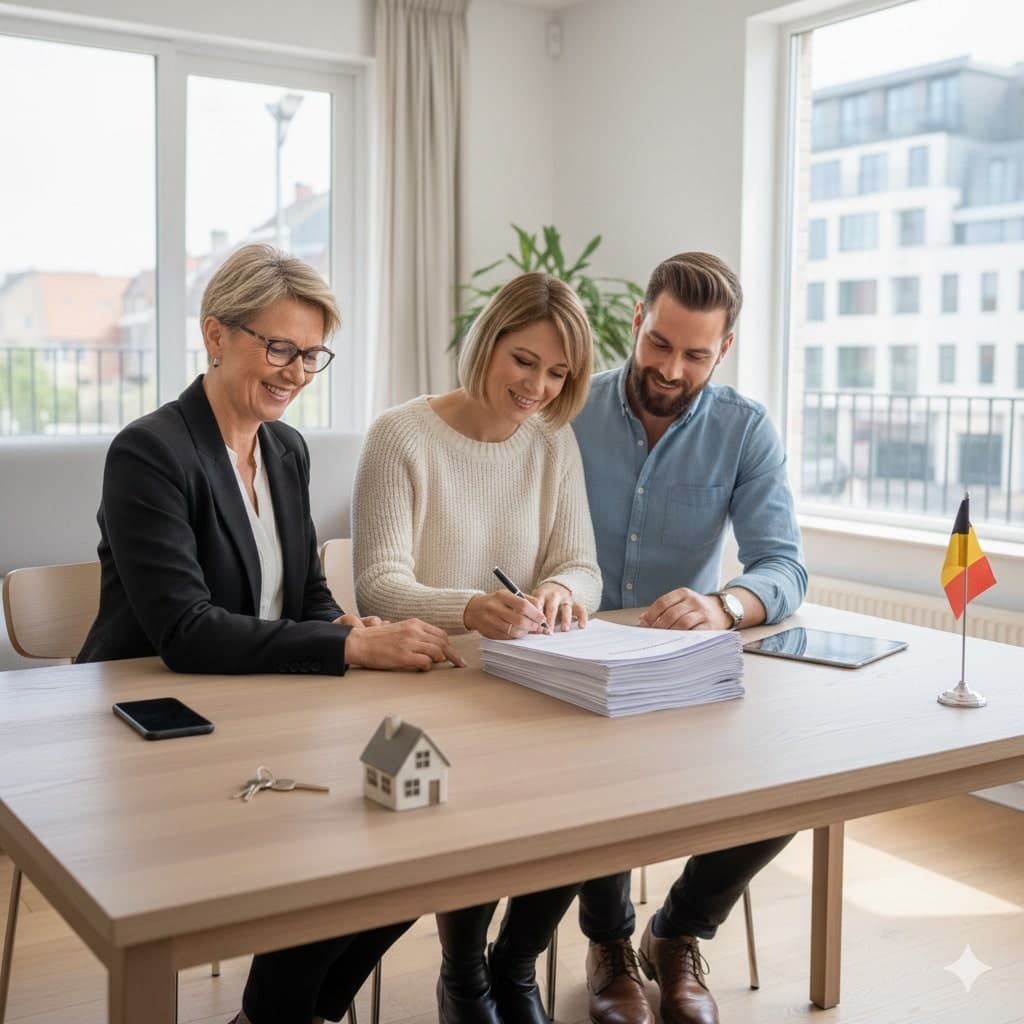
For many couples, buying a home together is the biggest financial commitment they make as a pair. Legally, that purchase works out very differently depending on whether you are married, legal cohabitants or simply living together. The difference mostly shows when things go wrong: after a death or a break-up.
This article explains how Belgian law treats those three situations, who becomes the owner of the home, what a cohabitation agreement does and does not cover, which clauses protect your partner, and which registration duties and inheritance tax apply. Belgium has no separate registered partnership of the kind known in the Netherlands.
Married, legal cohabitants or de facto cohabitants
Married
If you marry without a marriage contract, the statutory matrimonial regime applies. Assets you owned before the marriage remain your own. A home you buy together during the marriage belongs to the joint marital property. A marriage contract lets you arrange things differently, for example with separation of property.
Legal cohabitants
You become legal cohabitants by making a joint declaration to the registrar at your municipality. The declaration is recorded in the population register, and either partner can end it alone. Legal cohabitation does not make you joint owners automatically: there is no joint property and each partner keeps their own assets. Only assets that neither of you can prove belong to one of you are presumed to be owned by both.
The family home is protected, however, just as for married couples. The partner who owns it cannot sell or mortgage the family home without the other partner's consent. You also both contribute to the costs of living together, in proportion to your means.
✦ 100% free & No obligation
Sell your property with the best agent
Compare the top 3 agents in your region for free and save on commission.
Compare agents →De facto cohabitants
If you live together without marriage or a declaration, there is no legal tie between you. The family home is not protected: the owner can sell it without the other's agreement. Nor is there any presumption that assets belong to both of you, so after a break-up each of you has to prove what is yours.
Who owns the home? The deed of purchase decides
For a home, the notarial deed of purchase sets out who owns it and in what share. If you buy together, you become co-owners, each for a share. It does not have to be 50/50: you can buy 60/40 or 30/70, for example, to reflect what each of you puts in. Choose that split deliberately, because it later determines what belongs to whom after a death or a separation.
What does a cohabitation agreement cover?
In a cohabitation agreement, partners who live together make practical and financial arrangements. According to the Belgian notaries, it can cover among other things:
- how you share expenses;
- which assets belong to whom and how ownership is divided;
- arrangements about the family home;
- how debts are dealt with;
- what happens if you split up, such as maintenance payments.
Legal cohabitants must have their cohabitation agreement drawn up by a notary. De facto cohabitants may also write it themselves, although a notarial deed gives more legal certainty. One important limit: arrangements about who inherits what do not belong in a cohabitation agreement. For that you need a will.
What does your partner inherit if one of you dies?
Inheritance law is federal and the same throughout Belgium.
- Married: if there are children, the surviving spouse inherits the usufruct of the whole estate and the children receive the bare ownership. You can therefore keep living in the home or let it. Without children, the spouse inherits the joint property in full ownership and the deceased's own assets in usufruct.
- Legal cohabitants: the survivor inherits the usufruct of the family home and its contents. That right is limited and fragile: a legal cohabitant is not a reserved heir and can be disinherited by will.
- De facto cohabitants: no inheritance rights. Without a will or a clause, the deceased partner's share goes to their legal heirs, not to you.
For more detail on each situation, read what the surviving partner receives in Belgium.
Clauses that protect your partner when you buy
Accretion clause
With an accretion clause (beding van aanwas, clause d'accroissement), you agree that the share of whoever dies first passes to the survivor. According to the notaries, it is used by de facto and legal cohabitants who each own half. Both partners need a comparable chance of surviving the other, otherwise the tax authorities may treat it as a disguised gift. Because it is a contract, neither of you can withdraw from it alone. You can give the survivor the usufruct, the bare ownership or the full ownership, and make the clause optional. The share that accrues does not count towards the children's reserved portion, unlike a legacy or a gift. The downside, according to the notaries: that share is subject to the same registration duties as at the purchase. Also agree who bears the remaining mortgage balance if it is not fully covered by insurance at the time of death.
Will
A will lets you leave your share of the home to your partner. According to the notaries, inheriting through a will is usually cheaper than an accretion clause, but a will can always be changed unilaterally, even without the other partner knowing. That is why notaries often combine the two: the survivor then chooses the better option at the time of death. De facto cohabitants who do not want to leave each other ownership can also sign a lifelong lease before a notary: the survivor stays in the home and pays rent to the heirs. The notaries set out these options on notaris.be.
Inheritance tax on the partner's share
Inheritance tax depends on the region where the deceased had their tax residence for the longest period in the last five years, not on where the home is.
- Flanders: spouses, legal cohabitants and de facto cohabitants with at least one year of uninterrupted shared household pay the same partner rates. The partner is fully exempt on their share in the family home if it was the main residence you lived in together. De facto cohabitants must have lived together for at least three years for this.
- Brussels: the spouse and the legal cohabitant are exempt on their share in the family home. De facto cohabitants do not get the favourable partner rates.
- Wallonia: the spouse and the legal cohabitant are exempt on their share in the home that was the deceased's main residence for at least five years. De facto cohabitants are taxed as unrelated persons, without that exemption.
Example for a death in 2026 in Flanders. Lotte and Jonas are de facto cohabitants with no children and bought a home together for €300,000, half each. Jonas leaves his half to Lotte by will. We assume a net share of €150,000 and no other assets.
| Situation | Calculation | Inheritance tax |
|---|---|---|
| At least 3 years living together in that home | family home exemption | €0 |
| 2 years living together (but 1 year of shared household) | 3% on €50,000 = €1,500, plus 9% on €100,000 = €9,000 | €10,500 |
Flanders has announced a reform of inheritance tax, but nothing has been decided yet. The current rates still apply. See also how much inheritance tax a spouse pays.
Registration duties on the purchase
Registration duties depend on the region where the home is located and on the date of the notarial deed. For deeds signed in 2026:
| Region | Only own home | Other purchases |
|---|---|---|
| Flanders | 2% on the full price | 12% |
| Wallonia | 3% on the full value | 12.5% |
| Brussels | 12.5% with an abatement: the first €200,000 exempt, if the taxable base does not exceed €600,000 | 12.5% |
In Flanders, the Flemish Tax Administration assesses the conditions for the 2% rate per buyer. On the date of the deed, no buyer may be full owner of the whole of another home or building plot, in Belgium or abroad, and each must register at the address within three years. For sale agreements from 1 January 2026, that registration must be kept for at least one uninterrupted year, and only purchases in full ownership qualify. If one of you still owns a home, the reduced rate remains possible if that buyer undertakes to dispose of it within two years of the deed and there is a causal link with the new purchase. If you need to sell first, compare local estate agents to keep that deadline realistic.
Example: you buy a home together for €250,000, half each.
- Flanders, you both meet the conditions: 2% of €250,000 = €5,000.
- Flanders, one of you still owns another home and does not sell it: €125,000 x 12% = €15,000, plus €125,000 x 2% = €2,500, making €17,500.
- Wallonia, only own home: 3% of €250,000 = €7,500.
- Brussels, with the abatement: (€250,000 minus €200,000) x 12.5% = €6,250.
How it works out in Wallonia and Brussels if only one of you meets the conditions is best checked with your notary. For more on the regional rules, read registration duties in Flanders and registration duties in Brussels.
Personal income tax
De facto cohabitants are each taxed as a single person for personal income tax and each file their own return. Whether spouses and legal cohabitants are taxed jointly depends on their situation and on when they married or made the declaration. The FPS Finance explains the rules on its website fin.belgium.be.
And if you separate?
If one of you takes over the other's share, partition duty is payable. In Flanders it is 2.5%. The reduced rate of 1% applies there only to spouses who divorce and legal cohabitants who end their legal cohabitation, provided it lasted at least one year and the partition takes place within three years. De facto cohabitants pay 2.5% in Flanders. In Brussels and Wallonia, partition duty is 1%, including for de facto cohabitants. If one of you becomes the sole owner, the duty is calculated on the value of the whole home. For a €300,000 home in Flanders, that is €7,500 at 2.5% or €3,000 at 1%. In Flanders, the 2% rate from the purchase can be kept if the partner who takes over the other share remains the only one registered there. See also selling a house during a separation.
In short
When you buy together, the key choices are made at the notary: the split of your shares, any protective clauses and the registration duties. Discuss them before you sign the sale agreement, so you know from the start what happens if life turns out differently than planned.
Frequently asked questions
Does legal cohabitation make us joint owners automatically?
No. Legal cohabitation does not create joint property. Who owns the home and in what share is set out in the notarial deed of purchase. The family home is protected, though: the owner cannot sell or mortgage it without the partner's consent.
What does my partner inherit if we are de facto cohabitants and I die?
Nothing, unless you have made a will or you agreed an accretion clause when you bought the home. Without such an arrangement, your share goes to your legal heirs.
What does a legal cohabitant inherit?
The usufruct of the family home and its contents. A legal cohabitant is not a reserved heir, so that right can be excluded by will. A married partner inherits more: where there are children, the usufruct of the whole estate.
Can a cohabitation agreement provide that my partner inherits the home?
No. According to the Belgian notaries, arrangements about inheritance do not belong in a cohabitation agreement. You need a will for that. When you buy, an accretion clause is also possible if you each own half.
Which registration duties do we pay when we buy a home together?
For deeds signed in 2026, an only own home is taxed at 2% in Flanders and 3% in Wallonia. In Brussels the rate is 12.5% with an abatement on the first 200,000 euros if the taxable base does not exceed 600,000 euros. Otherwise the rate is 12% in Flanders and 12.5% in Wallonia and Brussels.
One of us already owns a home. Do we still get 2% in Flanders?
In Flanders the conditions are assessed per buyer. The partner who is still full owner of the whole of another home pays 12% on their share, unless they undertake to dispose of it within two years of the deed and there is a causal link with the new purchase. The other partner can get 2%. For a 250,000 euro home bought half each, that is 15,000 plus 2,500 euros, making 17,500 euros.
Will my partner pay inheritance tax on my share of the family home?
That depends on the region of your last tax residence. In Flanders the partner is exempt on their share in the family home, including a de facto cohabitant after at least three years of living together. In Brussels that exemption applies to the spouse and the legal cohabitant, and in Wallonia too, provided the home was the main residence for at least five years.
"Tech entrepreneur and strategist focused on digital transformation in the real estate sector."