
Comparing mortgage loans in Belgium: get the best rate and conditions

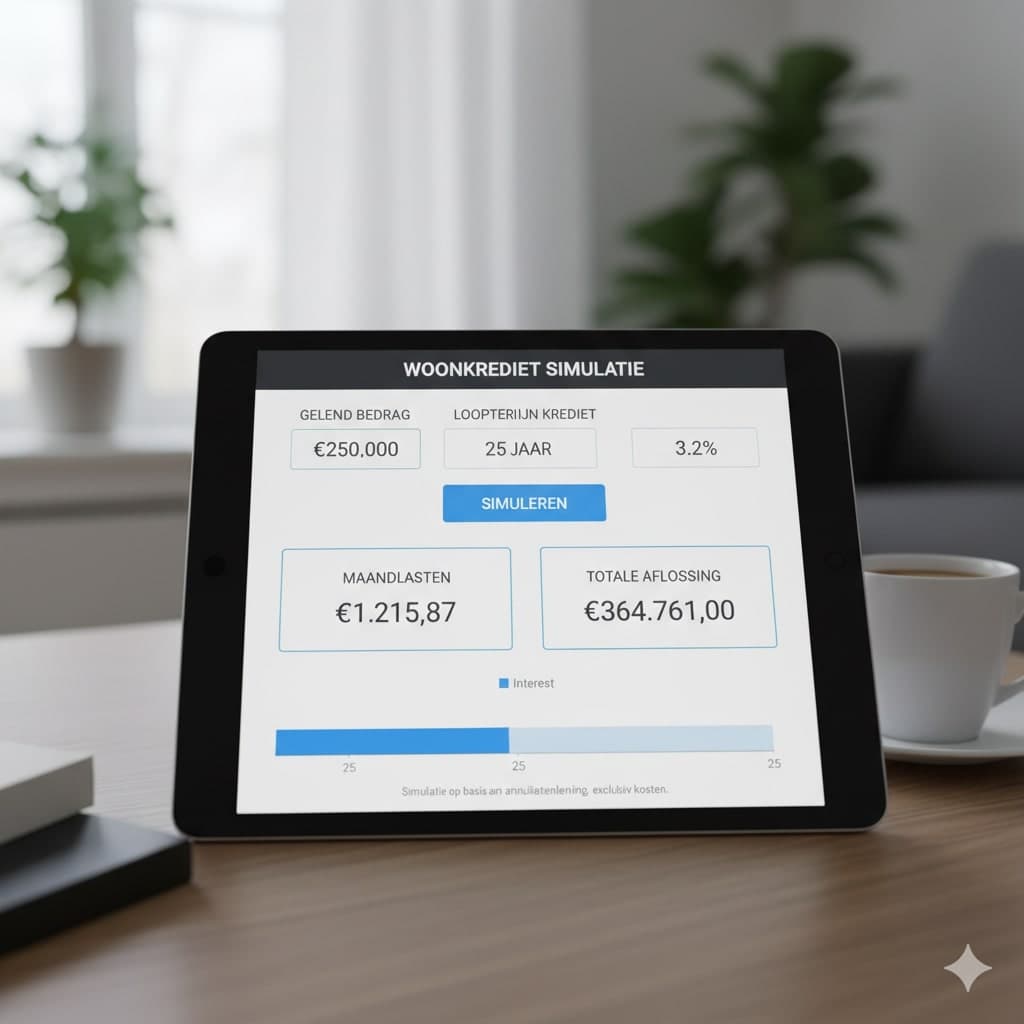
Comparing mortgage loans in 2025: save thousands of euros
For most people in Belgium, a mortgage is the biggest financial decision of their lives. Yet only one in three buyers actively compares different banks before taking out a home loan. That turns out to be a costly mistake: a difference of just 0.3 percentage points in interest rate can add up to €10,000 in extra costs on a €300,000 loan over 20 years. In 2025, the differences between banks are greater than ever, making comparison more important than it has ever been.
Why comparing mortgage loans in 2025 is key
The mortgage market in Belgium is going through an exceptional period in 2025. After years of rising rates, interest rates have stabilised between 3.3% and 4.1%, depending on the formula and term chosen. The European Central Bank has kept its policy rate stable since the summer, which has brought a degree of calm to the market. At the same time, the differences between banks remain considerable: ING, Belfius, KBC and BNP Paribas Fortis offer fixed rates from 2.74% for ‘premium’ files, but standard profiles often pay 3.2% or more.
For families, this means in practice that a well-prepared file and active comparison can quickly yield an advantage of 0.3 to 0.5 percentage points. On a loan of €300,000 over 25 years, that difference amounts to around €150 per month - or more than €45,000 over the full term. Comparison is therefore not a luxury but a necessity.
Current interest rates per bank
In October 2025, average rates for fixed-rate home loans range between 3.3% and 4.1%, depending on term and profile. Keytrade scores as the most competitive for online applications, while Argenta scores highly on customer satisfaction for mortgage loans. KBC automatically offers its sharpest rate without the need for negotiation, which saves time. ING gives a 0.2% interest discount for energy-efficient properties with an EPC certificate below 150 kWh/m², while BNP Paribas Fortis offers a 0.1% discount.
What determines your mortgage rate in 2025?
Banks assess your credit profile based on five key criteria. Not every profile receives the same rate: the differences can reach up to 1 percentage point between ‘premium’ profiles and standard applications.
✦ 100% free & No obligation
Sell your property with the best agent
Compare the top 3 agents in your region for free and save on commission.
Compare agents →Own contribution and loan-to-value
The National Bank of Belgium requires that banks lend a maximum of 90% of the purchase value for an owner-occupied home. The higher your own contribution, the lower the Loan-To-Value (LTV) and the more favourable the rate. For premium files, a 10% own contribution is sufficient, but for investment property banks require 20% or more. Notably, 35% of loans for a first home may even exceed the 90% LTV threshold, and 5% of all loans may exceed 100% - provided strong conditions are met, such as sufficient income and an energy-efficient property.
Stability and income
Banks look at your professional stability, debt burden and Debt Service To Income ratio (DSTI). For net incomes up to €3,500 per month, the DSTI is around 50%; for higher incomes this rises to 60%. After deducting the monthly loan repayment, single applicants must retain at least €1,000 to €1,100, couples €1,400 to €1,500, plus €100 to €150 per dependent child. Families with two stable incomes and a clearly defined property project are in a stronger position to negotiate.
Energy label of the property
Energy-efficient properties receive better conditions. ING offers a 0.2% interest rate advantage for EPC labels up to 150 kWh/m², and BNP Paribas Fortis gives a 0.1% discount. In addition, energy loans are available at favourable rates when at least 75% of the works are aimed at energy saving - such as a heat pump, boiler or solar panels. Properties with an A or B label rise in value more quickly and offer buyers immediate savings on heating costs.
Five strategies for the lowest mortgage rate
Negotiating your mortgage may seem complicated, but with the right preparation you can achieve concrete results. Experts advise comparing at least three banks and always requesting written simulations.
Set aside two days for mortgage shopping
Start by approaching the lender that offers the best deal according to our comparison tool or that of Test Aankoop, then visit a number of major banks such as KBC, ING, Belfius and BNP Paribas Fortis. Request a written simulation with full details: monthly repayments, notary fees, valuation fees, file fees and insurance costs. Present this quote to your trusted financial institution and negotiate a better offer. Use every proposal as a basis for negotiation with the competition.
Compare the annual percentage rate (APR)
Do not focus solely on the interest rate - pay particular attention to the annual percentage rate (APR). This covers all costs of the loan: interest, file fees, insurance and any additional products. A mortgage with the lowest interest rate can end up being more expensive due to higher ancillary costs. Also ask for amortisation tables on paper, so you can more easily persuade another bank to make a better offer.
Choose the right term
Shorter terms (15-20 years) save a great deal of interest but increase the monthly payment. Longer terms (25-30 years) spread the burden more comfortably, but you pay considerably more in interest. On a loan of €300,000 at 3.3%, a 15-year term costs around €2,108 per month and €79,500 in total interest, while a 30-year term costs €1,306 per month but €170,000 in total interest. The sensible middle ground is between 20 and 25 years: sufficient security, a manageable monthly payment and controllable total cost.
Negotiate ancillary conditions
Banks often tie mortgages to compulsory products such as outstanding balance insurance, home insurance and current accounts. Request quotes for outstanding balance and home insurance from multiple insurers and present these to your bank. If the bank refuses to adjust its rate, consider taking out the insurance for one partner through the bank, so that you still obtain the sharpest interest rate. This can save hundreds of euros per year.
Use mortgage brokers
Independent brokers such as Hypotheekwinkel, Immotheker Finotheker or Credishop compare more than 20 to 25 banks on a daily basis and receive their commission from the bank, not from you. They follow the evolution of interest rates closely and know exactly which bank offers the best conditions for your profile. They also defend your interests during negotiations and ensure your documentation is in order.
Common mistakes in mortgage applications
Even well-prepared buyers make mistakes that delay their application or make it more expensive. Here are the most common pitfalls and how to avoid them.
Incomplete or incorrect documentation
One of the biggest stumbling blocks is incomplete or faulty documents. Make sure your employer's declaration is no more than three months old and is consistent with your pay slips. Bank statements must be in your name and show the correct balance. Self-employed applicants must provide annual accounts for the last three calendar years. Double-check everything before submitting your application: corrections such as crossing out or correction fluid are not permitted and require a completely new form.
Misjudging affordability
Many buyers underestimate the total cost of home ownership: maintenance, taxes, insurance, energy costs and potential renovations. They also often overestimate the amount they can borrow without taking the long term into account. Draw up a realistic overview of all your monthly expenses and use a loan simulator to calculate your exact borrowing capacity.
Not disclosing debts in time
Failing to disclose existing debts, student loans or credit cards in time can block your application. Banks check through the Central Individual Credit Register whether you have outstanding debts. Be transparent and mention all current loans, including small amounts. If you have recently paid off debts, provide proof of repayment and deregistration from the credit register.
Checklist: documents needed for your mortgage application
To ensure your mortgage application runs smoothly, it is best to gather all documents in advance. Banks systematically request the same information, so prepare this thoroughly.
Identification and income:
- Copy of identity card or passport (your own and, if applicable, your partner's)
- Employer's declaration (no more than 3 months old)
- Recent pay slips (last 3 months)
- Annual income statements
- For the self-employed: annual accounts and tax returns for the last 3 years
Financial situation:
- Up-to-date statements for all bank and savings accounts
- Overview of current loans and debts
- Any student debt (DUO or equivalent)
- Signed gift agreement (if applicable)
Property and project:
- Sale agreement or preliminary purchase contract
- Valuation report (no more than 6 months old)
- EPC certificate for the property
- Any quotes for renovation works
- Planning permits (for new-build projects)
Personal situation:
- Marriage certificate or cohabitation agreement
- Prenuptial agreement and any amendments, if applicable
- Divorce settlement (if applicable)
The impact of reduced registration duties
Since 1 January 2025, buyers of their only own home in Flanders benefit from a historically low rate of 2% registration duties (down from 3% previously). In Wallonia, the rate fell from 12.5% to 3%, which makes an enormous difference. On a property worth €350,000, that saving amounts to €3,500 in Flanders and no less than €33,250 in Wallonia. This advantage reduces your total purchase costs and increases your negotiating position with the bank.
Combine this advantage with an energy-efficient property and a solid own contribution, and you are better placed than ever to secure the best mortgage conditions. Bear in mind that the renovation obligation has also been relaxed: new owners have six years to bring their property up to EPC label D, which gives renovation plans more breathing room.
From simulation to contract: step by step
After comparing and negotiating comes the moment of the final decision. Use all the information you have gathered to make a well-considered choice. Check the final offer on every detail: interest rate, term, monthly payment, total interest, insurance costs, file fees and any penalties for early repayment.
Only sign when you are certain of your choice. A mortgage is a commitment of 15 to 30 years, so take the time to go through everything thoroughly. Also consider the possibility of refinancing in the future should rates fall further - although this again brings notary costs and sometimes penalties.
Conclusion: comparing always pays off
Comparing mortgage loans in 2025 is not a luxury - it is a basic strategy that saves you thousands of euros. The differences between banks are greater than ever, and with the right preparation, active negotiation and the use of independent brokers you can achieve concrete results. Remember that a strong credit profile - with sufficient own contribution, stable income and an energy-efficient property - is the key to the best conditions.
Ready to get started? Use a loan simulator to calculate your borrowing capacity, compare estate agents for a realistic valuation of your property, and request quotes from at least three banks. Your future home and your wallet will thank you.
Ready to find the best mortgage? Start today with a free valuation or compare local estate agents via immomakelaarvergelijker.be - make smart financial decisions in 2025.
Frequently asked questions
How much can I save by comparing mortgage rates in Belgium?
A difference of 0.3 percentage points in interest rate can add up to €10,000 in extra costs on a €300,000 loan over 20 years. On a 25-year loan, a well-prepared file and active comparison can yield a monthly advantage of around €150, or more than €45,000 over the full term.
What interest rates can I expect for a mortgage in Belgium in 2025?
Fixed-rate home loans in October 2025 range between 3.3% and 4.1%, depending on term and profile. Banks like ING, Belfius, KBC and BNP Paribas Fortis offer fixed rates from 2.74% for premium files, but standard profiles often pay 3.2% or more.
Does the energy label of my property affect my mortgage rate?
Yes, energy-efficient properties receive better conditions. ING offers a 0.2% interest rate discount for EPC labels up to 150 kWh/m², while BNP Paribas Fortis gives a 0.1% discount.
How much of my own money do I need to buy a home in Belgium?
The National Bank of Belgium requires banks to lend a maximum of 90% of the purchase value for an owner-occupied home, meaning you need at least a 10% own contribution for a premium file. For investment property, banks require 20% or more.
Should I use a mortgage broker when applying for a home loan in Belgium?
Independent brokers like Hypotheekwinkel, Immotheker Finotheker or Credishop compare more than 20 to 25 banks daily and receive their commission from the bank, not from you. They can negotiate on your behalf and ensure your documentation is in order.
"Tech entrepreneur and strategist focused on digital transformation in the real estate sector."