
EPC label explained: what do A, B, C, D, E, F mean and how do you improve yours?

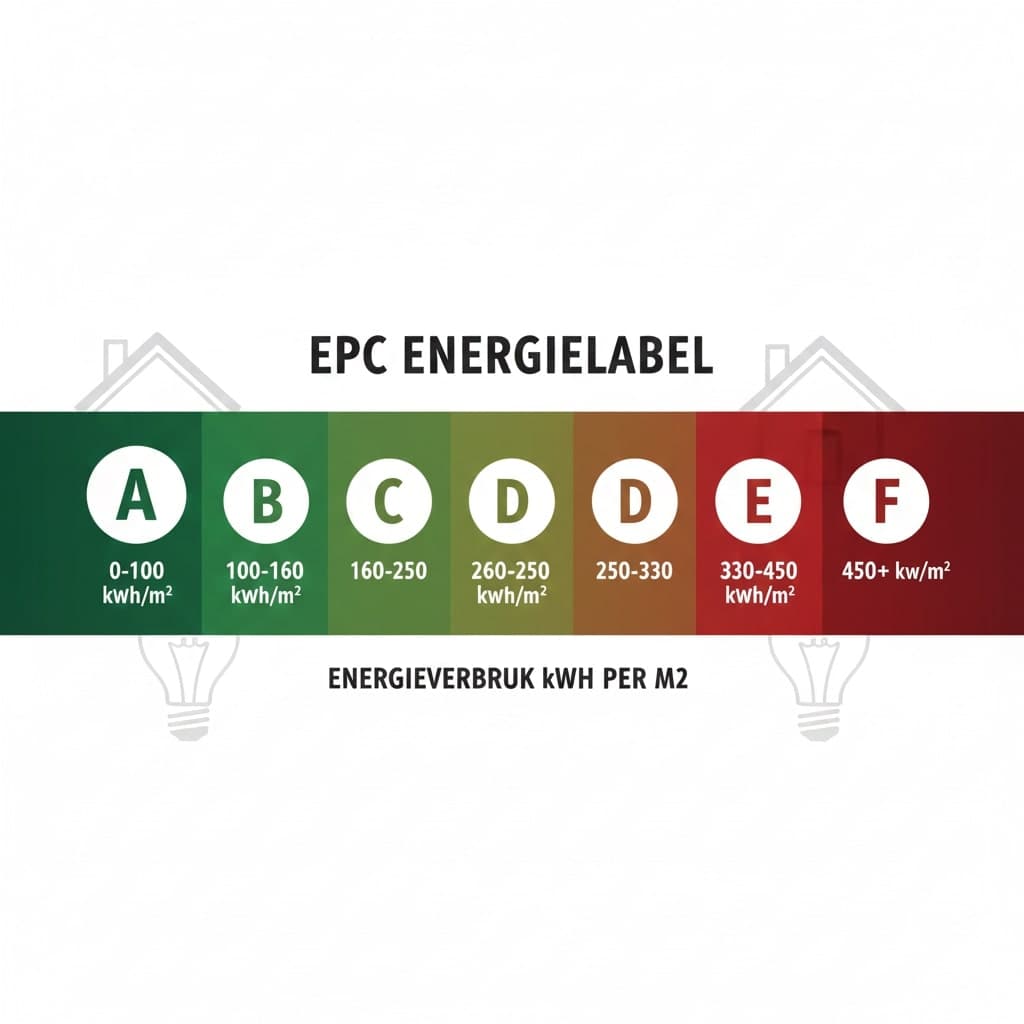
EPC label in Belgium 2025: no smoke and mirrors - it's your wallet on the line
For home buyers and sellers alike, the EPC label (Energy Performance Certificate) matters more than ever in 2025. This label does not only determine your energy bill, but also your property's value, your mortgage conditions, and now even your obligations as an owner. Buying a home with an EPC label E or F in Flanders? You will need to renovate. Label D? Fine, you can wait. Label A? Congratulations - your property gains value and your energy bill drops dramatically.
What does each label actually mean, and how do you improve yours? This article gives you the full picture, including costs and savings.
What is an EPC label? The basics
An EPC label is an energy certificate that shows how energy-efficient - or energy-hungry - your home is. It is expressed in kWh/m² per year - the lower the figure, the better. This number determines your label: from A+ (ultra-efficient) to F (an energy black hole).
Important: The EPC label describes the technical characteristics of the property - insulation, heating, ventilation system - regardless of who lives in it. So even if your household uses very little energy day to day, that does not change the EPC label.
Validity: An EPC label is valid for 10 years.
✦ 100% free & No obligation
Sell your property with the best agent
Compare the top 3 agents in your region for free and save on commission.
Compare agents →The EPC labels explained: from F to A+
Here is a practical breakdown of each label as applied in Belgium:
| Label | kWh/m² per year | Meaning | In practice |
|---|---|---|---|
| A+ | ≤ 0 | Ultra-efficient to energy-neutral | New build, heat pump, solar panels, excellent insulation |
| A | 0-100 | Very energy-efficient | Modern new builds or excellently renovated homes |
| B | 101-200 | Energy-efficient | Well-renovated homes, high-performance glazing, insulation |
| C | 201-300 | Average energy consumption | Reasonably maintained, standard insulation |
| D | 301-400 | Moderate energy consumption | Older homes, no major issues but no standout advantages either |
| E | 401-500 | Energy-hungry (renovation required after a purchase in Flanders) | Outdated homes, little insulation, old heating system |
| F | >500 | Very energy-hungry (renovation required after a purchase in Flanders) | Very old homes with no insulation, gas heating, single glazing |
Practical examples:
- A modern new-build apartment: label A (approx. 90 kWh/m²/year)
- A 1970s house with modest insulation: label D (approx. 380 kWh/m²/year)
- A 1950s house with no insulation: label F (approx. 600+ kWh/m²/year)
Heating costs: the gap between labels is significant
Where the EPC label really hits you in the pocket is on your energy bill. On paper, a label A home uses at least three times less energy than a label D home.
Theoretical energy use and cost per label (per year, 150 m² home heated with gas, Flemish EPC scale, gas at 9.37 cents per kWh, the CREG average for August 2026):
| Label | Theoretical use | Theoretical cost |
|---|---|---|
| A+ | 0 kWh or less | Close to zero |
| A | Up to 15,000 kWh | Up to €1,410 |
| B | 15,000 to 30,000 kWh | €1,410 to €2,810 |
| C | 30,000 to 45,000 kWh | €2,810 to €4,220 |
| D | 45,000 to 60,000 kWh | €4,220 to €5,620 |
| E | 60,000 to 75,000 kWh | €5,620 to €7,030 |
| F | More than 75,000 kWh | More than €7,030 |
These amounts are theoretical. The EPC calculates consumption under standard conditions (every room at 18 °C all year, the home occupied 365 days a year), including heating, hot water and ventilation. Real bills are often much lower, especially for poorly rated homes: CREG uses 17,000 kWh of gas a year as a typical household's consumption, about €1,590 at the August 2026 average price. The gap between two labels is still real, and it adds up year after year.
That is money coming straight out of your budget.
Renovation obligation 2025: who has to do what?
New rules came into force in 2025. These are important to understand if you are buying a home with label E or F.
In Flanders:
- EPC label E or F: You MUST renovate to at least label D within 6 years (extended from 5 years in 2025).
- EPC label D: No mandatory renovation, but experts recommend pushing on towards C or B (in view of future regulations).
- EPC label C or higher: No obligations.
In Wallonia and Brussels: No renovation obligation applies to the buyer today. A Walloon draft plan proposes one for purchases from 2028, but it is not law yet. Brussels requires every home to reach at least class E (PEB 275) by 1 January 2033, whether or not it is sold.
Consequences of non-compliance:
- An administrative fine of 500 to 200,000 euros, which does not cancel the obligation
- Lower sale price when you eventually sell the property
- Lower rental income if you let it out
- Stricter financing conditions from banks
How do you improve your EPC label? Priorities and costs
Want to go from F to D, or further? Start with whatever cuts heat loss the most. Savings and payback depend heavily on your home: its starting point, size, heating system and energy prices. No general figure replaces an estimate for your own house.
Step 1: Roof insulation
In an uninsulated house, the roof is usually the largest single source of heat loss, roughly a quarter to a third. That makes it the usual first step and one of the most cost-effective.
Step 2: Wall insulation
Walls come next. Insulating a cavity wall is usually simpler and cheaper than insulating from the outside or the inside.
Step 3: Windows and floor
New windows improve comfort and the label, but they are expensive compared with the energy they save, so they pay back slowly if energy is the only reason. Floor insulation, from the cellar or crawl space, is often overlooked but can be worthwhile.
Step 4: Heating and solar panels
Once the home is well insulated, a heat pump and solar panels help you reach the best labels. Insulate first: a heat pump works best in a house that loses little heat.
Best approach for F→D: start with the roof and the walls. For the cost, saving and payback period for your own home, get quotes and an energy audit. Your EPC certificate also lists recommended works.
Grants and loans for renovation
Grants and subsidised loans can make a renovation considerably cheaper, but the schemes change often.
Flanders: the EPC label grant has been phased out. The EPC before the works had to be issued by 31 December 2025 at the latest, and the last applications closed on 30 June 2026. Support now runs through Mijn VerbouwPremie, a grant for works such as insulation, windows and heating whose amount depends on your income, and Mijn VerbouwLening, a renovation loan of up to 60,000 euros over up to 25 years.
Wallonia: from 1 October 2026, support comes as loans: the Rénopack, a 0% loan of which part does not have to be repaid (income categories C1 to C3), and the Rénoprêt, a preferential-rate loan.
Brussels: No Renolution grants are open for new works: the scheme only covered works with a final invoice dated 2024 and that filing period is closed, and no new support has been decided.
Check the current amounts and conditions on vlaanderen.be, wallonie.be or with Bruxelles Environnement before you start.
Impact on property price and mortgage
The EPC label affects your property's price, but the gap varies by region and type of home.
Asking-price differences compared with an equivalent label D property:
- Flanders: +18.6% for a label A house, +16.1% for a label A apartment, and 10.4% less for a label F house
- Wallonia: +12% for a label A house, +14.1% for a label A apartment
- Brussels: +12.2% for a label B house (label A is still rare there)
Source: Immoweb analysis of listings published from April 2025 to April 2026 (May 2026). These are asking prices, not sale prices.
Notaries' figures point the same way: in Flanders, a house with label A sold for €498,667 on average in 2025, against €272,829 for a house with label F (Fednot, January 2026). Those raw averages also reflect differences in size and location, so they overstate the effect of the label alone. For your own property, location, size and condition matter as much as the label.
What your label does to your mortgage:
- A good label can cut your rate. Several Belgian banks give an energy discount on a home loan. KBC applies a discount of 0.20% for EPC label A, 0.15% for label B, 0.10% for label C and 0.05% for label D, according to its own home loan rate card no. 678, valid from 1 September 2026. Exceptions apply, among others for building land, a bridging loan and refinancing an existing loan with the same bank.
- A weak label means no discount. A home rated E or F gets no energy discount, and the bank counts the renovation into your budget: you borrow for the purchase and for the works. Every bank sets its own conditions and amounts, so ask about the discount and compare before you sign.
Practical tips: buying a label F home - is it a smart move?
Advantages:
- Cheaper to buy (in Flanders, a label F house is advertised about 10% below a comparable label D house)
- Renovation pays itself back through savings and grants
- Younger buyers grow into their home over time
- Value increase after renovation
Disadvantages:
- Mandatory renovation within a set deadline (the years go faster than you think)
- Budget risk: unforeseen costs (pipework, drainage, roof)
- Longer depreciation period for renovation works
- Lower rental yield if you let the property before renovating
Advice: Only buy a label F property if you:
- Have at least €15,000 of extra budget set aside for renovation (on top of the purchase price)
- Plan to live in the property for at least 10-15 years
- Can set your own priorities (roof insulation FIRST)
- Want to cut your energy costs and think long-term
Conclusion: the EPC label affects more than you might think
Your EPC label determines three things: your energy bill, your property's value, and - from now on - your obligations as an owner. A label A/B means comfort and rising value; a label F means renovation pressure and a lower price.
Want to live without the worry of a looming renovation? Go for label C or better. Want to save on the purchase price and renovate afterwards? Label F can be a smart choice - provided you have the budget and the time. Either way: consult an energy adviser, compare estate agents with local expertise, and request a free valuation to get a realistic picture of renovation costs.
Choose your EPC label wisely - it will shape your living comfort and your finances for decades to come.
Frequently asked questions
How long is an EPC label valid in Belgium?
An EPC label is valid for 10 years. It describes the technical characteristics of the property, so it does not change based on how much energy the current occupants actually use.
What happens if I buy a home with EPC label E or F in Flanders?
You are required to renovate the property to at least label D within 6 years. Failing to comply can lead to an administrative fine of 500 to 200,000 euros, and the obligation still applies afterwards. A poor label also means a lower sale price, and it costs you the energy discount that several Belgian banks give on a home loan.
What is the cheapest way to improve my EPC label?
Roof insulation is usually the first and one of the most cost-effective steps: in an uninsulated house, the roof often accounts for a quarter to a third of heat loss. To go from F to D, roof and wall insulation are usually combined. The cost and payback period depend on your home, so get quotes and an energy audit.
Are there grants available for EPC renovation in Flanders?
The EPC label grant in Flanders has been phased out: the last applications closed on 30 June 2026. Support now runs through Mijn VerbouwPremie, a grant whose amount depends on your income, and Mijn VerbouwLening, a renovation loan of up to 60,000 euros over up to 25 years.
How does the EPC label affect my property value?
It depends on the region and the type of home. According to an Immoweb analysis of listings from April 2025 to April 2026, a label A house in Flanders is advertised for 18.6% more than a comparable label D house, and a label F house for 10.4% less. In Wallonia, a label A house is advertised for 12% more than a label D house. Location, size and condition matter as well.
"Tech entrepreneur and strategist focused on digital transformation in the real estate sector."