
How much does mortgage protection insurance cost in Belgium?

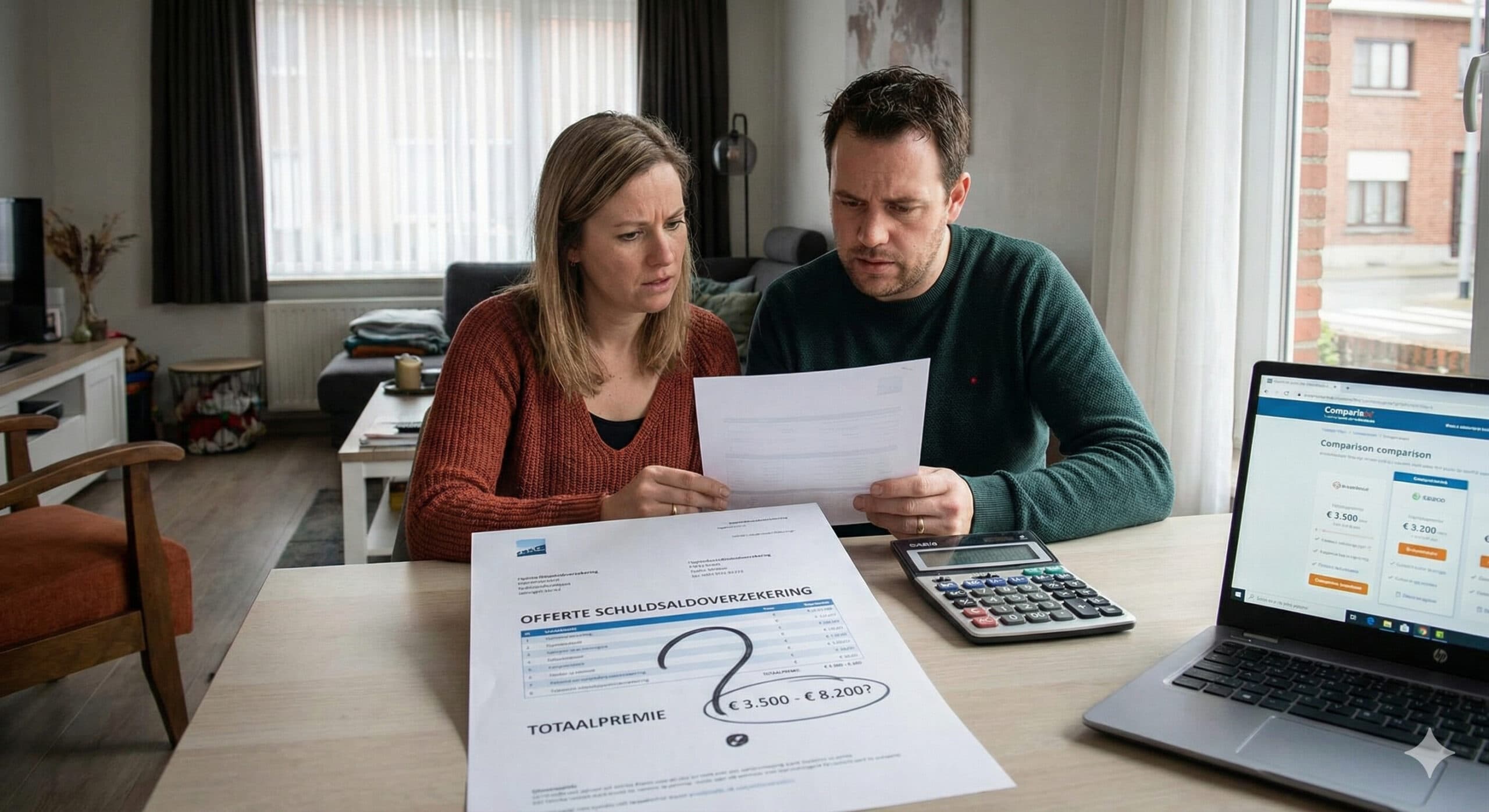
Mortgage protection insurance pays off the outstanding balance of your home loan if you die before the loan is repaid. It is not required by law, but virtually every Belgian bank makes it a condition for granting the loan. The premium varies enormously from one file to the next, which is why the question of what it costs has only one honest answer: it depends on who is insured and for how much.
What sets the premium
Five things weigh heaviest. Your age at the start, because the risk rises every year. Your health, established through a medical questionnaire and sometimes an examination. Whether you smoke, which is a separate rate class at most insurers. The capital insured and the term of the loan. And the percentage you insure per borrower.
That last point is often underestimated. If you buy with two, you choose how much of the balance each of you covers. Two times fifty percent is the cheapest formula, but half the loan then stays open if one of you dies. Two times one hundred percent costs the most and leaves the home entirely free of debt for the surviving partner. Intermediate formulas, at seventy or eighty percent per person, also exist.
If you have a medical history, the insurer may ask an extra premium or write in an exclusion. For people cured of certain illnesses there is a right to be forgotten: after ten years in principle, that history may no longer count in the rate.
Single premium or periodic premium
You pay in one of two ways. With a single premium you settle everything at the start, usually by borrowing that amount within the loan. With periodic premiums you pay yearly or monthly, often for part of the term.
✦ 100% free & No obligation
Sell your property with the best agent
Compare the top 3 agents in your region for free and save on commission.
Compare agents →The single premium is generally cheaper in total cost, but you borrow it, so you pay interest on it. The periodic formula feels lighter and adds up over many years. So always ask for both calculations, with the same cover, and compare the total over the full term.
Your bank's policy is not compulsory
The bank granting your loan may require that mortgage protection insurance exists. It may not require you to take that policy with them. In practice it often ties a rate discount to it, and that changes the sum.
So compare in two steps. First ask your bank for an offer with and without its insurance, so you can see what the rate discount is worth over the full term. Then ask two other insurers or a broker for quotes with exactly the same cover, the same percentage and the same term. Only then do you know whether the discount makes up for the difference in premium.
The tax relief is gone
This is the big change of recent years. For loans taken out from 1 January 2025 there is no longer any tax relief for capital repayments, interest or mortgage protection premiums, in any region. Older loans may still fall under their own scheme, and in a refinancing only the part that replaces an older loan with relief counts.
There is a catch in older files too. Anyone who once claimed tax relief on the premiums is taxed on the pay-out. That is no reason to leave the relief unclaimed, but it is a reason to know what comes later. For anyone borrowing today the question has become simpler: choose the policy on price and cover, not on tax.
What to check before you sign
Do not compare only the premium, but the conditions as well. Look at the waiting period in case of suicide, the exclusions for risky sports or dangerous professions, and whether the cover falls in line with the real outstanding balance or with a theoretical schedule. The latter sometimes differs from your actual repayment table.
Apply in good time as well. Medical acceptance sometimes takes weeks, certainly if a further examination is needed, and without a policy the deed does not go through. Anyone buying should therefore settle this right after the compromis. And anyone selling in order to buy something else should compare a few agents first before committing to a new loan.
Frequently asked questions
Is mortgage protection insurance compulsory in Belgium?
Not by law, but virtually every bank makes it a condition for a home loan. The bank may require that the insurance exists, not that you take it with them.
What determines the price of mortgage protection insurance?
Your age at the start, your health, whether you smoke, the capital insured, the term and the percentage insured per borrower. Two times fifty percent is the cheapest, two times one hundred percent leaves the home entirely free of debt for the survivor.
Single premium or monthly premium, which is better value?
A single premium is usually cheaper in total cost, but you generally borrow it and pay interest on it. Ask for both calculations with identical cover and compare the total over the full term.
Is there still tax relief on the premiums?
Not for loans from 1 January 2025: no region then offers relief on capital, interest or premiums. Older loans keep their own scheme, and anyone who claimed relief on the premiums is taxed on the pay-out.
Do I have to take the policy with my own bank?
No. The bank often ties a rate discount to it, so ask for an offer with and without its policy and put two external quotes with identical cover next to it. Only then do you know whether the discount covers the difference in premium.
"Tech entrepreneur and strategist focused on digital transformation in the real estate sector."