
Home mortgage risks in Belgium: pitfalls and scenarios

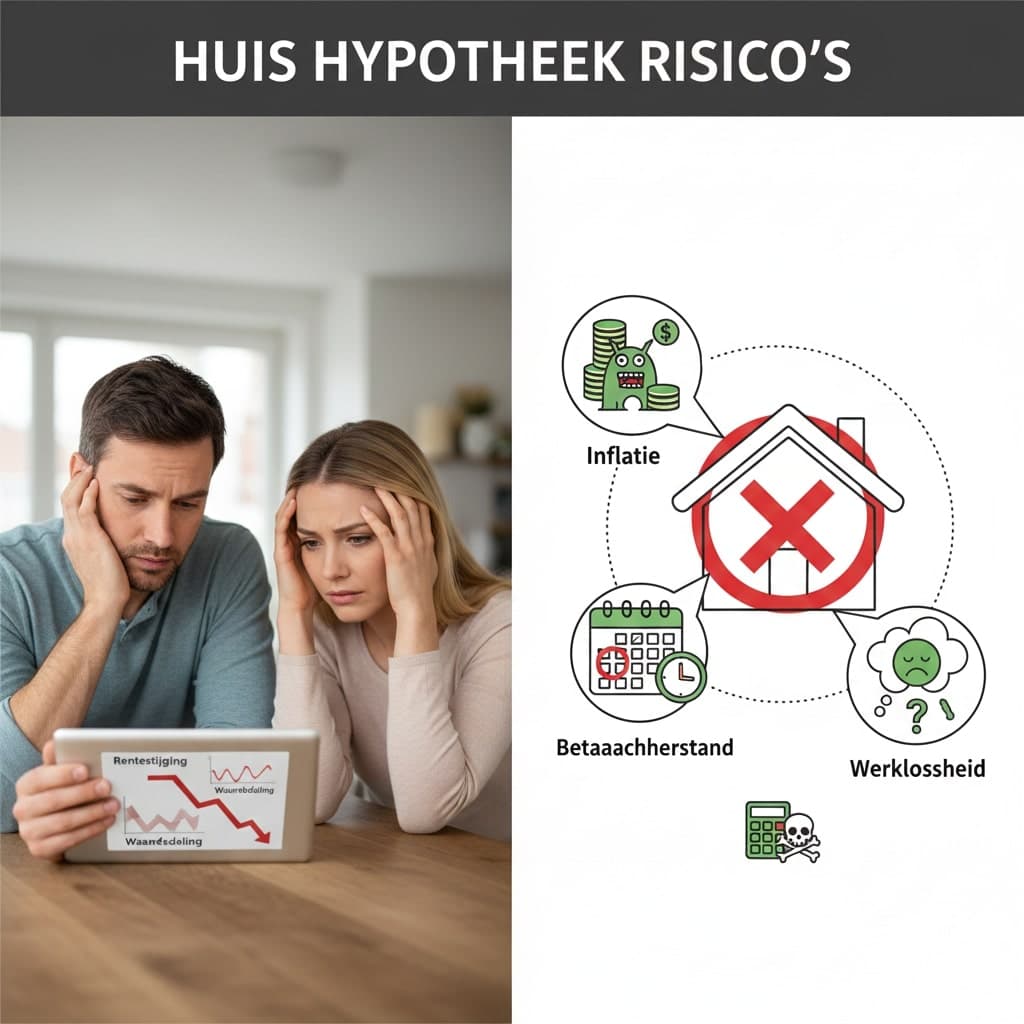
The Short Answer
Mortgage Risks = Real & Serious! Here Is What You Need To Watch Out For!
The Core Risks:
| Risk | Probability | Severity | Details |
|---|---|---|---|
| Interest Rate Rise | ⭐⭐⭐⭐ High | ⭐⭐⭐ | Monthly payment +€200-€400 |
| Loss of Income | ⭐⭐⭐⭐ High | ⭐⭐⭐⭐ Very High | Unemployment = unable to pay |
| Debt Trap | ⭐⭐⭐ Medium | ⭐⭐⭐⭐ Very High | House sold, debt remains |
| House Price Drop | ⭐⭐ Low | ⭐⭐ Medium | Negative equity |
| Family Problems | ⭐⭐⭐⭐ High | ⭐⭐⭐ | Divorce, inheritance |
| Rising Maintenance Costs | ⭐⭐⭐ Medium | ⭐⭐⭐ | EPC upgrades, repairs, energy bills |
| Default / Repossession | ⭐ Very Low | ⭐⭐⭐⭐⭐ Catastrophic | You Lose Your Home! |
This Article Explains All The Risks & Solutions!
1. What Are Mortgage Risks? - The Serious Stuff
The Basics
Mortgage Risk = Things That Can Go Wrong With Your Loan
✦ 100% free & No obligation
Sell your property with the best agent
Compare the top 3 agents in your region for free and save on commission.
Compare agents →Examples:
- Interest rates go up (you pay more)
- You lose your job (no income)
- House price falls (your debt exceeds the value)
- Maintenance costs spiral (EPC renovations, boiler, roof)
- You can no longer pay (bank takes the house)
Why Does This Matter?
A Mortgage Is Not Just Any Loan:
- It is a debt of usually €200,000+
- It can last 25-30 years
- Your home is collateral (the bank can take it!)
- It limits flexibility (you cannot just move)
- Belgian banks now apply stricter loan-to-value (LTV) rules - higher LTV = higher margin you pay
Consequences Of Getting It Wrong: You can lose your home AND still remain in debt!
Context (November 2026): Belgian mortgage volumes dropped sharply in 2023 when rates spiked. They have partially recovered since, but lenders are more cautious than ever. The average rate for a 25-year mortgage is currently around 4.0%, and any new rate movement hits variable-rate borrowers hard and fast. That makes risk management more important now than it was five years ago.
2. The Interest Rate Risk - What If Rates Rise?
The Scenario
Your Situation:
- Mortgage: €200,000
- Rate: 4.0% (Variable)
- Monthly Payment: €955/Month
- Term: 25 Years
What Could Happen (2026-2027):
- Rate rises to 5.0% (realistic scenario)
- Monthly payment rises to: €1,090/Month
- Difference: +€135/Month!
And worse:
- Rate rises to 6.0% (unlikely but possible)
- Monthly payment: €1,225/Month
- Difference: +€270/Month = +€3,240/Year!
Important context for November 2026: Many Belgian borrowers chose variable-rate products during the low-rate era of 2015-2021. A common Belgian product is an 8/3/3 variable rate - fixed for 8 years, then adjustable every 3 years. Borrowers who took those loans around 2018 are now entering their first reset window. If rates stay elevated, their payments reset upward automatically. Check your loan contract to know exactly when your next reset date falls.
Budget Impact
Family Example:
- Household Income: €3,500/Month
- Mortgage Now: €955 (27% Of Income = OK)
- Mortgage At 6%: €1,225 (35% Of Income = Stretched!)
Problem: They Have Less Money For:
- ❌ Food
- ❌ Children
- ❌ Healthcare
- ❌ Savings (Emergency Fund)
How To Protect Yourself
Solution 1: Fixed Rate (Best!)
- Take a fixed rate (not variable!)
- The rate never changes
- You always know what you pay
- Benefit: Complete security!
Solution 2: Interest Rate Buffer
- Keep monthly payment at or below 30% of income
- Not 35-40% (no buffer!)
- That way you have room if rates rise
Solution 3: Emergency Fund (6 Months)
- Set money aside (€5,000-€10,000)
- This is your safety net
- Can help in case of loss of income
Solution 4: Remortgage / Refinance
- If you are on a variable rate, explore switching to a fixed rate now
- Refinancing has a cost (dossier fees, penalty clause) but can save thousands over the remaining term
- Compare offers from at least three lenders before deciding
- A mortgage broker can do this comparison for you at no extra cost
3. The Income Risk - What If You Lose Your Job?
The Reality
This Can Happen:
- ❌ Getting made redundant
- ❌ Company closes down
- ❌ Long-term sick leave
- ❌ Partner unemployment
- ❌ Burnout or disability (often underestimated!)
Statistics: Approximately 5-10% of workers temporarily lose their job or income source each year. Burnout and long-term illness are rising steadily in Belgium and are now among the top causes of mortgage payment problems - more than pure unemployment in many cases.
Practical Impact
Scenario: You Are Made Redundant
Your Situation:
- Mortgage: €955/Month
- Unemployment benefit: €1,200/Month (about 80% of previous salary - Belgian rules cap this over time)
- Other costs: €800/Month (food, gas, water, etc.)
- Total needed: €1,755/Month
- You have: €1,200/Month
- Shortfall: -€555/Month!
Problem: You cannot pay the mortgage!
Consequences:
- ❌ Bank sends a reminder
- ❌ Debts grow (interest + penalties)
- ❌ After 3 months in default - house is sold
- ❌ Debt remains (you still pay!)
Note on Belgian unemployment rules: In Belgium, unemployment benefit is NOT unlimited. After the first year it typically steps down. If your job search drags on beyond 12-15 months, your monthly income from the benefit falls further, making the shortfall even larger. Plan for this drop from day one.
How To Protect Yourself
Solution 1: Payment Protection Insurance (Important!)
- This is an insurance that pays your mortgage if you become unemployed
- Usually covers 5-12 months
- Cost: €15-€40/Month
- Benefit: You are protected!
Caution: Ask exactly what is covered!
- Unemployment: ✅ Yes
- Long-term illness: ✅ Yes (sometimes)
- Burnout: ❓ Check! (Many policies exclude this - read the fine print)
- Disability: ❓ Check!
- Self-employment income loss: ❓ Often excluded - verify!
Solution 2: Emergency Fund (Essential!)
- 6-12 months of living costs
- €5,000-€15,000 minimum
- This gives you time if you become unemployed
- Prevents panic and default
Solution 3: Partner Income (Diversification)
- Make sure both partners can contribute
- Not 100% dependent on one person
- This halves your risk!
Solution 4: Keep Your Skills Marketable
- The faster you find a new job, the shorter the income gap
- Keep your CV updated and your professional network active
- A short gap = manageable with savings; a long gap = dangerous
4. The Debt Trap - Negative Equity
What Is This?
Debt Trap = You Owe More Than Your House Is Worth!
Example:
- You buy a house for: €250,000
- You borrow: €200,000
- You put in: €50,000 of your own money
Scenario: House Price Falls
- House is now worth: €220,000
- You owe: €195,000 (€5,000 repaid)
- No debt trap! Difference: €25,000 (this is OK)
Worse Scenario:
- House is now worth: €180,000
- You owe: €195,000
- You are in negative equity!
- You owe €15,000 more than the house is worth!
Consequences Of The Debt Trap
Situation: You Need To Move
- You want to sell the house
- House sells for: €180,000
- You owe: €195,000
- You pay €15,000 yourself!
- You do not have that money!
Worse: You Cannot Move!
- You are trapped in the house
- Moving is too expensive
- You must stay (even if you want to leave!)
Probability
Note: This is rare in Belgium!
- Belgian house prices have generally risen over the long term
- Debt traps only happen during crises or in specific local markets
- 2008 crisis: this happened (that is in the past)
- November 2026: Belgian property prices have stabilised after a correction period in 2023-2024 driven by higher rates - a full crash remains unlikely but a local price dip in certain regions is possible
Risk Assessment:
- Probability: ⭐⭐ Low
- Impact if it happens: ⭐⭐⭐⭐⭐ Catastrophic
How To Protect Yourself
Solution 1: Borrow Cautiously (Smart!)
- Do not borrow the maximum
- For example: 80% of property value
- Not 95% (too risky!)
- This gives you a buffer
Solution 2: Buffer Of 10-15%
- House purchase: €250,000
- You borrow: €200,000 (80%)
- You put in: €50,000 (20%)
- Buffer: If house falls to €235,000, you are still OK!
Solution 3: Repay Quickly!
- The more you repay, the less risk
- Extra repayments = avoiding the debt trap
- Priority: pay down debt fast!
5. The Hidden Risk - Rising Maintenance & Sustainability Costs
Why This Risk Is Growing In 2026
This risk barely appeared on most buyers' radar five years ago. It is now one of the fastest-growing financial pressures for Belgian homeowners and deserves its own section.
What Is Driving Costs Up?
- Belgian EPC (Energy Performance Certificate) legislation is tightening - homes with a poor EPC label face mandatory renovation targets
- Febelfin and the Belgian government have set out clear timelines: the housing stock needs to become significantly more sustainable by 2035-2050
- Banks are starting to factor EPC ratings into mortgage conditions - a low-rated home can mean a higher interest rate or a shorter loan term
- Energy prices remain volatile - a poorly insulated home can cost €2,000-€4,000/year more in energy bills than an efficient one
Practical Examples Of Unexpected Costs:
- Roof replacement: €8,000-€20,000
- Boiler replacement (to heat pump): €10,000-€18,000
- Wall/roof insulation: €5,000-€15,000
- Electrical rewiring (older homes): €5,000-€12,000
- Total for a full renovation: easily €40,000-€80,000 on top of your purchase price!
How To Protect Yourself
Solution 1: EPC Check Before You Buy
- Always check the EPC label of any property
- Labels D, E, F and G mean renovation costs are coming
- Factor these costs into your total budget - not just the purchase price
Solution 2: Technical Inspection
- Commission an independent technical survey (bouwkundige keuring) before signing
- This reveals hidden defects - roof leaks, damp, faulty wiring
- Cost: €300-€600 - money well spent
Solution 3: Renovation Reserve Fund
- Set aside €100-€200/month in a dedicated savings account from day one
- After 5 years you have €6,000-€12,000 available for major repairs
- This prevents an unexpected repair from destroying your finances
Solution 4: Renovation Loans & Subsidies
- Belgium offers subsidies (premies) for insulation, heat pumps and solar panels - check your regional government website
- Green renovation loans often carry lower interest rates than standard personal loans
- Plan renovations in phases so you do not need to finance everything at once
6. Default & Repossession - The Worst-Case Scenario
What Is Default?
Default = You Do Not Pay Your Mortgage (For More Than 3 Months)
What Happens Then:
| Stage | Timing | What The Bank Does |
|---|---|---|
| 1 Month Missed | Month 1 | Bank sends a reminder |
| 2-3 Months Missed | Month 2-3 | Bank sends a formal notice |
| More Than 3 Months | Month 4+ | Bank demands full repayment (entire loan!) |
| 6 Months | Month 6+ | Bank starts repossession proceedings |
| House Sold | Month 8-12 | Property goes to public auction! |
Consequences Of Default
For You:
- Credit Rating Destroyed
- You will get no more loans
- You cannot buy a home again easily
- This lasts 10 years!
- Your House Is Sold (At A Low Price!)
- Forced sale = always cheaper
- 20-40% below market value is normal
- You have no control
- You Still Have A Debt!
- House sold for: €180,000
- You owed: €200,000
- You pay: €20,000 out of pocket!
- This can take years to clear
- Legal Consequences
- Creditor agreement required
- Possible bankruptcy
- Seizure of assets
How Likely Is This?
Note: In Belgium - very rare!
- Default rate: below 0.5% (latest available data)
- This means: of 1,000 mortgages, fewer than 5 default!
- But: It can happen and you must prevent it!
How To Protect Yourself (Important!)
Solution 1: Pay Your Mortgage!
- This is the #1 priority
- Pay this before any luxury spending
- Never skip a month!
Solution 2: Payment Protection Insurance (Again!)
- Covers you if you cannot pay
- It pays the bank
- You pay the premium (€15-€40/Month)
- Benefit: Your home is safe!
Solution 3: Emergency Fund (Again!)
- 6-12 months of mortgage payments
- €5,700-€11,400 for a €955 mortgage
- This prevents default
- Priority: build this up quickly!
Solution 4: Talk To Your Bank!
- If you are in financial difficulty, speak directly to your bank
- Banks are willing to help (selling the house = a loss for them too)
- You can often defer payments temporarily
- Many banks have hardship programmes - ask about a "payment holiday" (betalingsuitstel)
- Do this EARLY - before you miss a payment, not after
Solution 5: Debt Mediation Service
- Every Belgian municipality has a OCMW/CPAS debt mediation service
- This is free and confidential
- They can negotiate with your bank on your behalf
- Do not wait until bailiffs are involved - contact them early
7. Family Problems - Divorce & Inheritance
Divorce
Scenario:
- You and your partner bought a home together
- Joint mortgage (€200,000)
- 10 years later: divorce!
- Problem: who pays the mortgage?
Consequences:
- ❌ Both are legally responsible for the full debt
- ❌ The house must be divided (sold or one partner buys the other out)
- ❌ Debts must be divided
- ❌ Disputes can last years!
- ❌ If one partner stops paying, the other partner's credit rating is also damaged
Important Belgian legal note: Even after a divorce, if both names are on the mortgage, both people remain liable to the bank. A divorce settlement between you and your ex does NOT automatically release one party from the bank's claim. You need the bank's explicit agreement to transfer or release the debt. This surprises many people - get legal advice from a notary before you separate.
Inheritance
Scenario:
- A parent dies, leaving a house
- The house still has a mortgage (€80,000 remaining)
- Problem: The children inherit the debt!
Consequences:
- ❌ You inherit the house (good!)
- ❌ You also inherit the debt (not so good!)
- ❌ You must take over the mortgage or sell the house
- ❌ Inheritance tax (erfbelasting/droits de succession) comes on top!
Note: In Belgium you have the right to refuse an inheritance (verwerping van erfenis) if the debts exceed the assets. Do not accept an inheritance automatically if you are unsure - consult a notary first.
How To Protect Yourself
For Divorce:
- Make sure you have a clear ownership agreement (through a notary) from the start
- Insure everything (payment protection insurance!)
- Put clear financial arrangements in place - what happens if you separate?
- Consider a cohabitation contract (samenlevingscontract) if unmarried
For Inheritance:
- Make sure the mortgage is covered (life insurance / schuldsaldoverzekering)
- Draw up a will (clearly!)
- Discuss debts with family openly (prevent conflict!)
- The schuldsaldoverzekering (outstanding balance insurance) pays off the remaining mortgage if you die - this is one of the most important insurances a Belgian homeowner can take
8. Checklist - How To Protect Yourself
Before You Apply For A Mortgage
- ☐ Calculate your debt-to-income ratio (max 33% for mortgage!)
- ☐ Build an emergency fund (6 months of costs)
- ☐ Ask for payment protection insurance
- ☐ Choose a fixed rate (not variable!)
- ☐ Do not over-borrow (max 80% of property value!)
- ☐ Check the EPC label and factor renovation costs into your budget
- ☐ Commission a technical inspection before signing
- ☐ Take out a schuldsaldoverzekering (outstanding balance insurance)
During Your Mortgage
- ☐ Pay your mortgage every month without exception
- ☐ Review your income/debt ratio every year
- ☐ Keep growing your emergency fund (extra payments!)
- ☐ Make extra repayments when you can (debt gone faster!)
- ☐ Keep your bank informed of life changes (divorce? Tell your bank!)
- ☐ Check your variable rate reset dates and refinance if it makes sense
- ☐ Build a renovation reserve fund (€100-€200/month)
Emergency Situation
- ☐ Illness / unemployment: call your bank immediately!
- ☐ Not paying: this makes the situation worse!
- ☐ Payment protection insurance: activate it!
- ☐ Creditor agreement: ask your bank about a payment holiday (betalingsuitstel)
- ☐ Professional help: contact your local OCMW/CPAS debt mediation service
- ☐ Legal help: consult a notary or legal aid service (juridische eerstelijnsbijstand)
9. Summary: Home Mortgage Risks
Core Risks:
- Interest Rate Risk (Level: ⭐⭐⭐⭐)
- Monthly payment can rise by +€200-€400
- Solution: fixed rate! Budget buffer! Refinance if needed!
- Income Risk (Level: ⭐⭐⭐⭐)
- Unemployment = unable to pay
- Solution: payment protection insurance! Emergency fund!
- Debt Trap (Level: ⭐⭐ In Belgium)
- Debt greater than property value
- Solution: borrow carefully (80%)! Buffer!
- Rising Maintenance & EPC Costs (Level: ⭐⭐⭐ Growing!)
- Unexpected repair bills + mandatory energy renovation costs
- Solution: check EPC before buying! Build a renovation reserve!
- Default & Repossession (Level: ⭐ Rare)
- House sold, debt remains
- Solution: pay your mortgage! Insurance! Communicate early!
- Family Problems (Level: ⭐⭐⭐)
- Divorce / inheritance complications
- Solution: clear agreements! Schuldsaldoverzekering! Notary advice!
10. Golden Rules - Core Wisdom
Rule 1: Mortgage ≤ 33% Of Gross Income
- Keep the home affordable
- Not 40% (too risky!)
Rule 2: Emergency Fund = 6-12 Months Of Costs
- This is your safety net
- Without it = risk!
Rule 3: Payment Protection Insurance Is Key
- Protects you in case of unemployment / illness
- Inexpensive! (€15-€40/Month)
- Do not skip it!
Rule 4: Fixed Rate (Not Variable!)
- No risk from rising rates
- You know what you pay
- Clarity = peace of mind!
Rule 5: Always Pay Your Mortgage!
- Mortgage = first priority
- Talk to your bank if there are problems!
- No silent default!
Rule 6: Always Check The EPC And Budget For Renovation
- A cheap house with a bad EPC is not actually cheap
- Add renovation costs to your total budget before you decide
- In November 2026 this is more important than ever given Belgian energy legislation timelines
Next Step
Want to minimise your mortgage risks?
- Calculate your debt-to-income ratio (max 33%)
- Build an emergency fund (6 months)
- Take out payment protection insurance and a schuldsaldoverzekering
- Choose a fixed rate
- Borrow carefully (max 80% of property value)
- Check the EPC label and budget for renovation costs
- Always pay your mortgage!
Good luck and make wise decisions with your mortgage!
Frequently asked questions
What are the biggest risks of a mortgage in Belgium?
The main risks are: interest rate rises (especially on variable-rate loans), loss of income through unemployment or illness, falling into a debt trap if house prices drop, unexpected maintenance and renovation costs (including EPC upgrades), default and repossession, and family events like divorce or inheritance that complicate joint debts.
What is a safe mortgage payment as a percentage of income in Belgium?
Belgian lenders and financial advisors generally recommend keeping your monthly mortgage payment at or below 33% of your gross household income. Payments above 35-40% leave very little financial buffer if rates rise or income drops.
What is the current mortgage interest rate in Belgium (2026)?
As of late 2026, the average interest rate for a 25-year fixed mortgage in Belgium is around 4.0%. Variable rates can be lower initially but carry the risk of resetting upward. Always compare at least three lenders before choosing.
What happens if I cannot pay my mortgage in Belgium?
If you miss payments, the bank first sends reminders. After 3 months in arrears the bank can demand full repayment of the entire outstanding loan. After 6 months, repossession proceedings can begin and the house may be sold at public auction. Even after the sale, if the proceeds do not cover the debt, you still owe the difference. Contact your bank immediately if you are struggling - most banks have hardship programmes and can offer a temporary payment deferral.
Is payment protection insurance worth it for a Belgian mortgage?
Yes, for most borrowers it is worth the cost. Payment protection insurance typically costs €15-€40 per month and covers your mortgage payments if you become unemployed or seriously ill. Always read the fine print carefully - burnout and self-employment income loss are often excluded from standard policies.
What is a schuldsaldoverzekering and do I need one in Belgium?
A schuldsaldoverzekering (outstanding balance insurance or mortgage life insurance) pays off the remaining mortgage balance if you die before the loan is repaid. This protects your family from inheriting the debt. It is not legally mandatory in Belgium but most banks require it as a condition of the loan. Even if your bank does not require it, taking one out is strongly recommended.
How does a poor EPC label affect my mortgage in Belgium?
In Belgium, EPC legislation is becoming stricter. Homes with a poor energy label (D, E, F or G) face mandatory renovation obligations in the coming years. Belgian banks are increasingly factoring EPC ratings into mortgage conditions - a low-rated property can result in a higher interest rate or shorter loan term. Before buying, always check the EPC label and include estimated renovation costs (insulation, heating system, etc.) in your total budget.
Can I refinance my Belgian mortgage to get a lower rate?
Yes, refinancing (or remortgaging) is possible in Belgium. You can switch from a variable to a fixed rate, or move to a new lender with a better deal. There are costs involved - a dossier fee and possibly a penalty clause (wedersamenstelling) - but refinancing can save thousands of euros over the remaining term if the new rate is significantly lower. Always compare at least three offers and consider using a mortgage broker.
What is negative equity and can it happen in Belgium?
Negative equity means you owe more on your mortgage than your home is currently worth. In Belgium this is relatively rare because property prices have risen over the long term, but it can happen during economic crises or in local markets with oversupply. The best protection is to borrow no more than 80% of the property value (LTV 80%) so you have a buffer if prices fall.
What should I do if I am going through a divorce and have a joint mortgage in Belgium?
A divorce does not automatically release either party from a joint mortgage. Both names remain liable to the bank until the bank formally agrees to a transfer or release. Options include: selling the property and splitting the proceeds, one partner buying the other out (which requires bank approval and a new mortgage assessment), or continuing to pay jointly until a solution is found. Always work with a notary and get written confirmation from your bank about any changes to the mortgage liability.
Follow us on Google
Pick Immomakelaar Vergelijker as a preferred source and you will see our articles more often in Google, including in AI answers.
Redactie ImmoMakelaarVergelijker
"We write about selling, valuing and costs in Belgium. Articles are drafted with the help of AI from official sources and checked by our team."