
How much can I borrow based on my salary in Belgium?

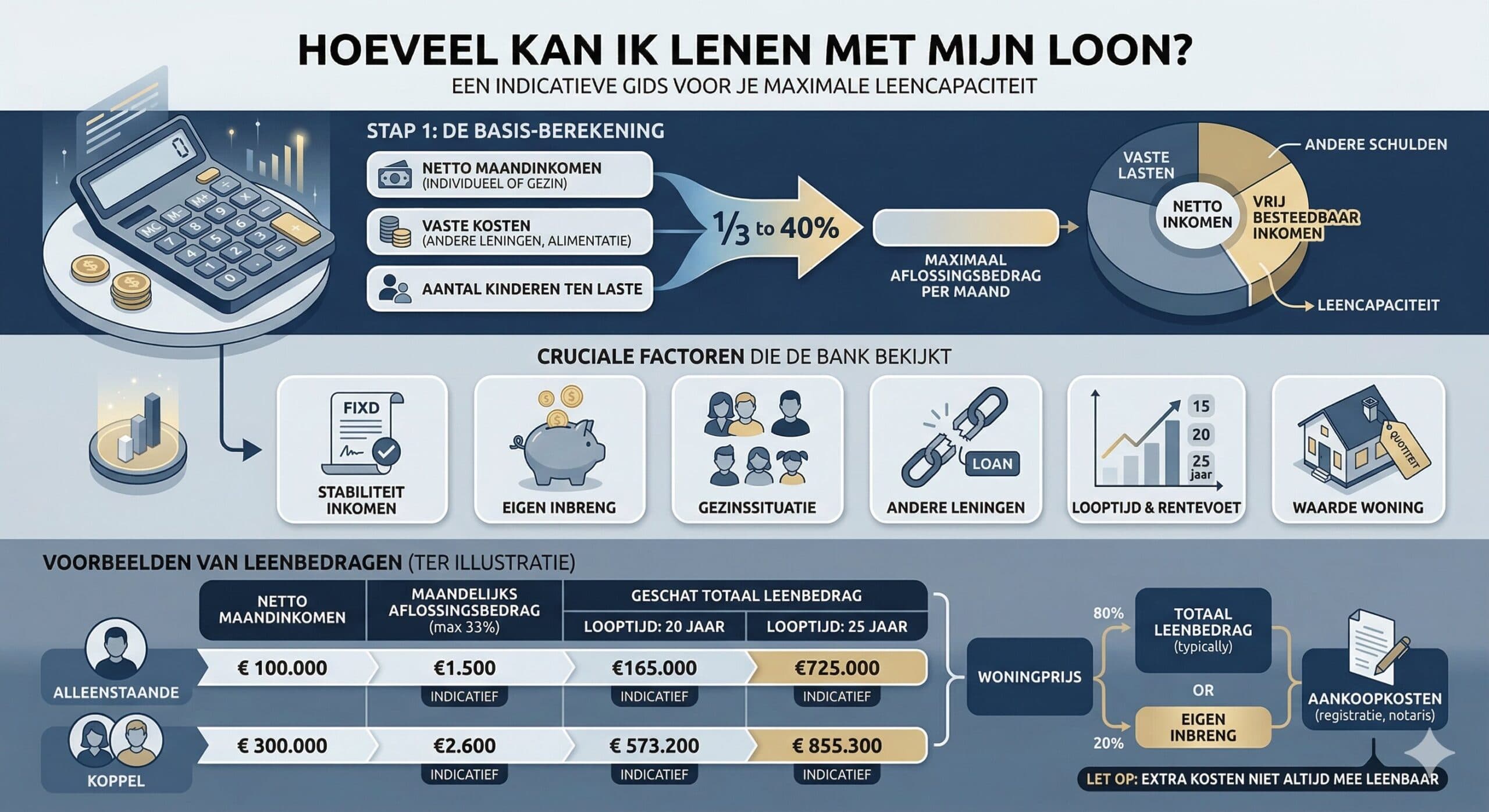
When you start making plans to buy a home, the first question is almost always: how much can I borrow based on my salary? Your salary, combined with your fixed costs and personal contribution, determines the maximum amount your bank will be willing to finance. Banks and credit brokers work with a number of rules of thumb: your total monthly repayments generally may not exceed 30-40% of your net household income, and in most cases the bank finances a maximum of 90% of the property value. In this guide we explain how this works and give concrete examples per income level.
1. The basics: how much of your salary can go towards loans?
The core question behind how much can I borrow based on my salary is: what share of your salary can go towards credit repayments without putting you in financial difficulty?
Sources and banks apply similar limits:
- NB Projects and other experts: 30-35% of your net household income as a safe limit for your mortgage.
- KBC Brussels: the total of your monthly credit obligations (all loans combined) should ideally not exceed 40% of your net income.
- Keytrade Bank: uses 45% of your net income as the upper limit for the monthly repayment in its examples, depending on your profile.
- Hypotheekwereld: banks generally apply a limit whereby your mortgage may amount to a maximum of 40-50% of your net income, with some margin for strong files.
- Defa mortgage brokers: amortisations up to 40% of net income are commonly allowed, which broadly corresponds to a loan of roughly €300,000 over 20 years for a profile at that ceiling.
Lenders also look at a minimum living allowance: what you have left after all repayments to cover daily living costs. As a general benchmark, this is around €1,000 for a single person and around €1,200 for a couple, with an additional amount per dependent child. Banks check this minimum remaining income independently of the percentage rule - both conditions must be satisfied simultaneously.
In practice, this comes down to the following.
✦ 100% free & No obligation
Sell your property with the best agent
Compare the top 3 agents in your region for free and save on commission.
Compare agents →- Conservative approach: aim for 30-35% of your net income.
- Slightly more ambitious approach (strong profile, no other debts): up to 40-45%.
Why two different tests matter
The percentage rule and the minimum living allowance can give different results depending on your income level. For a household earning €2,500 net per month, 35% equals €875 - but after paying €875 in mortgage and covering other fixed costs, the remaining budget may fall below the bank's minimum living allowance threshold. This is why lower-income files are sometimes declined even when the percentage ratio looks acceptable on paper. Conversely, a high-income household may be able to allocate 40% to repayments and still have far more than the minimum living allowance left over, giving the bank additional comfort.
How different banks weigh up your file
It is worth understanding that each Belgian bank has its own internal scoring model, and the 40% ceiling is not a rigid legal maximum - it is a widely used guideline. In practice, the outcome for any individual file depends on several factors beyond salary:
- Employment type: civil servants and employees on permanent contracts are generally viewed more favourably than self-employed borrowers or those on fixed-term contracts. Self-employed applicants typically need to show at least three years of stable, rising income based on their tax returns.
- Credit history: any defaults or late payments registered at the National Bank of Belgium's Central Individual Credit Register (CKP/CCP) will be flagged and can lead to a refusal regardless of current income.
- Age at end of loan: most Belgian banks prefer that the mortgage is repaid before the borrower reaches 75-80 years of age. Older applicants may therefore be offered shorter terms, which increases the monthly repayment and reduces the maximum loan amount relative to their salary.
- Number of dependants: each dependent child typically increases the minimum living allowance threshold by €200-€300 per month, reducing your available mortgage budget accordingly.
- Other assets: if you own other property or have significant savings above the required personal contribution, some lenders will view your file more positively, even if the income ratio is on the higher side.
Because of this variability, comparing offers from at least two or three lenders - or working with an independent mortgage broker - often yields meaningfully different results for the same applicant.
2. Loan-to-value: what percentage of the property can you borrow?
Alongside your salary, the loan-to-value ratio (the relationship between the loan amount and the value of the property) also plays a role in how much you can borrow.
Guidelines from the National Bank of Belgium and commercial banks:
- Most banks finance a maximum of 90% of the property value for an owner-occupied home.
- For first-time buyers, a limited share of files may go up to 100% (sometimes slightly more to cover costs, but this is the exception and subject to strict conditions).
- For investment properties, banks typically finance a maximum of 80% of the value.
Concretely: if you buy a property for €300,000, you can in most cases borrow up to approximately €270,000 (90%), and you must finance the remainder plus costs from your own resources.
What does hypotheekwinkel.be say about costs?
According to hypotheekwinkel.be (updated April 2026), there is technically no hard ceiling on the loan amount itself - what ultimately limits you is your income and repayment capacity. On the costs side, their guidance remains consistent with the broader market: assume roughly 10% of the purchase price as a working estimate for transaction costs (registration duties, notary fees, bank charges). So for a property at €300,000, budget around €30,000 on top for costs. This 10% estimate is a conservative average; in Flanders the reduced registration duty rate of 2% for an only own home (in force since 2025) and the Walloon rate of 3% for an only own home (also since 2025) can bring total costs down somewhat, while in Brussels the 12.5% registration duty applies, with the first €200,000 exempt for an only own home priced at most €600,000.
How the loan-to-value ratio affects your interest rate
The LTV ratio does not only determine whether a bank will lend to you - it also directly influences the interest rate you are offered. Borrowers at 80% LTV or below typically receive better rates than those at 90% LTV, because the lender carries less risk. In practical terms, if you can bring a larger personal contribution and push your LTV below 80%, you may qualify for a rate that is 0.1-0.3 percentage points lower. On a loan of €300,000 over 25 years, even 0.2 percentage points translates to a saving of several thousand euros in total interest. This makes it worth calculating whether temporarily delaying your purchase to save an additional buffer is financially worthwhile.
Interest rates in September 2026
The interest rate environment has a direct bearing on how much you can borrow at a given repayment level. According to market data from pavimmo.be (June 2026), fixed mortgage rates in Belgium are currently running at roughly 3.2% to 3.7% for standard owner-occupied loans, depending on the lender, the loan-to-value ratio and the loan term. The Brussels Housing Fund offers fixed rates of between 3.25% and 5% for eligible borrowers (rates vary depending on household composition and income level), which can be advantageous for lower-income buyers purchasing in the Brussels-Capital Region. Rates are meaningfully lower than the peaks seen in late 2023 and into 2024, which gives buyers somewhat more borrowing capacity per euro of monthly repayment compared with two years ago. The examples below use a rate range of 3.2%-3.7% as the current realistic benchmark.
3. How much can I borrow based on my salary? Worked examples
The examples below assume "standard" files (no heavy additional loans, normal term and interest rate at mid-2026 levels). They are intended as a rough guide, not as precise bank decisions.
Example 1: Single person, net income €2,500/month
Rules of thumb:
- 30% of €2,500 = €750
- 35% of €2,500 = €875
- 40% of €2,500 = €1,000
Online mortgage simulations show that with a monthly repayment of around €800-€950 (keeping within the 30-38% band), a term of 25-30 years and a fixed rate of around 3.2-3.7%, you can support a loan of roughly €175,000-€230,000. At a 25-year term and 3.5%, a monthly repayment of €900 corresponds to a loan of approximately €185,000-€190,000.
Bear in mind the minimum living allowance test: after paying €875-€900 in mortgage, a single person on €2,500 net has roughly €1,600 left. Once other fixed costs (utilities, insurance, food, transport) are deducted, this is generally workable but leaves limited margin. Banks will scrutinise the full budget carefully at this income level.
Indicative purchase price: with a loan of €190,000 and a 10% personal contribution on the purchase price, the property value would be around €211,000. With 20% own funds, the same loan could support a property at around €237,000 - but then costs must also be covered from savings.
Practical note for single buyers: at this income level, the type of property matters as much as the price. A flat with a low co-ownership charge (syndic costs) leaves more room in the monthly budget than a house with high energy costs or maintenance needs. Banks increasingly ask about expected running costs for the property, particularly for older buildings that may require significant renovation. If you are buying a property that needs work, factor renovation loan repayments into your total credit ratio from the outset.
Example 2: Couple, combined net income €4,000/month
NB Projects indicates: with an average net household income of €4,000, your maximum loan is around €320,000-€350,000, depending on the interest rate and term.
Rules of thumb:
- 30% of €4,000 = €1,200
- 35% of €4,000 = €1,400
- 40% of €4,000 = €1,600
With a monthly repayment of €1,300-€1,600, a term of 25-30 years and current rates of around 3.2-3.7%, you will find yourself in practice within the range of €310,000-€375,000 in borrowing capacity. The upper end of that range requires a clean file with no other significant debts.
Indicative purchase price: a loan of €330,000 with 10% own funds corresponds to a property at approximately €367,000. With 20% own funds on top of the loan, the same household could look at properties around €412,000, provided the savings also cover transaction costs.
What changes if one partner earns significantly more than the other? Banks look at the combined net income, but they also consider the risk profile of each borrower individually. If one partner earns €3,000 and the other €1,000, the bank may apply more caution than for two partners each earning €2,000 - particularly if the lower-earning partner is on a fixed-term contract or self-employed. In such cases, it is worth asking the bank how they would assess the file if the lower earner's income were disregarded entirely, as a stress test for job loss.
Example 3: Couple, combined net income €5,000/month
Rules of thumb:
- 30% of €5,000 = €1,500
- 35% of €5,000 = €1,750
- 40% of €5,000 = €2,000
Simulations show that a couple with such a monthly budget can often borrow between €370,000 and €470,000, depending on the interest rate, term and whether other loans are running concurrently. At a 30-year term and 3.5%, a monthly repayment of €1,750 corresponds to a loan of roughly €395,000-€400,000.
Indicative purchase price: a loan of €400,000 with 10% personal contribution points to a property at around €444,000. With 20% own funds, the same loan could reach a property valued at around €500,000 - though transaction costs on a property at that level are substantial and must also be budgeted.
Important: if you already have existing loans (car loan, personal loan, credit card), these are factored into your total credit ratio. This reduces your maximum mortgage amount accordingly. A car loan with a monthly repayment of €250, for instance, directly eats into the 40% ceiling and can reduce your available mortgage budget by €50,000 or more over a long term.
Example 4: Single person, net income €3,500/month
This income level comes up frequently among higher-earning individual buyers - senior employees, mid-career professionals or single parents with good stable income. Rules of thumb:
- 30% of €3,500 = €1,050
- 35% of €3,500 = €1,225
- 40% of €3,500 = €1,400
With a repayment of €1,100-€1,300 and a 25-30 year term at current rates, a borrowing capacity of roughly €250,000-€310,000 is realistic. The minimum living allowance is less of a binding constraint at this income level for a single person: after €1,200 in mortgage repayment, roughly €2,300 remains, which is well above the €1,000 threshold even after fixed costs. This gives the bank more comfort and makes approval more straightforward, provided the file is otherwise clean.
Indicative purchase price: a loan of €270,000 with 10% own funds corresponds to a property at approximately €300,000. That budget opens up a reasonable range of properties in most Belgian cities outside the most expensive central districts of Brussels and Antwerp.
Quick reference table: salary to borrowing capacity (September 2026 rates, 3.2-3.7%)
| Net household income | 35% monthly budget | Indicative loan (25 yr) | Indicative loan (30 yr) |
|---|---|---|---|
| €2,000 | €700 | €140,000-€155,000 | €155,000-€170,000 |
| €2,500 | €875 | €175,000-€190,000 | €195,000-€215,000 |
| €3,000 | €1,050 | €210,000-€230,000 | €230,000-€255,000 |
| €3,500 | €1,225 | €245,000-€270,000 | €270,000-€300,000 |
| €4,000 | €1,400 | €280,000-€310,000 | €310,000-€345,000 |
| €5,000 | €1,750 | €350,000-€385,000 | €390,000-€430,000 |
| €6,000 | €2,100 | €420,000-€460,000 | €465,000-€515,000 |
Figures are indicative only, based on a fixed rate of approximately 3.2-3.7%, no other outstanding credit, and the 35% income rule. Actual bank decisions depend on your full financial profile.
4. The impact of term and interest rate
With the same salary, you can borrow more or less depending on:
- the loan term (20 vs 25 vs 30 years);
- the interest rate (2.8% vs 4.5%, fixed or variable).
A longer term reduces your monthly repayment, allowing you to borrow more at the same income limit; but you pay more interest in total. Rate simulations from banks and comparison websites show that interest rate changes of one percentage point can easily shift your maximum borrowing capacity by tens of thousands of euros.
Concrete illustration
Take a monthly repayment budget of €1,400 and compare three scenarios:
- 20-year term at 3.5%: loan of roughly €240,000
- 25-year term at 3.5%: loan of roughly €290,000
- 30-year term at 3.5%: loan of roughly €325,000
That is an €85,000 difference in borrowing capacity purely from extending the term by 10 years - without changing your income or the interest rate. The trade-off is total interest paid: on a 30-year loan you will pay significantly more interest in absolute terms than on a 20-year loan, even though the monthly cost is lower.
Total interest cost: a figure worth knowing
Many buyers focus on the monthly repayment and lose sight of what they pay in total over the life of the loan. Here is a comparison for a €300,000 loan at 3.5%:
- 20-year term: monthly repayment approximately €1,739 - total repaid approximately €417,000 - total interest approximately €117,000
- 25-year term: monthly repayment approximately €1,500 - total repaid approximately €450,000 - total interest approximately €150,000
- 30-year term: monthly repayment approximately €1,347 - total repaid approximately €485,000 - total interest approximately €185,000
The 30-year borrower pays roughly €68,000 more in interest than the 20-year borrower on an identical loan amount. Whether that trade-off is worth making depends on what you do with the €392 per month saved on the shorter term - if that money goes into savings or investments, the net position may look different. But if it simply increases monthly spending, the cheaper monthly repayment of the longer term comes at a real cost.
Fixed vs variable rate
Belgian banks offer both fixed and variable (adjustable) rate mortgages. With a variable rate, the initial repayment is often lower, which can increase your calculated borrowing capacity at the moment of application. However, banks stress-test variable rate applications at a higher rate to protect against future increases, so the actual approved amount may be more conservative than the headline figure suggests. The most common variable product in Belgium is the so-called "5-5-5" formula, where the rate is reviewed every five years and cannot increase by more than 5 percentage points above the initial rate over the full term. For most first-time buyers in Belgium, a fixed rate provides more predictability and is currently preferred by the majority of applicants, particularly given that fixed rates in September 2026 remain at levels that are historically moderate.
5. Personal contribution: how much do you need?
Alongside the question of how much can I borrow based on my salary, there is another one: how much do I need to put in myself?
Guidelines:
- Banks generally expect at least 10% personal contribution on the purchase price (the bank typically finances a maximum of 90%).
- In practice, 20% of your own funds is often healthier, as it also allows you to cover part of the costs (registration duties, notary fees, bank charges) from your savings.
Immomakelaarvergelijker sums it up: banks standardly finance a maximum of 90% of the property value; you contribute the difference plus the costs.
Breaking down the costs: what do you actually need in savings?
For a property at €300,000, here is a realistic breakdown of what you need to bring to the table in September 2026:
- Own contribution (10% of purchase price): €30,000
- Registration duties: €6,000-€37,500 depending on region and whether own-home reductions apply (2% in Flanders and 3% in Wallonia for an only own home since 2025; 12.5% in Brussels with the first €200,000 exempt for an only own home priced at most €600,000; 12% or 12.5% for other purchases)
- Notary fees: approximately €3,000-€5,000
- Bank charges and mortgage deed: approximately €2,000-€3,500
- Total minimum savings needed (Flanders or Wallonia, only own home): roughly €41,000-€48,000
- Total minimum savings needed (12.5% rate without reductions, e.g. a second home): roughly €70,000-€80,000
This is why many advisers recommend having at least 20% of the purchase price saved before you start house-hunting seriously - that buffer absorbs both the own contribution and the bulk of the transaction costs.
Regional differences in registration duties matter more than many buyers realise
The gap between Flanders (2% for an only own home) and Wallonia (3% for an only own home) is small - on a €300,000 purchase it amounts to €3,000. Brussels keeps the 12.5% rate, but exempts the first €200,000 for an only own home priced at most €600,000, so the same purchase costs €12,500 in registration duties there. For a second home or an investment you pay 12% in Flanders and 12.5% in Wallonia and Brussels, which is €36,000 or €37,500 on a €300,000 purchase. These regional rules change periodically, so it is worth verifying the current position with a notary before you commit to a budget. The registration duty is not something you can borrow - it must come from your own savings.
Can you borrow without any personal contribution?
Technically possible in limited cases: some lenders will consider a 100% loan (or even slightly above 100% to cover costs) for borrowers with a very strong income, stable employment and no other debts. However, since the National Bank of Belgium tightened its macroprudential guidance, these files are rare and face very close scrutiny. A Reddit discussion (r/belgium) from 2024 echoes what advisers say in practice: most buyers in Belgium are expected to bring at least 20% of the total amount needed (purchase price plus costs) from their own savings.
Gifts and family loans as own contribution
Belgian banks generally accept funds received as a gift from parents or family members as part of the personal contribution, provided they are documented - typically through a bank statement showing the transfer and, ideally, a gift declaration. A formal family loan is treated differently: if repayments are expected, the bank may count it as an existing debt and factor the monthly repayment into your total credit ratio. If it is a gift with no expectation of repayment, most banks accept it as equivalent to savings. It is worth clarifying this with your bank before assuming a gift will be treated as free capital.
6. Quick steps to estimate your own maximum
Want to make an estimate in 5 minutes of how much you can borrow based on your salary:
- Calculate your net household income per month. Include only stable, recurring income - salary, guaranteed bonuses, rental income if declared. Avoid counting one-off payments.
- Take 30-35% of that amount as the target monthly repayment for your mortgage (40% if you want to calculate on the higher side and you have no other loans running).
- Use an online mortgage simulator (from ING, KBC, Keytrade or an independent provider) and enter this monthly repayment to see which loan amount corresponds to that repayment, for terms of 20, 25 or 30 years.
- Check whether you have sufficient personal contribution to reach the purchase price plus costs within the loan-to-value limit (generally a maximum of 90%).
- Apply the minimum living allowance check: subtract the estimated mortgage repayment from your net income, then deduct your known fixed monthly costs (rent until you move, car costs, existing loans, insurance, subscriptions). The remainder should comfortably exceed €1,000 for a single person or €1,200 for a couple - if it does not, a bank will likely ask you to reduce the loan amount.
- If you have existing credit, subtract those monthly repayments first from your 40% ceiling before calculating your mortgage budget.
This gives you an initial framework to search for properties in the right price range, before sitting down in detail with a bank or mortgage broker.
One step further: approach multiple lenders
The estimate you arrive at through the steps above is a starting point, not a final answer. Banks can differ by €20,000-€50,000 or more in the loan amount they are willing to approve for the same applicant, because their internal models, risk appetites and current commercial priorities vary. In September 2026, some banks are actively competing for mortgage business and may apply more generous assessments than they did in 2022-2023 when rates were rising sharply. Comparing at least two or three offers - either directly or through a mortgage broker who can access multiple lenders simultaneously - is the most reliable way to find your actual maximum and the best rate available to you.
7. Frequently asked questions
How much can I borrow with a net salary of €2,000 per month?
At €2,000 net per month, applying the 35% rule gives you a monthly mortgage budget of around €700. At current rates (3.2-3.7%) and a 25-year term, that corresponds to a loan of roughly €140,000-€155,000. Over 30 years, the same budget supports approximately €155,000-€170,000. The minimum living allowance is likely to be the binding constraint at this income level: after paying €700 in mortgage, a single person has €1,300 left, which is workable but leaves very little margin once fixed costs are covered. Banks will assess the file carefully.
How much can I borrow with a net salary of €3,000 per month?
At €3,000 net per month, 35% gives a monthly budget of €1,050. At current rates over 25 years, this supports a loan of approximately €210,000-€230,000; over 30 years, roughly €230,000-€255,000. The minimum living allowance is less of a constraint at this income: after €1,050 in mortgage, €1,950 remains, which is above the threshold for either a single person or a couple. A clean file with no other debts and a standard employment contract should generally proceed without difficulty in this range.
Does my gross salary or net salary determine how much I can borrow?
Belgian banks work with net income - the amount that actually arrives in your bank account each month after tax and social security contributions. Gross salary is not the relevant figure for mortgage calculations. If you have variable income components such as performance bonuses, most banks will only count those if they are contractually guaranteed or have been paid consistently for at least two years, and even then they may apply a discount (for example, counting only 75% of average bonus income). Rental income from property you already own is often counted, provided it is declared and verifiable.
What happens to my maximum loan if I already have a car loan?
Existing credit repayments are included in your total monthly credit obligations. If the bank applies a 40% ceiling and your car loan already costs €300 per month, that €300 comes directly off the amount available for mortgage repayment. On a net income of €3,500, the 40% ceiling is €1,400 - minus €300 for the car loan leaves only €1,100 for the mortgage. At current rates over 25 years, €1,100 supports a loan of roughly €220,000 rather than the €275,000 you could otherwise borrow. Over the full term, a single car loan can therefore reduce your property budget by €50,000-€80,000.
Can a self-employed person borrow as much as an employee?
In theory yes - banks look at income level and stability rather than employment status. In practice, self-employed borrowers face a higher bar: most Belgian banks require three years of tax returns showing stable or growing income, and they base the calculation on the net taxable income from those returns rather than on turnover or gross earnings. If your most recent year shows a dip in income, the bank may use the average of the three years or the lowest year as the reference figure. Having your accounts in good order and ideally working with an accountant who can present the file clearly makes a significant difference.
How much do I need in savings before I can buy a home in Belgium?
As a general rule, you need savings equal to at least 10% of the purchase price (own contribution) plus the transaction costs. In Flanders, for an only own home at €300,000, total costs including registration duties at 2%, notary fees and bank charges come to roughly €11,000-€15,000. That puts the minimum savings needed at around €41,000-€45,000. In Wallonia, where the rate for an only own home is 3%, add about €3,000. In Brussels, the first €200,000 is exempt for an only own home priced at most €600,000, so registration duties come to €12,500. Where the full 12.5% rate applies, for example for a second home, the same purchase requires roughly €70,000-€80,000 in savings. Having 20% of the purchase price in savings before you start looking is a widely recommended minimum, as it gives you a comfortable buffer and may also improve the interest rate you are offered.
Does a longer loan term increase or decrease the total amount I pay?
A longer term reduces your monthly repayment but increases the total amount you pay over the life of the loan. On a €300,000 loan at 3.5%, a 20-year term costs approximately €117,000 in total interest; a 30-year term costs approximately €185,000 - a difference of around €68,000. The monthly saving of roughly €392 between the 20-year and 30-year options is real, but so is the additional interest cost. Many buyers choose a longer term to stay within the income ratio limits while keeping their monthly budget manageable, and then make voluntary early repayments when their income grows - Belgian law allows partial early repayment, though some lenders charge an indemnity (typically capped at three months' interest on the amount repaid early).
Is there a maximum age to take out a mortgage in Belgium?
There is no legal maximum age, but most Belgian banks apply a practical limit: they prefer the loan to be fully repaid before the borrower reaches 75-80 years of age. This means that if you are 55 and want a 30-year mortgage, some banks may not approve the full term and will propose a 20-25 year term instead - which increases the monthly repayment and reduces the maximum loan amount relative to your income. Older buyers who own other assets or property may find that some lenders are more flexible, but this varies significantly by institution.
Frequently asked questions
How much can I borrow with a net salary of €2,000 per month in Belgium?
At €2,000 net per month, applying the 35% rule gives a monthly mortgage budget of around €700. At current Belgian mortgage rates (3.2-3.7%) and a 25-year term, that corresponds to a loan of roughly €140,000-€155,000. Over 30 years, the same budget supports approximately €155,000-€170,000. The minimum living allowance is likely to be the binding constraint at this income level, so banks will assess the full budget carefully.
How much can I borrow with a net salary of €3,000 per month in Belgium?
At €3,000 net per month, 35% gives a monthly mortgage budget of €1,050. At current rates over 25 years, this supports a loan of approximately €210,000-€230,000; over 30 years, roughly €230,000-€255,000. A clean file with no other debts and stable employment should generally proceed without difficulty in this range.
Do Belgian banks use gross or net salary to calculate how much you can borrow?
Belgian banks work with net income - the amount that arrives in your bank account each month after tax and social security contributions. Gross salary is not the relevant figure for mortgage calculations. Variable income such as bonuses is typically only counted if contractually guaranteed or paid consistently over at least two years, and often at a discount.
How much of my salary can go towards my mortgage in Belgium?
The widely applied rule is that all monthly credit obligations combined should not exceed 40% of your net household income. For the mortgage alone, most advisers recommend targeting 30-35% as a safe limit. Banks also apply a minimum living allowance test: after all repayments, you should have at least €1,000 left per month as a single person, or €1,200 as a couple, before other costs are deducted. Both the percentage rule and the living allowance test must be satisfied simultaneously.
How much savings do I need before buying a home in Belgium?
You typically need savings covering at least 10% of the purchase price as a personal contribution, plus transaction costs. For your only own home at €300,000, registration duties are €6,000 in Flanders (2%), €9,000 in Wallonia (3%) and €12,500 in Brussels (12.5% after the €200,000 abatement, available up to a price of €600,000). With notary fees and bank charges on top, that brings minimum savings to roughly €40,000-€50,000. If the property is not your only own home, duties rise to 12% (Flanders) or 12.5% (Wallonia and Brussels) and you need roughly €70,000-€80,000. Having 20% of the purchase price saved is the widely recommended minimum.
Does having a car loan reduce how much mortgage I can get in Belgium?
Yes. Existing loan repayments count towards your total monthly credit obligations. If a bank applies a 40% ceiling and your car loan costs €300 per month, that amount is deducted from your available mortgage budget. On a net income of €3,500, this can reduce your maximum loan by €50,000-€80,000 depending on the term and interest rate.
What loan-to-value ratio do Belgian banks apply for mortgages?
Most Belgian banks finance a maximum of 90% of the property value for an owner-occupied home. This means you must cover at least 10% of the purchase price from your own savings, plus transaction costs. For investment properties, the maximum is typically 80%. In exceptional cases, first-time buyers with a very strong file may access 100% financing, but this is rare and subject to strict conditions.
Does a longer mortgage term increase the total cost of the loan?
Yes. A longer term reduces your monthly repayment but increases the total interest paid over the life of the loan. On a €300,000 loan at 3.5%, a 20-year term costs approximately €117,000 in total interest, while a 30-year term costs approximately €185,000 - a difference of around €68,000. Many buyers choose a longer term to keep monthly repayments within the income ratio limits, and then make voluntary early repayments when their income grows.
What are current mortgage interest rates in Belgium in 2026?
As of mid-2026, fixed mortgage rates in Belgium are running at roughly 3.2% to 3.7% for standard owner-occupied loans, depending on the lender, loan-to-value ratio and term. The Brussels Housing Fund offers fixed rates between 3.25% and 5% for eligible borrowers in the Brussels-Capital Region. These rates are meaningfully lower than the peaks seen in late 2023 and into 2024.
Can a self-employed person borrow as much as an employee for a Belgian mortgage?
In principle yes, but self-employed borrowers face a higher bar in practice. Most Belgian banks require three years of tax returns showing stable or growing net taxable income. If income has dipped in a recent year, the bank may use the average of the three years or the lowest year as the reference figure. Having well-organised accounts and a clear file presentation significantly helps.
"Real estate expert focused on quality control and strategic partnerships."