
How much can you borrow for a house in Belgium? Rules of thumb and examples

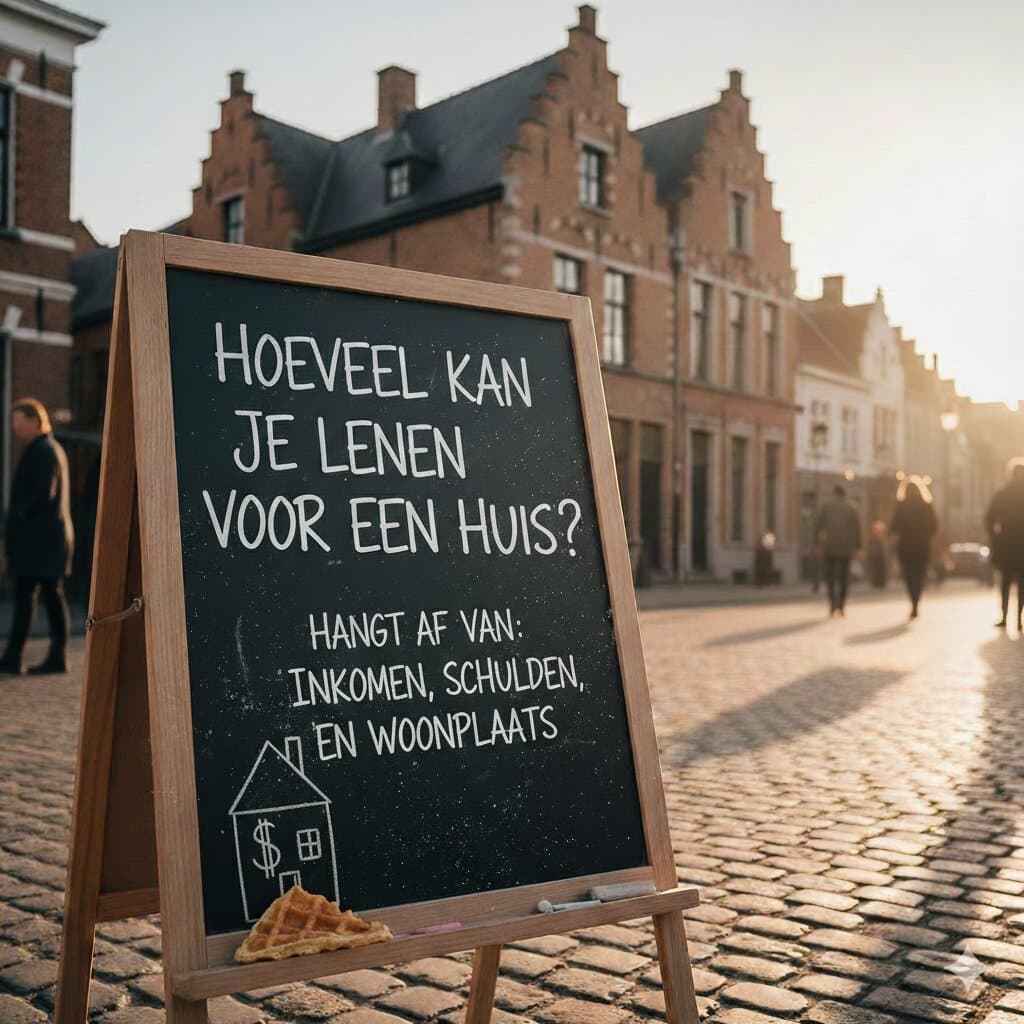
In Belgium in 2026, you can generally borrow a maximum of 90% of the property value for your primary residence, and in practice most buyers fall around 80 to 90%.
- Standard rule: banks typically finance up to 90% of the property value; you must cover the difference yourself, plus registration duties and notary fees.
- First-time buyers can, in certain cases, borrow more than 90% (sometimes up to 100% of the purchase price), but this is an exception subject to strict screening, not the norm.
- Your final borrowing capacity also depends on factors such as your gross income, fixed expenses, family situation and the current 2026 lending standards; banks use simulations to determine how much mortgage, interest rate and monthly repayment fits your profile.
1. Basic rule: the maximum percentage of the property value
1.1 National guideline (90% loan-to-value ratio)
The National Bank of Belgium asks banks to keep loan-to-value ratios restricted for mortgage loans on primary residences:
- For the majority of cases: a maximum of 90% of the property value is financed.
- For first-time buyers, a small portion of the portfolio may exceed 90% (sometimes even 100%, with stricter tests and limited quotas).
- Interest rates and loan terms are kept at healthy levels in order to ensure a solid maximum mortgage in any case.
In practice, for a property worth €300,000, you can generally borrow up to around €270,000, and you must finance the remainder - plus costs - from your own funds.
1.2 Why are 100% loans rarely the norm?
Banks have received signals to seek better risk diversification, so that the vast majority of cases remain around an 80 to 90% borrowing capacity.
A high loan-to-value ratio means a greater risk of over-indebtedness if rates rise or income falls; as a result, 100% loans are:
- Only permitted in limited cases (first-time buyers, specialised products).
- Always subject to stricter testing of income and fixed expenses.
2. How much can you personally borrow?
Your personal borrowing capacity in 2026 depends mainly on the factors below.
✦ 100% free & No obligation
Sell your property with the best agent
Compare the top 3 agents in your region for free and save on commission.
Compare agents →- Your income and recurring fixed charges.
- Whether or not you already have other loans outstanding.
- Number of dependent children and your family situation.
- Desired fixed-rate period and loan term.
- The bank's internal lending standards for 2026 (DSTI threshold around 35 to 36%).
Banks simulate your situation using:
- A stress-test rate for the DSTI calculation.
- The maximum percentage of monthly income that can go towards repayments.
- Your own contribution percentage and loan-to-value ratio.
The result: an estimated maximum mortgage amount plus the corresponding monthly repayment. Online simulation tools and options from brokers and banks let you see what your "budget" is in just a few minutes.
3. Calculation examples - how much can you borrow?
3.1 Property worth €250,000 - a typical budget purchase
- Property value: €250,000.
- Standard loan-to-value: max. 90% = €225,000 mortgage.
- Own contribution: at least the difference of €25,000, plus registration duties and notary fees (about €9,400 for an only own home in Flanders, €10,600 in Brussels or €11,900 in Wallonia, but about €34,000 to €36,000 at the standard rate), bringing the total own funds needed to approximately €34,000 to €37,000 for an only own home.
In a well-balanced scenario:
- Mortgage: €225,000 for a standard purchase.
- Own contribution: €25,000 + costs of approximately €9,400 to €11,900 for an only own home - very achievable for an average household with a stable income.
3.2 Property worth €350,000 - first-time buyer case (variants)
- Property value: €350,000.
- Standard case: max. 90% = €315,000 mortgage.
- Own contribution: the remaining €35,000 plus notary fees and registration duties (for an only own home €7,000 in Flanders, €10,500 in Wallonia or €18,750 in Brussels; €42,000 to €43,750 at the standard rate) must be covered from your own resources.
Within an approved first-time buyer file, some banks may lend you:
- The full €350,000 (100%).
- Or up to 105% through additional energy credit or sustainability agreements (energy measures).
In all cases, the bank strictly tests your income ratios and your monthly repayment must never exceed the permitted ceiling.
3.3 First-time buyers vs. general structure
- First-time buyers:
- Can often borrow more than 90%, or even 100% of the purchase price.
- But only if you fall within the quota and have a good borrowing profile (income, job stability).
- "Standard" households:
- A maximum of 80 to 90%, with a solid own contribution in place.
In both cases, your own contribution is clearly visible at the time of signing the deed; you can use additional energy credit schemes and social products to spread your contribution.
4. Lending standards 2026 - what determines your maximum?
The bank checks:
- Financial standards (DSTI)
- The maximum monthly repayment (including interest and outstanding balance insurance) is expressed as a percentage of income.
- 2026 standards: typically around 35 to 36% of gross income as the "maximum" in risk tests.
- Value standards (loan-to-value)
- A maximum of 90% of the individual property valuation.
- First-time buyer files currently have better chances of obtaining "more than 90%", under limited conditions.
- Quota-based limits
- 90% as the definitive reference value.
- Renovation or energy credits can reach up to 106% of the value (in specific combinations).
For your convenience, the following combination is often typical:
- Own contribution of 20 to 30% of the total cost.
- Mortgage amount of 70 to 90% of the property value.
This positioning offers you particularly attractive conditions.
5. Tools: how to find out how much you can borrow
Banks and platforms offer simulations that let you test how much you or your partner can borrow:
- Run application simulations with: Hypotheek.winkel, Hypotheek.be, Kredietadvies.be.
- Enter:
- Gross income (fixed salary / highest income type).
- Fixed monthly expenses (existing loans, family allowances received, etc.).
- Number of children, loan term, desired fixed-rate period.
The tool shows you:
- Your maximum mortgage.
- The corresponding monthly repayment.
- Possibly an "extra margin" if your property achieves energy label B or if you implement environmental measures.
Weighing up several mortgage loans? Our guide to comparing mortgage loans in Belgium helps you estimate which combination (bank + interest rate + loan-to-value ratio) suits you best.
6. Summary - why does it matter to know how much you can borrow?
- Borrowing too much at once leads to unmanageable monthly repayments and carries real risk.
- Borrowing too little means you end up priced out of the market or unable to see the extra margin you need.
- The right balance delivers:
- Realistic property choices.
- Achievable financial planning with room for renovation, quality of life and a contingency fund.
Therefore make sure to include:
- At least one conversation with a qualified adviser.
- Balanced online simulation tools.
- Strict budget checks in your shortlist - home and budget together.
Sources / References used
This guide is based on guidelines updated for 2026 and on practical experience drawn from:
- Guidelines from the National Bank of Belgium (lending standards and loan-to-value restrictions for mortgage loans).
- Mortgage and loan simulations and explanations from Hypotheek.winkel.be and Hypotheek.be.
- Articles on maximum mortgage amounts in Belgium in 2026 (e.g. Kredietadvies.be, Immoweb Blog, savings guide and estate agency websites).
- Explanations of 2026 lending standards (from financial experts and web portals).
Reliable reference links:
- How much can I borrow - overview - Hypotheek.be
- Banking information and standards articles - Immoweb Blog
- 2026 lending standards explained - Spaargids.be
(This is an informative, non-commercial collection of sources; all references cited are publicly available - use them to deepen your understanding.)
Frequently asked questions
What is the maximum percentage of a property value you can borrow in Belgium in 2026?
Banks can finance up to 90% of the property value for a primary residence. This means for a property worth 300,000 euros, you can generally borrow up to around 270,000 euros.
Can first-time buyers borrow more than 90% of the purchase price?
Yes, in certain cases first-time buyers can borrow up to 100% of the purchase price, and sometimes even up to 105% through additional energy credits. This is an exception subject to strict income testing and limited quotas, not the standard.
How much of your own funds do you need when buying a home in Belgium?
You need to cover at least the difference between the purchase price and the mortgage, plus registration duties and notary fees. For a property worth 250,000 euros bought as your only own home, this adds up to around 34,000 to 37,000 euros in total own funds, depending on the region; at the standard registration duty rate it is closer to 60,000 euros.
What percentage of your income can go towards mortgage repayments according to 2026 lending standards?
In 2026, the maximum monthly repayment is typically around 35 to 36% of your gross income, based on the DSTI threshold banks apply in their risk tests.
What factors does a bank look at when calculating how much you can borrow?
Banks consider your gross income, fixed monthly expenses, any outstanding loans, your family situation and number of dependent children, and the desired loan term and fixed-rate period. They also apply a stress-test rate to simulate whether you can still manage repayments if conditions change.
"Real estate expert focused on quality control and strategic partnerships."