
How much does an apartment cost in Belgium in 2025-2026?

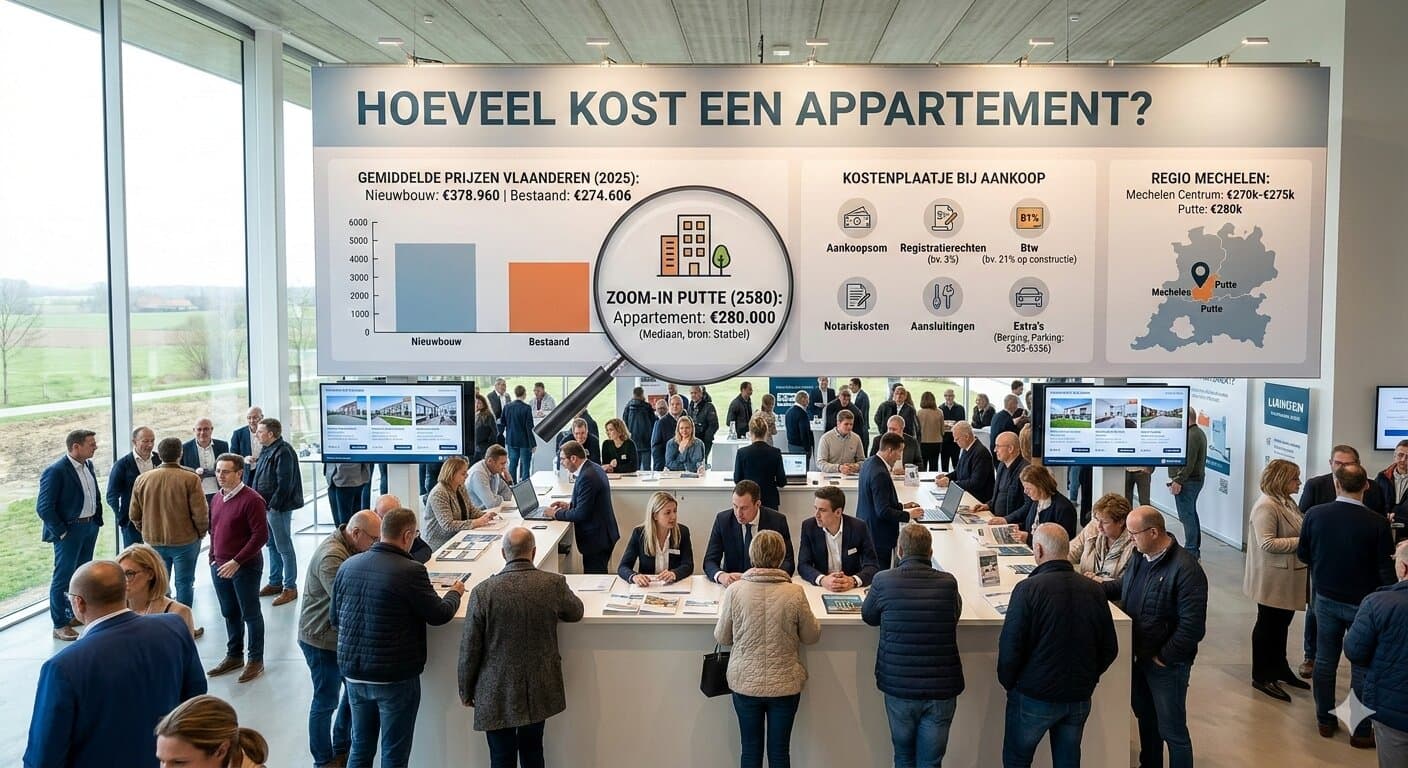
For anyone considering buying their own home, the first practical question is often: how much does an apartment cost in Belgium today? In recent years, apartments have held up relatively well, even during a period of higher interest rates. In 2025, the average price of an apartment in our country is around 278,000 euros, with clear differences between Flanders, Brussels and Wallonia. In 2026, a further rise towards an average of 280,000-281,000 euros is expected. This article gives you a clear overview of recent price levels and the factors that will determine what you actually end up paying.
Average apartment price: Belgium and its regions
According to the real-estate barometers published by Fednot and recent market analyses, an apartment in Belgium cost on average 277,927 euros in 2025, an increase of around 2.4% compared with 2024. For 2026, a further rise to above 281,000 euros is expected, amounting to an additional 3 to 4% price increase for apartments.
The question how much does an apartment cost gets a different answer depending on the region:
- Brussels-Capital Region
- Average price around 297,000-300,000 euros in 2025.
- BRUZZ cites an average of 297,411 euros, making Brussels the most expensive region in the country.
- Flanders
- Average price around 286,000-289,000 euros in 2025.
- VRT reports a rise of 4.1% for apartments in Flanders in 2025.
- Wallonia
- Average price around 210,000 euros in 2025, clearly lower than in Flanders and Brussels.
Alongside the average price, the median price is often used as well - the price below which half of all sales fall and above which the other half sit. In 2025, the median price of an apartment in Belgium was around 250,000 euros, up from 245,000 euros in 2024. That means many buyers in practice pay between 200,000 and 300,000 euros, depending on location, size and condition.
How much does an apartment cost per m²?
Another way to look at how much an apartment costs is through the price per square metre. This makes it easier to compare cities, neighbourhoods and types of apartment.
✦ 100% free & No obligation
Sell your property with the best agent
Compare the top 3 agents in your region for free and save on commission.
Compare agents →Recent figures from property pricing tools show the following for 2025:
- Brussels (region):
- Average price per m² for an apartment: ± 3,423 euros, with a range of roughly 2,700 to 4,400 euros per m².
- Flemish Region (example: East Flanders):
- Average price per m² for an apartment: ± 2,890 euros, with a range of roughly 1,950 to 4,100 euros per m².
- Flemish Brabant / West Flanders (average):
- Apartments often between 3,200 and 3,800 euros per m², depending on the municipality.
For a standard two-bedroom apartment of 95 m², that works out roughly as follows:
- in Brussels: 95 m² × ~3,500 euros/m² ≈ 332,500 euros as a reference price;
- in Flanders: 95 m² × ~2,900 euros/m² ≈ 275,500 euros;
- in Wallonia: lower price per m², often around 2,200-2,400 euros/m², so closer to 200,000-230,000 euros for 95 m².
The exact price per m² in a city like Ghent or Antwerp can be considerably higher than the provincial average, especially in popular neighbourhoods with strong demand.
New-build apartment or existing apartment: the price difference
When asking how much an apartment costs, you also need to distinguish between new builds and existing properties:
- In Brussels, the price of a new-build apartment in 2025 was around 366,000-395,000 euros, noticeably higher than the roughly 298,000 euros for an existing apartment.
- At the Belgian level, the reference price for a new-build apartment of 95 m² was around 318,480 euros, compared with approximately 265,000 euros for a comparable existing apartment.
New builds are therefore on average more expensive to purchase, but:
- they carry a better energy performance certificate (EPC) rating, which means lower energy bills;
- they require less immediate renovation work;
- they meet stricter standards for insulation and comfort.
Existing apartments are cheaper to buy, but you need to factor in future renovation costs and, with a poor EPC rating, a lower resale or rental value. In 2025, the price of apartments with an F energy label actually fell noticeably, while energy-efficient apartments continued to rise in value.
Factors that determine how much you pay
Beyond region and apartment type, several classic factors have a major impact on how much an apartment costs:
- Location:
- City versus countryside, city centre versus outskirts, proximity to public transport, schools and shops.
- In Brussels, Antwerp and Ghent, prices are on average higher than in smaller towns or rural municipalities.
- Size and layout:
- More m² = higher total price, but not always in a linear way.
- Compact, efficiently laid-out flats can be more expensive per m², but remain affordable in terms of total budget.
- Year of construction and EPC rating:
- Energy-efficient apartments with an A or B rating are clearly priced higher than properties with an F rating, which often require significant renovation work.
- Balcony, terrace and view:
- Outdoor space and natural light have become even more important since the pandemic and are systematically factored into the asking price.
- Garage/parking and cellar:
- An underground parking space or closed garage box can easily add 20,000 to 40,000 euros in cities - sometimes more - and is often listed separately.
Example prices: what can you buy, and where?
To make the question how much does an apartment cost more tangible, here are a few fictional but realistic scenarios (prices based on recent averages):
| Situation | Location | Type | Indicative price |
|---|---|---|---|
| First-time buyer 1 | Secondary city in Flanders | 1 bedroom, 60 m², existing, good EPC | 180,000-220,000 euros |
| First-time buyer 2 | Ghent/Antwerp outskirts | 2 bedrooms, 80 m², existing | 250,000-320,000 euros |
| First-time buyer 3 | City of Brussels | 2 bedrooms, 85-95 m², existing | 280,000-350,000 euros |
| Investor | Near a station in a mid-sized city | 1-2 bedrooms, 60-70 m² | 200,000-260,000 euros |
| New build | Flemish city centre | 2 bedrooms, 90-95 m², new build | 300,000-360,000 euros |
These are not official price lists, but they sketch the ballpark figures a buyer needs to bear in mind in 2025-2026.
The purchase price is not everything: additional costs
When working out how much an apartment costs, you also need to calculate the additional costs:
- Registration duties (or VAT for new builds): depending on the region and the type of purchase (sole own home, or investment).
- Notary fees and deed costs.
- Cadastral income (for annual taxes).
- Property manager fees and provisions for common areas (lift, roof, entrance hall, garden).
- Insurance (fire insurance, and possibly outstanding-balance insurance).
- Renovation budget (for older or energy-poor buildings).
In Flanders, the combination of reduced registration duties for a sole own home and a possible 6% VAT rate for demolition and reconstruction can significantly affect the total bill, particularly for renovation or new-build projects. Rules differ in Brussels and Wallonia, so it is always worth checking the applicable regime with a notary before you commit.
How do you know what a specific apartment is worth?
The general figures provide a useful framework, but the answer to how much an apartment costs only becomes truly relevant when you look at a specific property. At that point, the following come into play:
- exact location (street, neighbourhood, view);
- condition of the building and the owners' association reserves (funds set aside for future works);
- EPC rating and any planned renovation works;
- supply and demand at that moment in that particular micro-market.
A local estate agent can, on the basis of recent comparable sales, give a much sharper assessment of whether the asking price for a given apartment is realistic and how much room there is to negotiate. If you want to know how much an apartment you have in mind is worth, or what your own apartment could fetch on the market, a professional valuation is the logical next step.
Frequently asked questions
What is the average price of an apartment in Belgium in 2025?
The average apartment price in Belgium in 2025 is around 278,000 euros, based on Fednot barometer data showing 277,927 euros - a rise of about 2.4% compared to 2024. In 2026, prices are expected to climb further to above 281,000 euros.
Which Belgian region has the highest apartment prices?
Brussels is the most expensive region, with an average apartment price of around 297,000-300,000 euros in 2025. Flanders follows at around 286,000-289,000 euros, while Wallonia is clearly lower at around 210,000 euros.
How much more does a new-build apartment cost compared to an existing one?
At the Belgian level, a new-build apartment of 95 m² costs around 318,480 euros on average, compared to approximately 265,000 euros for a comparable existing apartment. New builds come with a better EPC rating and require less immediate renovation work, but carry a higher purchase price.
What additional costs should I budget for on top of the apartment purchase price?
On top of the purchase price, buyers need to account for registration duties or VAT, notary and deed costs, property manager fees, fire insurance, and a potential renovation budget for older properties. In Flanders, reduced registration duties for a sole own home can significantly affect the total bill, so checking with a notary before committing is recommended.
Does the EPC rating of an apartment affect its price?
Yes - in 2025, energy-efficient apartments with an A or B rating are priced noticeably higher, while apartments with an F energy label actually fell in value. A poor EPC rating also means higher energy bills and a lower resale or rental value down the line.
"Tech entrepreneur and strategist focused on digital transformation in the real estate sector."