
How much does the surviving partner receive when one partner dies in Belgium?

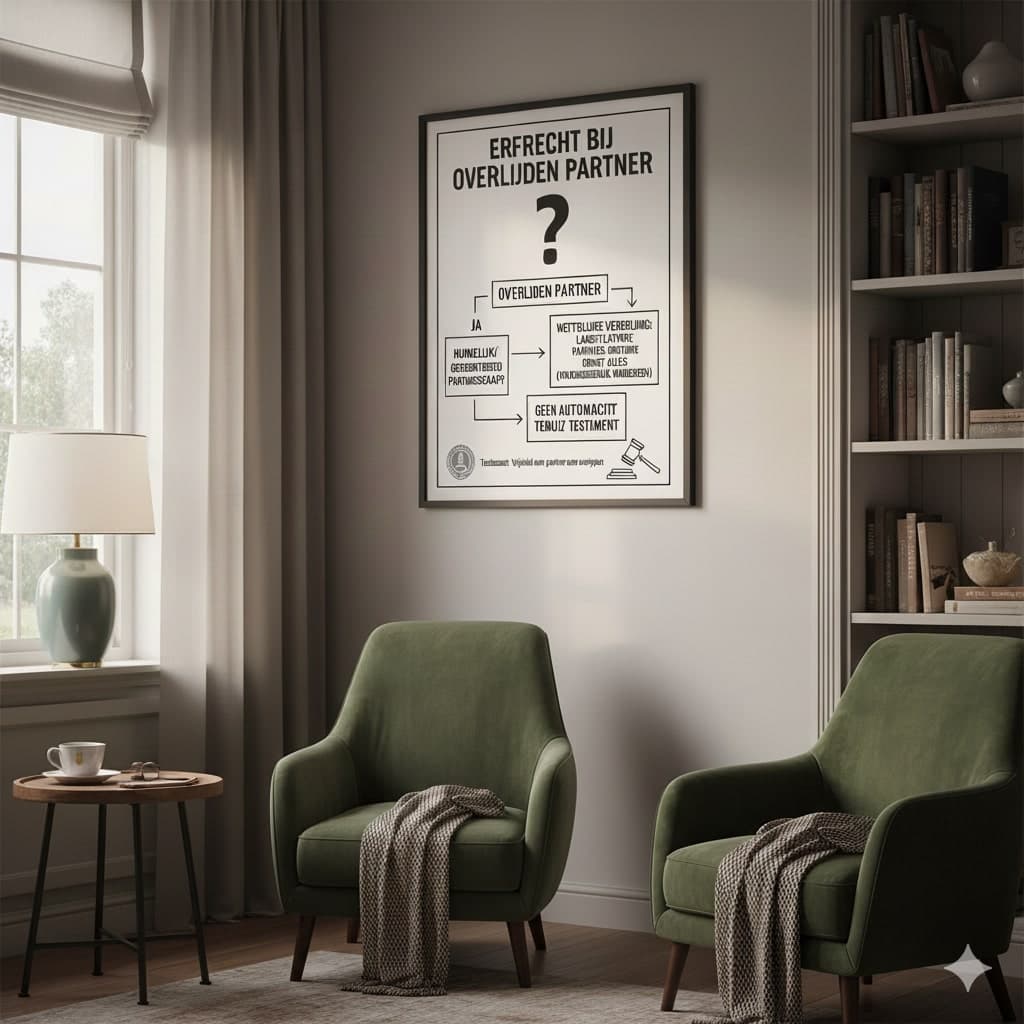
What the surviving partner receives in Belgium depends on two separate things. Inheritance law decides who inherits what. It is federal and the same everywhere in the country. Inheritance tax (called erfbelasting in Flanders and succession duties in Brussels and Wallonia) decides how much tax you pay on that share, and it differs by region.
Below we set both side by side for the three situations Belgian law recognises: married, legal cohabitation and de facto cohabitation. A separate registered partnership does not exist in Belgium. Partners who make a joint declaration at the municipality are legal cohabitants.
What does the partner inherit by law?
Married
A married partner has the strongest protection. If there are children, the surviving spouse inherits the usufruct of the whole estate and the children inherit the bare ownership. Usufruct means you can keep living in the home or rent it out and collect the rent, and you receive the interest on the accounts. The children are already the owners in economic terms, but can only use the assets once the usufruct ends.
If there are no children, the surviving spouse inherits the joint property in full ownership and the usufruct of the deceased's own property. The bare ownership of that own property goes to the other heirs. If the deceased leaves no children and no other relatives who inherit, the spouse receives the whole estate in full ownership. What exactly belongs to the estate also depends on the matrimonial property regime.
A married partner is also a protected (reserved) heir and in principle cannot be disinherited. That reserved share is the usufruct of half the estate, or the usufruct of the family home and its contents, whichever the survivor chooses. A court can never convert the usufruct of the family home and its contents into a sum of money without the surviving spouse's consent.
✦ 100% free & No obligation
Sell your property with the best agent
Compare the top 3 agents in your region for free and save on commission.
Compare agents →Legal cohabitants
A surviving legal cohabitant inherits the usufruct of the family home and its contents. If there are children, they inherit the bare ownership of the family home and the other assets in full ownership. Here too, the usufruct of the family home cannot be converted without the survivor's agreement.
The big difference with marriage is that a legal cohabitant is not a protected heir. That right can therefore be limited or removed by an ordinary will or by earlier gifts. Conversely, a will can give the partner more than the usufruct of the home, as long as the children's reserved share is respected.
De facto cohabitants
Partners who live together without a declaration at the municipality have no inheritance rights towards each other. Without a will the survivor receives nothing, even after many years together. The family home is not protected either: the owner can sell it without the other partner's agreement.
A will does let a de facto partner inherit. If you have children, half of your estate is reserved for them, whatever their number, and you can freely dispose of the other half. Without children, a will can leave everything to your partner. A will can always be changed unilaterally, though, even without the partner knowing.
| Situation | Without a will | Protected heir? |
|---|---|---|
| Married, with children | Usufruct of the whole estate | Yes |
| Married, without children | Joint property in full ownership, own property in usufruct | Yes |
| Legal cohabitants | Usufruct of the family home and contents | No |
| De facto cohabitants | Nothing | No |
How much inheritance tax does the partner pay?
The region of the deceased's fiscal residence determines the tax. If the deceased moved during the last five years, the region where they lived longest in that period counts. Where the home is located plays no part. The tax is calculated on the value of what you receive, after deducting debts and costs.
Flanders
For Flemish inheritance tax, a partner is the spouse, the legal cohabitant, or the de facto cohabitant who on the day of death had lived with the deceased for at least one uninterrupted year and shared a common household. All these partners pay the same rates as children, calculated separately on the movable and the immovable share.
| Bracket (per heir, separately for movable and immovable) | Rate |
|---|---|
| €0 to €50,000 | 3% |
| €50,000 to €250,000 | 9% |
| Over €250,000 | 27% |
Two further advantages apply to the surviving partner. The net share in the family home, the main residence where you lived together at the time of death, is fully exempt. For de facto cohabitants this exemption requires at least three years of living together before the death. In addition, for deaths from 1 January 2026 the first €75,000 of the net movable share is exempt (the partner allowance). This allowance takes out the lowest brackets; anything above it is taxed at 9% and possibly 27%. Neither advantage applies to a partner who is a direct-line relative of the deceased, such as a child living at home.
A de facto partner who had lived with the deceased for less than a year pays the rate for other persons: 25% up to €35,000, 45% from €35,000 to €75,000 and 55% above that. If the deceased left no partner and no children or grandchildren, they can name someone in their will for the single person reduction: 3% up to €50,000 and 9% from €50,000 to €100,000, for a maximum of €100,000 per estate. A reform of Flemish inheritance tax has been announced, but nothing has been decided yet. The current rates still apply.
Brussels
In Brussels only the spouse and the legal cohabitant get the favourable rate. They pay no succession duties on their net share in the home that was the family home at the time of death. On the rest of their share a single scale applies, with no split between movable and immovable assets, and the first €15,000 is exempt.
| Bracket (spouse, legal cohabitant) | Rate |
|---|---|
| €0 to €50,000 | 3% |
| €50,000 to €100,000 | 8% |
| €100,000 to €175,000 | 9% |
| €175,000 to €250,000 | 18% |
| €250,000 to €500,000 | 24% |
| Over €500,000 | 30% |
In Brussels a de facto cohabitant falls under the rate for other persons: 40% up to €50,000, 55% from €50,000 to €75,000, 65% from €75,000 to €175,000 and 80% above that. These duties are first calculated on what all heirs in that category receive together and then divided according to each person's share.
Wallonia
In Wallonia, too, only the spouse and the legal cohabitant get the favourable rate. Their net share in the home that had been the deceased's main residence for at least five years is fully exempt. The first €12,500 of the net share is exempt, plus another €12,500 if the net share does not exceed €125,000.
| Bracket (spouse, legal cohabitant) | Rate |
|---|---|
| €0 to €12,500 | 3% |
| €12,500 to €25,000 | 4% |
| €25,000 to €50,000 | 5% |
| €50,000 to €100,000 | 7% |
| €100,000 to €150,000 | 10% |
| €150,000 to €200,000 | 14% |
| €200,000 to €250,000 | 18% |
| €250,000 to €500,000 | 24% |
| Over €500,000 | 30% |
In Wallonia de facto cohabitants get neither the favourable rate nor the family home exemption. They pay the rate for other persons: 30% up to €12,500, 35% from €12,500 to €25,000, 60% from €25,000 to €75,000 and 80% above that.
Worked example for a death in 2026
Suppose the surviving partner receives in full ownership the deceased's share of the family home, half of the property, worth €150,000, plus €150,000 in savings. There are no children, no debts and no other heirs, and a partner who is not married inherits through a will. The deceased had lived in the home for more than five years.
- Flanders, married, legal cohabitants or de facto cohabitants for at least 3 years. The home is exempt. On the savings the first €75,000 is exempt; the remaining €75,000 falls in the 9% bracket. Tax: €75,000 x 9% = €6,750.
- Flanders, de facto cohabitants for 1 to 3 years. No home exemption, but the partner rate and the partner allowance apply. Home (immovable): €50,000 x 3% = €1,500 plus €100,000 x 9% = €9,000, making €10,500. Savings (movable): €6,750. Total €17,250.
- Brussels, de facto cohabitants. Rate for other persons on €300,000: €50,000 x 40% = €20,000, €25,000 x 55% = €13,750, €100,000 x 65% = €65,000 and €125,000 x 80% = €100,000. Total €198,750.
- Wallonia, de facto cohabitants. Rate for other persons on €300,000: €12,500 x 30% = €3,750, €12,500 x 35% = €4,375, €50,000 x 60% = €30,000 and €225,000 x 80% = €180,000. Total €218,125.
In the same situation a spouse or legal cohabitant pays €9,550 in Brussels and €10,250 in Wallonia, because the family home is exempt there too and only the savings are taxed.
If the partner inherits a usufruct alongside children, the value of that usufruct has to be determined first and the amount will differ. Your notary calculates the exact tax in the estate declaration. For the difference between a partner and children, read inheritance tax for a spouse versus a child and how much inheritance tax a spouse pays.
How can you protect your partner?
- A will. For de facto cohabitants it is the only way to let the partner inherit. Legal cohabitants can use it to give the partner more than the usufruct of the home. Keep the children's reserved share in mind.
- An accrual clause. If you buy a home together, each for half, you can agree that the share of whoever dies first passes to the survivor. That share is subject to the same registration duties as at the purchase. The clause does not affect the children's reserved share and cannot be cancelled unilaterally. See also buying a house with your partner.
- A lifelong lease. De facto cohabitants who do not want to give each other ownership or usufruct can sign a lifelong lease by notarial deed. The survivor can then stay in the home and pay rent to the heirs.
- A gift during your lifetime. A registered gift of movable assets, such as money, costs 3% between partners in Flanders and Brussels, including de facto cohabitants who have lived together for at least a year. In Wallonia it is 3.3% for spouses and legal cohabitants and 5.5% for others. An unregistered gift is added to the estate if the donor dies within five years (in Flanders for gifts from 1 January 2025, in Brussels from 1 January 2026, in Wallonia from 1 January 2022).
The difference between legal and de facto cohabitation therefore carries real weight, in inheritance law and, in Brussels and Wallonia, for tax. A notary can explain which combination suits your situation. Background information is on notaris.be and, for the Flemish partner rules, on vlaanderen.be.
Selling the inherited home
If the survivor does not want to stay in the home, a sale often follows. The tax is calculated on the market value of the property, so you need a realistic value for the declaration and for an asking price. A free valuation gives a first indication. If there are several heirs, also read do all heirs have to sign when selling an inherited house.
Frequently asked questions
What does my partner inherit if we are de facto cohabitants and there is no will?
Nothing. De facto cohabitants have no inheritance rights towards each other. Without a will the estate goes to the legal heirs, even after many years together. A will can let the partner inherit, but if you have children, half of your estate remains reserved for them.
What does a legal cohabitant inherit?
A surviving legal cohabitant inherits the usufruct of the family home and its contents. They are not a protected heir, so that right can be removed by a will or by earlier gifts. A will can also give them more.
What does a married partner inherit if there are children?
The surviving spouse inherits the usufruct of the whole estate and the children receive the bare ownership. The spouse is a protected heir: at least the usufruct of half the estate, or of the family home and its contents, is guaranteed.
Does a de facto cohabitant in Flanders pay more inheritance tax than a spouse?
Not if you had lived together for at least one uninterrupted year on the day of death and shared a common household. The same 3%, 9% and 27% rates as for a spouse then apply, as does the allowance on the first 75,000 euros of movable assets for deaths from 2026. The family home exemption does require three years of living together. Less than a year together means the rate for other persons: 25%, 45% and 55%.
What rate does a de facto cohabitant pay in Brussels or Wallonia?
In Brussels and Wallonia only spouses and legal cohabitants get the favourable rate. A de facto cohabitant pays the rate for other persons: 40% to 80% in Brussels and 30% to 80% in Wallonia, with no family home exemption.
Does the surviving partner pay inheritance tax on the family home?
In Flanders the net share in the family home is exempt for spouses, legal cohabitants and de facto cohabitants who had lived together for at least three years. In Brussels it is exempt for spouses and legal cohabitants. In Wallonia it is also exempt for spouses and legal cohabitants, provided the home had been the deceased's main residence for at least five years.
Which region's inheritance tax applies?
The region of the deceased's fiscal residence. If they moved during the last five years, the region where they lived longest in that period counts. Where the home is located plays no part.
"Real estate expert focused on quality control and strategic partnerships."