
How much savings should you keep after buying a house?

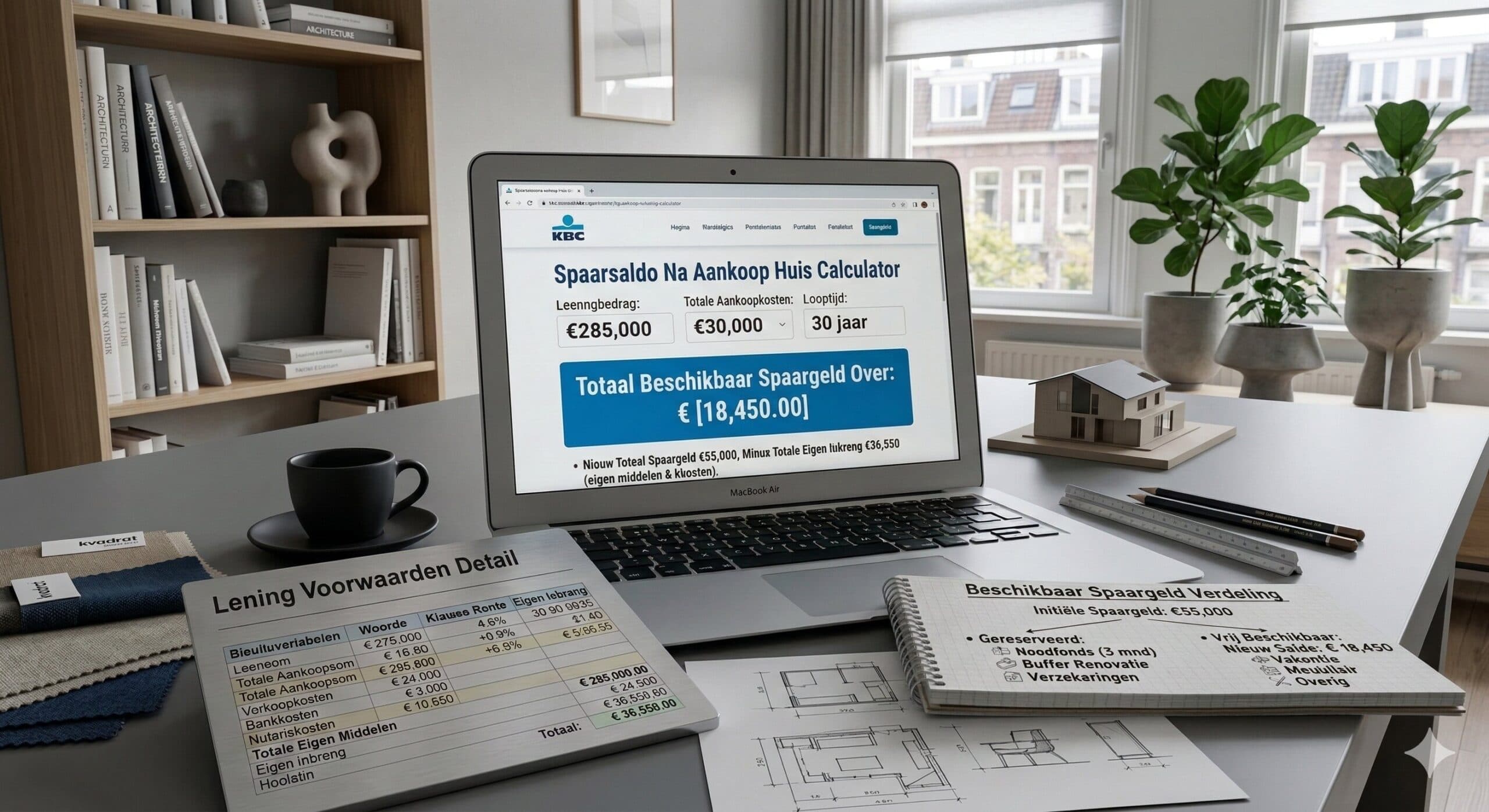
When buying a property, many buyers focus on a single question: "Do I have enough savings to complete the purchase?" A second question is just as important: how much savings should you keep after buying a house? Putting all your savings into the purchase and associated costs may seem efficient, but it leaves you financially vulnerable. Unexpected expenses, a broken boiler or a temporary loss of income can then cause immediate problems. In this guide, we look at useful rules of thumb, examples by income level and how to determine your ideal financial buffer.
1. Why you should not spend all your savings
Buying a property requires a significant amount of your own funds: part of the purchase price, registration duties, notary fees, bank charges and often the cost of initial renovations. Even so, it is a bad idea to be left with a nearly empty savings account after signing the deed.
Reasons:
- Owning a property structurally brings extra costs: maintenance, repairs, insurance, property tax.
- Regardless of your home, there are always unexpected expenses: car trouble, medical costs, temporary unemployment, growing family.
- Without a buffer, a setback can make it difficult to keep up with your mortgage repayments comfortably, increasing the risk of payment problems and financial stress.
Financial institutions and experts therefore stress that, alongside your own contribution for the purchase, you must also retain an emergency buffer.
2. Rule of thumb: a buffer of 6 months' net income
A widely used general rule of thumb is: after buying your home, keep a buffer of around 6 months of net household income. More conservative sources recommend as much as 6 to 12 months, especially in the situations below.
✦ 100% free & No obligation
Sell your property with the best agent
Compare the top 3 agents in your region for free and save on commission.
Compare agents →- have an uncertain or variable income;
- are single or the sole earner in the household;
- have dependent children;
- are buying an older property with a higher risk of unexpected works.
In concrete terms:
- Net household income €2,500 → ideal buffer: €15,000.
- Net household income €3,000 → ideal buffer: €18,000.
- Net household income €4,000 → ideal buffer: €24,000.
This is not a hard rule, but a safety margin that protects you against a combination of higher housing costs and unforeseen expenses.
3. Relation to your own contribution: 20% + buffer
In a previous post we saw that banks generally require you to contribute at least 10% of your own funds towards the purchase price, and in practice many buyers aim for 20% own contribution plus costs. On top of that comes the question of how much savings to keep after buying a house.
A realistic picture for many buyers looks like this:
- 20% of the purchase price as your own contribution (partly for the price, partly for costs).
- An additional buffer of 3 to 6 months' net income that you do not put into the purchase.
Example:
- Property: €300,000.
- Own contribution (20%): €60,000.
- Net household income: €3,000 → buffer of ±€18,000.
Ideal scenario:
- Total savings before purchase: ±€78,000.
- €60,000 used for the purchase and costs.
- €18,000 deliberately kept aside as an emergency buffer.
In practice, many buyers do not reach this ideal situation and end up with less. What matters is that you do not go so far that you are left with almost nothing after signing the deed.
4. Minimum buffer: what if you cannot reach 6 months?
Not everyone can set aside 6 months of income while also buying a property. There are nevertheless a few guidelines to keep you above the critical threshold:
- Make sure that after the purchase you still have at least one to three months' salary as an absolute minimum buffer. Anything less is very risky.
- Also factor in planned renovations: if you know that within 1-2 years you will need to tackle a roof, windows or a bathroom, a larger buffer is required.
- It is best to keep your buffer in a separate account that you do not use for day-to-day expenses, so that you reduce the temptation to chip away at it gradually.
Practical minimum check:
- Your monthly mortgage repayment and fixed housing costs (insurance, utilities, co-ownership charges) feel comfortable within your budget.
- After paying the deed, costs and renovation, you still have an amount that would allow you to cover at least a few months of mortgage repayments and basic living expenses if something goes wrong.
5. Examples by income level
To make how much savings to keep after buying a house more concrete, here are a few scenarios:
- Household with €2,500 net/month
- Ideal buffer: €15,000.
- Minimum buffer: €7,500-€10,000 as an absolute minimum.
- Household with €3,500 net/month
- Ideal buffer: €21,000.
- Minimum buffer: €10,000-€15,000.
- Household with €5,000 net/month
- Ideal buffer: €30,000.
- Minimum buffer: €15,000-€20,000.
The higher your income, the greater your fixed lifestyle expenses tend to be, and therefore the larger the buffer you need to sustain them temporarily.
6. Practical approach: how to determine your ideal remaining savings
To work out how much savings you should ideally keep after buying a house, you can follow these steps:
- Calculate your total savings before the purchase.
- Calculate your own contribution + costs (the portion of the price you cannot borrow, registration duties, notary fees, bank charges, initial renovations).
- Subtract that from your total savings and see what remains.
- Compare that remaining amount with your net household income:
- Ideally aim for around 6 months;
- try not to go below 1-3 months as a hard lower limit.
If your remaining buffer turns out to be too slim, there are several options:
- look for a slightly less expensive property;
- consider a longer loan term (lower monthly payment, but more interest);
- save for a little longer before buying;
- make strategic use of additional support (e.g. a gift), but make sure you still retain a buffer even then.
That way, you avoid turning your dream home into a source of financial stress. The key question is therefore not only: "Do I have enough savings to buy?", but above all: "After the purchase, do I still have enough savings to stay on a secure financial footing?"
Frequently asked questions
How much savings should I keep after buying a house?
The widely used rule of thumb is to keep around 6 months of net household income as a buffer after your purchase. More conservative advice suggests 6 to 12 months, especially if you have a variable income, dependents, or are buying an older property.
What is the minimum buffer I should have if I cannot save 6 months of income?
You should aim to keep at least 1 to 3 months of net salary as an absolute minimum after signing the deed. Having less than that is considered very risky, as unexpected costs or a temporary loss of income could make it hard to keep up with mortgage repayments.
How does my emergency buffer relate to my own contribution for the purchase?
Many buyers aim for a 20% own contribution toward the purchase price and costs, plus a separate buffer of 3 to 6 months of net income that is not used for the purchase. For a property of 300,000 euros with a net income of 3,000 euros per month, this means having around 78,000 euros in total savings before buying.
Where should I keep my emergency buffer?
It is best to keep your buffer in a separate account that you do not use for day-to-day expenses. This reduces the temptation to gradually chip away at it over time.
What can I do if my remaining savings after buying are too low?
You have a few options: look for a slightly less expensive property, choose a longer loan term to lower your monthly payment, save for a bit longer before buying, or consider additional support such as a gift - as long as you still retain a buffer after the purchase.
"Tech entrepreneur and strategist focused on digital transformation in the real estate sector."