
How tall can a hedge be in Belgium?

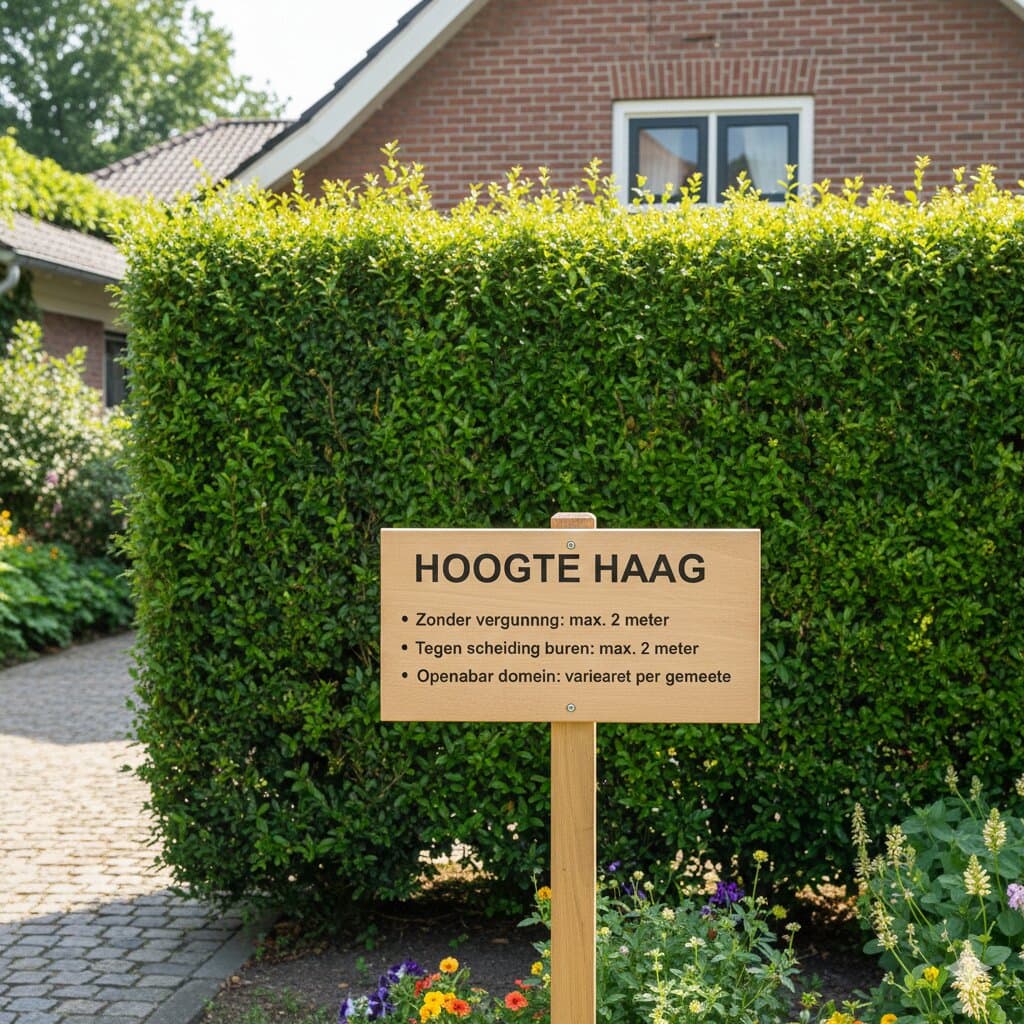
There is no general statutory maximum height for a hedge in Belgium. What does exist are minimum distances from the boundary, municipal rules on enclosures, and the law on neighbourhood nuisance. Together those three decide how tall your hedge may actually be, and they are the reason most hedge disputes end up in front of a justice of the peace rather than in a planning office.
No maximum height, but there are distance rules
The Civil Code and the Rural Code do not impose a fixed height. They do impose minimum distances from the plot boundary. As a rule of thumb, low hedges and shrubs stay at least half a metre from the boundary, while tall trees keep at least two metres. A hedge planted exactly on the boundary is possible, but only by agreement with your neighbour, and that agreement is best put in writing.
Once planted at the right distance, a hedge may in principle grow as tall as the owner wants. The limit is not a number in a code, it is the point at which the hedge causes abnormal nuisance to the neighbour.
Municipal and planning limits
Municipalities regularly set their own rules for enclosures, and a dense hedge usually counts as one. A common pattern is a maximum of about one metre in the front garden, for visibility from the street, and about two metres alongside and behind the house without a permit. On corner plots and near junctions the rules are stricter, because sight lines for traffic take priority.
These rules differ from one municipality to the next, so check the local planning regulations before you plant a screen along the pavement. A quick call to the planning department is cheaper than replanting a row of thirty plants.
✦ 100% free & No obligation
Sell your property with the best agent
Compare the top 3 agents in your region for free and save on commission.
Compare agents →When is a hedge legally too tall?
A hedge becomes a legal problem when it causes abnormal neighbourhood disturbance: it blocks light or sunlight, it darkens a room, or its roots damage a structure. Belgian law lets a neighbour who suffers more than an ordinary amount of inconvenience claim compensation, usually a trimming order rather than money.
The judge weighs the situation as a whole: the height, the position, how long the hedge has been there, and whether the complainant moved in after it was planted. A hedge that has quietly stood at three metres for twenty years is treated differently from one that shot up last season.
What if your neighbour refuses to trim?
Start with a written request, friendly and dated, because you will need to show that you asked. If that fails, the free conciliation procedure before the justice of the peace is the next step, and in practice most cases end there with an agreement on a height and a trimming schedule.
Do not cut the neighbour's hedge yourself on their side of the boundary. You may cut back roots and overhanging branches on your own side under the conditions set by the Civil Code, but taking a saw to the hedge itself turns your complaint into their claim.
Species and growth rate matter more than the rules
The practical height of a hedge is decided by what you plant. Fast growers such as cypress and laurel reach two metres in a few seasons and need trimming twice a year to stay in shape. Beech and hornbeam grow more slowly and hold a clean line for decades. Yew grows slowly, lives long and tolerates hard pruning.
For privacy in a normal garden, a screen of about two metres is usually enough, because what blocks the view is the position relative to the terrace rather than the last half metre of height. Planting slightly further from the boundary often buys more privacy than planting higher.
Differences across the regions
The distance rules come from federal civil law and apply throughout Belgium. What differs is the planning layer on top: Flanders, Wallonia and Brussels each have their own framework, and municipalities within them add their own enclosure rules. If you are close to a boundary, a listed streetscape or a road junction, check the local rules rather than a national summary.
What it means when you sell
A well kept hedge is a selling point: it gives privacy without the closed feeling of a wall, and it signals a garden that has been looked after. A hedge in dispute is the opposite, and it has to be disclosed if a case is running.
If you are planning to sell, settle any hedge discussion before the photos rather than during the negotiation. Compare a few local agents and ask how they present a garden that borders directly on the neighbours.
Frequently asked questions
How tall can a hedge be in Belgium?
There is no general statutory maximum. Distance rules from the boundary apply, municipalities often limit enclosures to about one metre in the front garden and two metres alongside and behind the house, and a hedge that causes abnormal nuisance can be ordered to be trimmed.
How far from the boundary must a hedge be planted?
As a rule of thumb, at least half a metre for low hedges and shrubs and at least two metres for tall trees. Planting on the boundary itself is possible by agreement with the neighbour, preferably in writing.
What can I do if my neighbour's hedge is too tall?
Start with a dated written request. If that leads nowhere, the free conciliation before the justice of the peace is the next step, and most cases end there with an agreed height and trimming schedule.
May I trim my neighbour's hedge myself?
You may deal with roots and overhanging branches on your own side under the conditions in the Civil Code, but you may not cut the hedge on their side. Doing so turns your complaint into their claim.
Which hedge is best for privacy?
For a normal garden, about two metres is usually enough. Fast growers such as cypress and laurel get there quickly but need trimming twice a year; beech, hornbeam and yew grow more slowly and hold their shape far longer.
"Tech entrepreneur and strategist focused on digital transformation in the real estate sector."