
Loft insulation or boiler replacement: which investment gives you a better EPC rating?

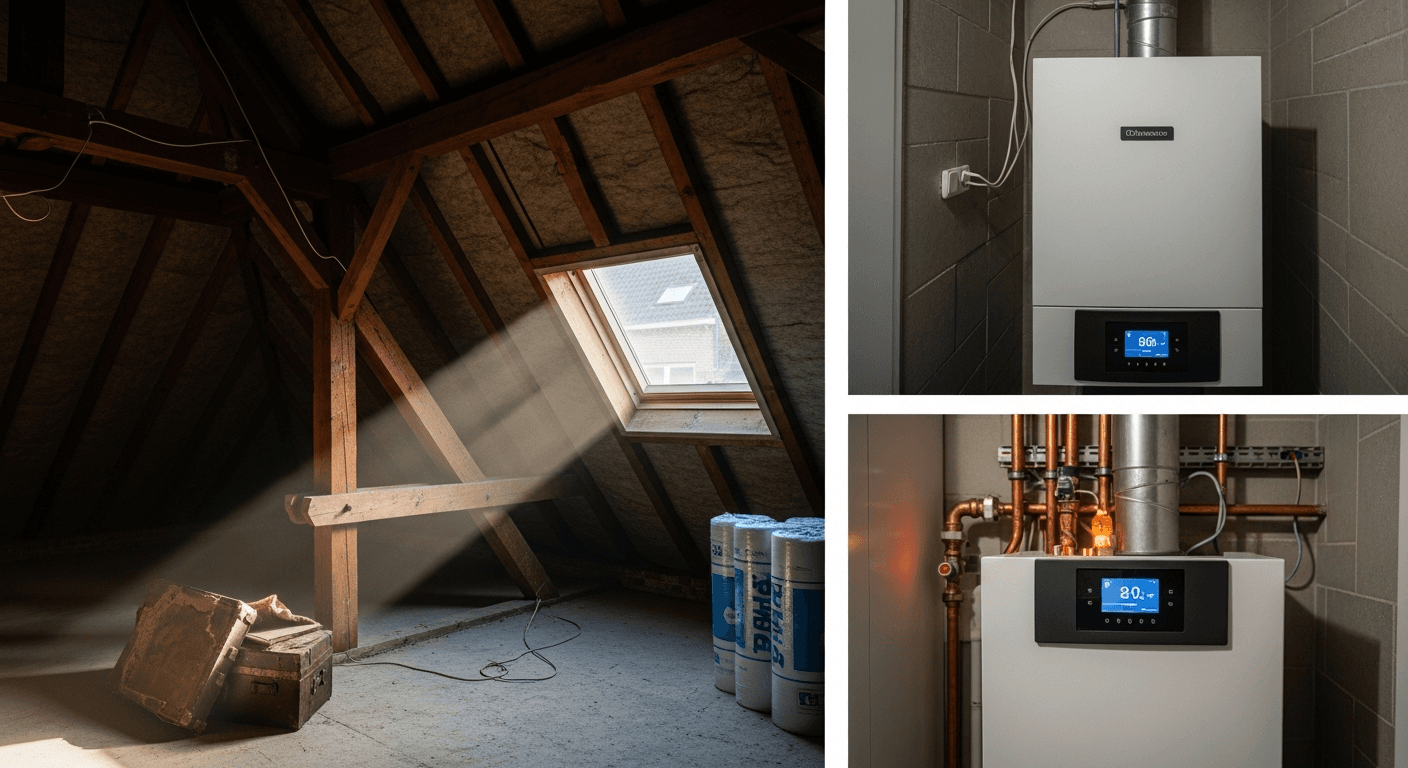
Loft Insulation or Boiler Replacement: Which Investment Gives You a Better EPC Rating?
You want to improve your EPC certificate before selling your home and you are torn between insulating the loft and replacing the boiler. Both works rank among the most commonly carried out in Belgium, but their impact on the energy score, the budget and the property's value differs considerably. This guide helps you make the right decision based on your specific situation.
Why the EPC directly influences the sale price in 2026
In Belgium, the Energy Performance Certificate (EPC) is mandatory for every property sale. For several years now, buyers have been factoring the energy score into their negotiations. According to Statbel, in 2025, the price difference between a property rated A and one rated E or F could reach 10 to 15% in certain regions such as Brussels and Flanders.
In Wallonia, the rules may also tighten: a draft renovation plan adopted by the Walloon Government in December 2025 proposes minimum PEB labels for all existing homes from 2031, but it is not yet law. Even without a fixed deadline, a poor EPC can extend the time your property sits on the market or push down the asking price. Improving your score before listing is therefore a decision that deserves careful thought.
The question is not purely technical - it is also a financial calculation. Which investment delivers the best return in terms of EPC points gained for every euro spent?
Loft insulation: a cost-effectiveness ratio that is hard to beat
Insulating a cold loft (non-habitable) is generally the intervention that offers the best ratio between cost and energy gain. In Belgium, around 25 to 30% of the heat lost in an unrenovated house escapes through the roof. Acting at this level can significantly reduce heating consumption.
✦ 100% free & No obligation
Sell your property with the best agent
Compare the top 3 agents in your region for free and save on commission.
Compare agents →The average cost of cold loft insulation in Belgium ranges from 1,500 to 4,000 euros depending on the surface area and the material chosen (glass wool, rock wool, blown cellulose). For habitable loft conversions, the bill rises further: between 6,000 and 15,000 euros depending on the technique used.
In terms of EPC impact, the gain can amount to several tens of kWh/m² per year, which in some cases can move a property from a D rating to a C rating. Grants in 2026 depend heavily on your region: the Walloon renovation premiums close on 30 September 2026, Brussels has no Renolution grants open, and in Flanders the Mijn VerbouwPremie for insulation remains only for income categories 3 and 4.
One important point: loft insulation is a relatively non-invasive job. It does not require any changes to your existing heating system and can be completed in one to two days for a standard-sized cold loft.
Boiler replacement: a real gain, but a more limited impact on the EPC score
Replacing an old oil or gas boiler with a recent condensing model - or better still, a heat pump - also improves the EPC. But the gain depends heavily on the starting point.
An oil boiler from the early 2000s often has an efficiency of 75 to 80%. A recent condensing model reaches 95 to 98% efficiency. This replacement can add a few points to the EPC score, but it will not compensate for a poorly insulated thermal envelope.
The cost of a new gas condensing boiler ranges from 3,000 to 6,000 euros, installation included. An air-to-water heat pump represents a more substantial investment: between 8,000 and 15,000 euros depending on the output and the brand, before grants. In Flanders, a Mijn VerbouwPremie for a heat pump remains available to every income category in 2026; in the other regions, check the current scheme first.
On the EPC score, switching from oil to a condensing gas boiler offers a modest gain. Switching from oil or gas to a heat pump can, on the other hand, meaningfully improve the certificate - especially if the house is already partially insulated. Without sufficient insulation, a heat pump operates less efficiently and the EPC gain remains limited.
Which work should you prioritise based on your property profile?
The choice between the two works depends on the current condition of your property. Here are some practical benchmarks.
If your house has an uninsulated loft and a recent boiler (less than 15 years old), start with the loft insulation. That is where the most effective lever lies for improving your EPC without overspending.
If your boiler dates from before 2000 or runs on oil, replacing it becomes relevant - especially if you are planning to sell within the next two to three years. An EPC certificate mentioning an old oil boiler can put off buyers who are sensitive to environmental concerns or future regulatory requirements.
If you have a limited budget and want to maximise your EPC gain, cold loft insulation remains the priority in most cases. It costs less, disrupts your daily life less and delivers a measurable return on your energy score.
If your goal is to make the property more attractive to demanding buyers in a competitive market - Brussels, Ghent, central Liège - combining both works may well be justified. A good local estate agent can help you assess what buyers in your area are actually looking for. To find a professional who knows your market, you can compare IPI-certified estate agents near you.
Grants and financial support available in 2026: do not fund everything yourself
In 2026, energy renovation support still exists in Belgium, but it differs strongly per region and the conditions change often. Here are the main sources to check before starting your works.
In Wallonia, the current renovation premium scheme (primes Habitation) is closing: every application, including the final invoice, must be filed by 30 September 2026. From 1 October 2026 it is replaced by loan-based support (Rénopack and Rénoprêt) for works that raise the PEB label, with a mandatory energy audit beforehand.
In the Brussels-Capital Region, no Renolution grants are open for new works, and the government has not yet decided on any new form of support.
In Flanders, the Mijn VerbouwPremie was reformed on 1 March 2026. Owner-occupiers in the two highest income categories and investors now only receive a premium for a heat pump or heat-pump boiler; premiums for insulation remain for income categories 3 and 4.
Before starting any works, request a free estimate of your property's value to check whether the planned investment is consistent with the expected sale price. It would be a shame to over-invest in a property whose market value will not allow you to recoup the outlay.
What your estate agent can advise you before the works
Many owners renovate before selling without having consulted a property professional. Yet an agent who knows your area well can tell you whether local buyers place more value on a good EPC or on other characteristics of the property - location, floor area, general condition.
In certain market segments, a D-rated property in a sought-after location sells just as well as a C-rated property in a less popular area. Spending 8,000 euros on a heat pump to gain one EPC class is not always worthwhile if the negotiating margin with buyers is already slim regardless.
To avoid this kind of mistake, compare several recognised IPI estate agents for free in your municipality before making your decision. They can give you their view on which works should take priority given the local market in 2026.
Frequently asked questions
Which work improves the EPC score more quickly: loft insulation or a new boiler?
In the majority of cases, cold loft insulation delivers a faster and larger EPC gain at a lower cost than a new boiler. This is particularly true if the loft is currently uninsulated or under-insulated. A heat pump can however offer a comparable gain, but at a considerably higher cost.
Should I insulate before replacing my boiler?
Yes, in most situations. A heat pump works at its best in a well-insulated house. If you replace the boiler first without improving the thermal envelope, the equipment's efficiency will be limited and the EPC gain disappointing. The logical order is: first the envelope - roof, walls, floors - then the heating system.
Can grants for loft insulation be combined with those for a boiler?
Where grants are still available, you can usually combine support for different works in the same property. In 2026 that mainly concerns Flanders: Brussels has no Renolution grants open and the Walloon premium scheme closes on 30 September 2026. The exact conditions vary by region and by your income level. It is recommended that you consult your region's official website or an accredited renovation adviser before getting started.
Does a better EPC really make a difference when selling?
Yes, increasingly so. In 2026, Belgian buyers are more aware than ever of energy costs and future renovation requirements. A property rated C or B generally sells faster and at a higher price than an equivalent property rated E. The impact is particularly visible in major urban areas such as Brussels, Antwerp and Liège.
Improving your EPC before selling is a step that deserves careful consideration. Whether you go for loft insulation or a boiler replacement, the right choice depends on the condition of your property, your budget and the local market. To make the best decision, consult an estate agent who knows your area. Through IMV, you can receive free, no-obligation assessments from several recognised IPI professionals.
Frequently asked questions
Which improvement gives a better EPC rating: loft insulation or a new boiler?
Cold loft insulation generally delivers a faster and larger EPC gain at a lower cost than a new boiler. It can reduce heat loss by 25 to 30% and in some cases move a property from a D rating to a C rating.
How much does loft insulation cost in Belgium?
Cold loft insulation typically costs between 1,500 and 4,000 euros depending on the surface area and material used. For habitable loft conversions, the cost rises to between 6,000 and 15,000 euros.
Should I insulate my loft before replacing my boiler?
Yes, in most situations. A heat pump works best in a well-insulated house, so replacing the boiler first without improving the thermal envelope will limit the equipment's efficiency and produce a disappointing EPC gain. The recommended order is to tackle the roof, walls and floors first, then the heating system.
Are there grants available in Belgium in 2026 to help cover the cost of these renovations?
It depends on the region. In Wallonia, applications under the current renovation premium scheme must be filed by 30 September 2026, with loan-based support (Rénopack and Rénoprêt) from 1 October 2026. Brussels currently has no Renolution grants open. In Flanders, the Mijn VerbouwPremie still supports insulation for income categories 3 and 4 and heat pumps for every income category. Conditions change annually, so it is worth checking the current rules before starting any works.
Does a poor EPC rating affect the sale price of a property in Belgium?
Yes, significantly. According to Statbel, in 2025 the price difference between an A-rated and an E- or F-rated property could reach 10 to 15% in regions such as Brussels and Flanders. A poor EPC can also extend the time a property sits on the market.
"Real estate expert focused on quality control and strategic partnerships."