
New-build 6% VAT: when do you pay less VAT in Belgium?

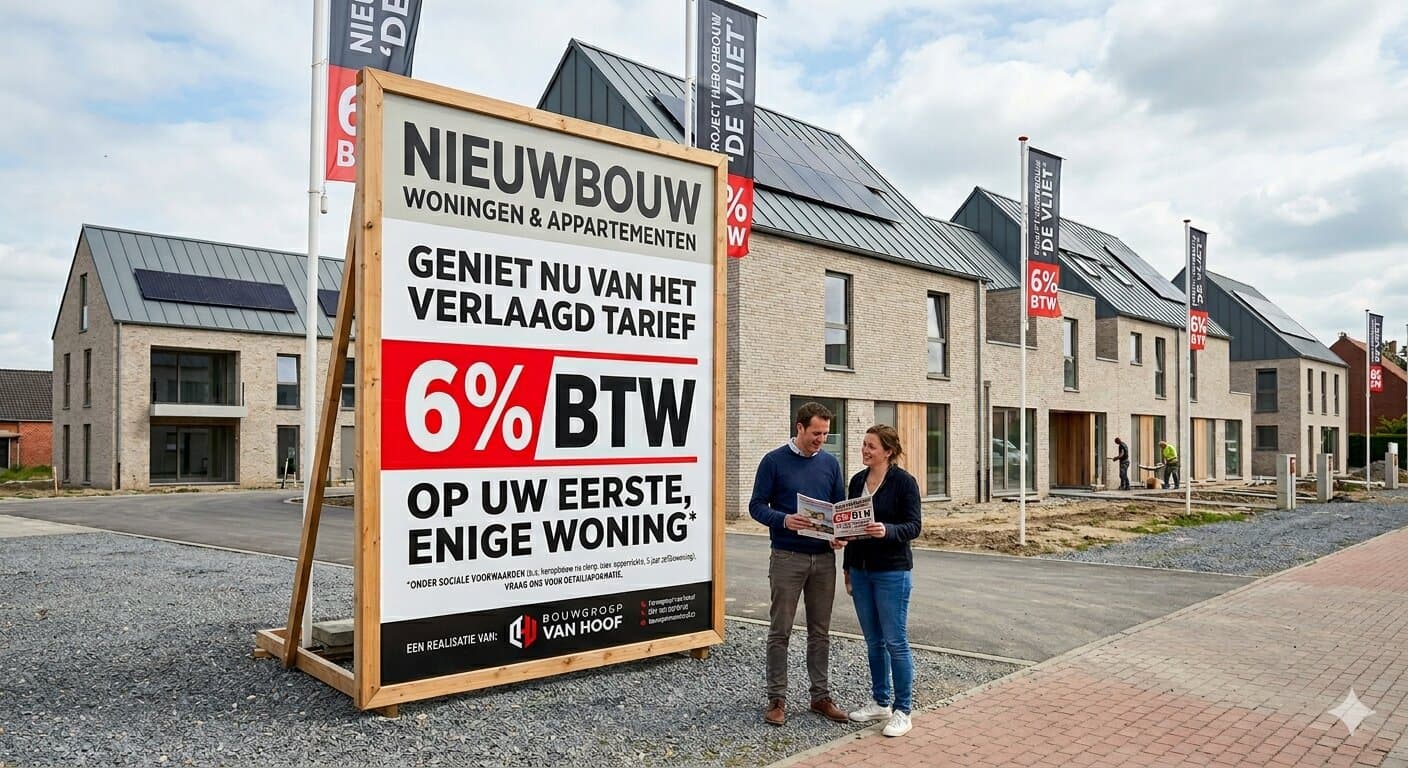
Anyone looking into new-build 6% VAT usually expects a significant tax advantage when buying or building a home. In Belgium, a reduced VAT rate of 6% does indeed exist in certain situations, but it does not apply automatically to every new-build project. The scheme is strictly tied to specific conditions, and that is precisely where things go wrong in practice.
For buyers and self-builders, it is therefore important to know exactly when the reduced rate applies. Since 2025, the demolition-and-reconstruction scheme has been structurally enshrined and applicable throughout Belgium under specific conditions. That makes it more relevant than ever for anyone looking for an affordable new-build project.
What does new-build 6% VAT mean?
The term new-build 6% VAT refers to projects where, instead of the standard rate of 21%, only 6% VAT is charged on a newly constructed or reconstructed building. In practice, this mainly concerns the demolition and reconstruction of houses or apartments, not classic new construction on a previously undeveloped plot. That distinction is important.
For a standard new build on an empty piece of land, the 21% standard rate continues to apply in principle. The reduced rate is therefore not a general discount on new construction, but a preferential regime for clearly defined situations. Anyone who does not meet the conditions automatically falls back on the normal VAT rate.
When does the reduced rate apply?
The scheme is primarily intended for the demolition and reconstruction of a dwelling. The new building must be erected on a plot where an existing structure previously stood and has been demolished. The legislation has been broadened and simplified in recent years, making it more widely applicable today than it was in the past.
✦ 100% free & No obligation
Sell your property with the best agent
Compare the top 3 agents in your region for free and save on commission.
Compare agents →It is important, however, that the project meets the statutory conditions. For example, in certain cases the dwelling must serve as the sole and own residence of the person commissioning the build, and the net habitable floor area in such files may not exceed 200 m². This makes the scheme particularly interesting for private buyers who are building a compact family home.
Which conditions apply?
The precise conditions depend on the type of project. For private self-builders, attention is typically paid to the use of the property as a sole and own residence, the maximum floor area, and the correct advance declaration to the tax authorities. Additional rules may apply for projects carried out through a property developer or under a sale-in-the-future-state-of-completion structure.
The legal structure of the project also plays a role. Sometimes you only purchase the construction value, while the land is taxed separately through registration duties. You therefore need to know exactly what falls under VAT and what does not. An error in that calculation can lead to a significant price difference.
Why does this matter so much?
The difference between 21% and 6% VAT is substantial. On a project worth several hundred thousand euros, it can mean a difference of thousands of euros. For many buyers, that is precisely the amount that makes the step towards a new build achievable. The scheme therefore has a direct impact on affordability.
Moreover, new construction in Belgium has become more expensive due to building costs, energy requirements, and financing conditions. A 6% tax advantage can therefore influence a significant share of the total budget. That explains why more and more buyers want to look into this before committing.
What about the purchase of land?
In a classic new build on an empty plot, you generally pay VAT on the construction value and registration duties on the land, depending on the ownership structure. The applicable registration duty rates and rules differ between the three Belgian regions - Flanders, Wallonia, and the Brussels-Capital Region each have their own regime. The land component therefore always remains a separate point of attention.
This means that "new-build 6% VAT" does not necessarily mean that everything is charged at 6%. Often only the works or the construction element are concerned. The land then remains subject to a different tax regime. You must therefore always look at these two elements separately.
Who is the scheme aimed at?
The scheme is most interesting for people who want to live in the property themselves and are not building a large villa. In many cases a maximum net habitable floor area of 200 m² applies. In practice, the measure therefore remains focused on family homes and compact projects.
The benefit can also apply to certain developer-led projects, but the structure of the project must then be fully compliant. Not every marketing label bearing "6% VAT" automatically means that your specific file will qualify. It remains essential to check the actual deed, the permit, and the declaration.
What do you need to do in advance?
Anyone wishing to benefit from new-build 6% VAT must first complete the necessary legal and tax checks. In many cases a declaration must be submitted on time via MyMinfin or a similar procedure. Without the correct prior formalities, you risk having the reduced rate refused.
It is therefore wise to discuss this with the seller, the builder, or the notary right at the start of the process. Waiting until after work has begun is often too late. Especially for demolition-and-reconstruction projects, you need to know in advance exactly which parts of the project fall under which regime.
Risk of mistakes
A common mistake is to assume that all new construction qualifies for 6% VAT. That is incorrect. Classic new builds remain in principle subject to 21% VAT. Only specific demolition-and-reconstruction projects can qualify for the reduced rate.
A second mistake is to look only at the sale price while ignoring the tax structure. The split between land, construction, registration duties, and VAT determines the true final cost. Anyone who does not examine these elements separately will quickly arrive at an overly optimistic budget estimate.
How to prepare properly
Start by asking whether your project genuinely qualifies as demolition and reconstruction, or whether it is rather a classic new build. Then check whether the dwelling meets the conditions regarding use, floor area, and ownership structure. Once that is clear, you can budget far more accurately.
It is also smart to align your financing with the VAT regime. A lower rate changes your total need for own funds and can affect your borrowing capacity. To find out how your purchase or construction budget compares to the market, you can also use a loan simulator to get a better picture of the financial impact.
Link with the sale of existing properties
The 6% VAT scheme also has an indirect effect on the existing housing market. When reconstruction projects become fiscally more attractive, part of the demand shifts towards older properties that are suitable for demolition and reconstruction. This can support the market for certain locations.
At the same time, the value of existing properties continues to depend strongly on location, energy performance, and renovation potential. Anyone who owns an older property that could potentially be redeveloped would do well to have its market value correctly assessed. A free valuation can help you decide more confidently whether selling, renovating, or rebuilding is the most advantageous option.
Practical summary
New-build 6% VAT is therefore not a general benefit for every new-build property, but a specific tax scheme for certain demolition-and-reconstruction projects. The main conditions relate to the type of project, the habitable floor area, use as an own residence, and correct administrative follow-up. Anyone who follows those rules carefully can achieve a substantial cost advantage.
For buyers and self-builders, it is therefore important not to rely on a marketing slogan but on the legal substance of the file. Have your project checked in good time and calculate the total cost structure carefully. That prevents an attractive VAT benefit from unexpectedly falling away later on.
Conclusion
If you want to approach a new-build 6% VAT project intelligently, start with a solid financial simulation and a correct tax check. Use the loan simulator to test your budget and make the right choices from the very beginning.
Frequently asked questions
Does the 6% VAT rate apply to all new-build projects in Belgium?
No, the reduced 6% VAT rate does not apply to standard new builds on empty plots - those remain subject to 21% VAT. The scheme is specifically for demolition-and-reconstruction projects that meet a set of statutory conditions.
What are the main conditions to qualify for the 6% VAT rate on a demolition-and-reconstruction project?
The new building must replace a demolished structure, the property must typically serve as the buyer's sole and own residence, and the net habitable floor area may not exceed 200 m². A correct advance declaration to the tax authorities is also required.
Does the 6% VAT rate apply to both the land and the construction cost?
No, the reduced rate generally applies only to the construction element. The land component is usually subject to a separate tax regime - registration duties - which differs across Flanders, Wallonia, and the Brussels-Capital Region.
When do you need to complete the necessary formalities to benefit from the 6% rate?
The required declaration must be submitted before work begins - waiting until after construction has started is often too late. The post recommends discussing this with the seller, builder, or notary at the very start of the process.
Can a project marketed as '6% VAT' by a developer be trusted to qualify automatically?
Not necessarily. The post warns that a marketing label does not guarantee your specific file will qualify. You should always verify the actual deed, the permit, and the declaration to confirm the reduced rate genuinely applies.
"Real estate expert focused on quality control and strategic partnerships."