
Party wall when selling a house: what do you need to sort out as a seller?

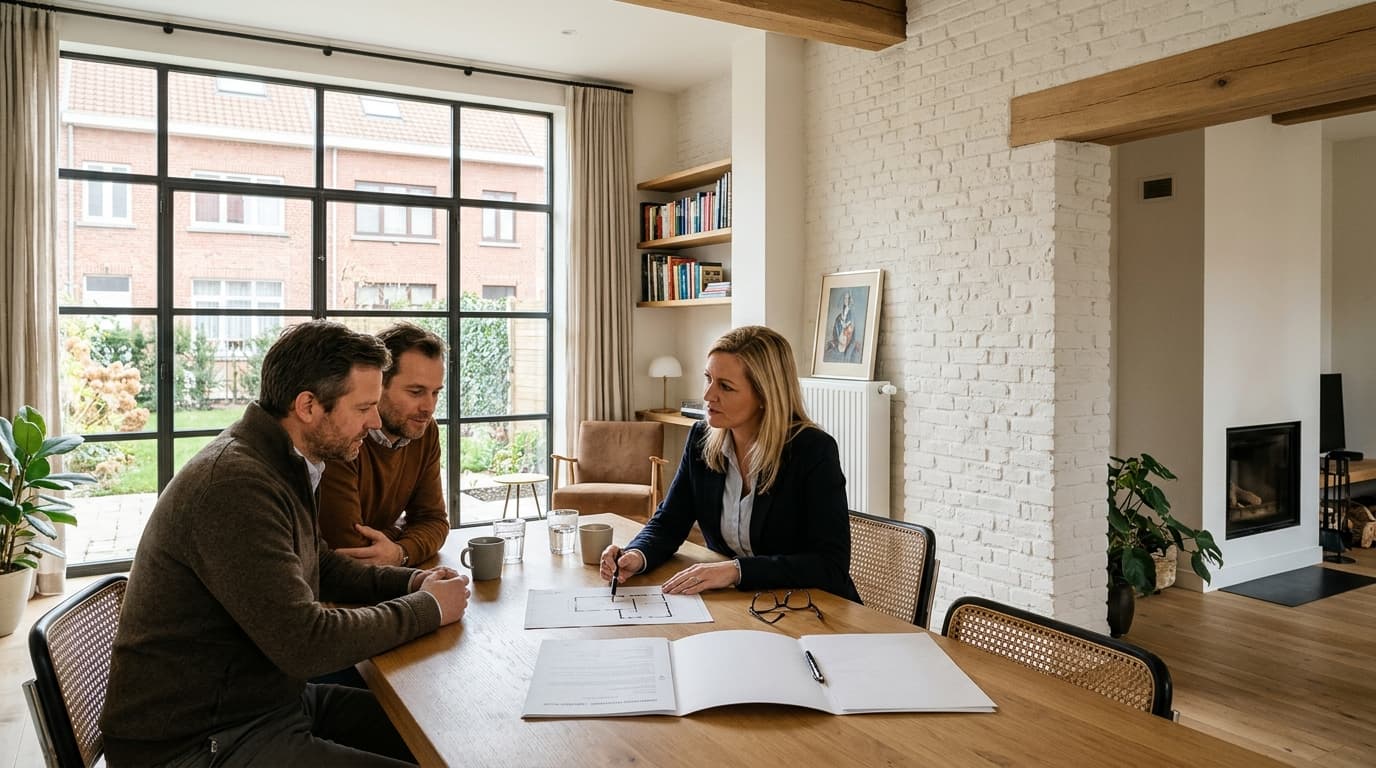
A party wall when selling a house raises plenty of questions for sellers. Who owns the wall, who pays for repairs, and what if the neighbour once built against it without paying? In terraced and semi-detached houses, a shared wall like this is the rule rather than the exception. In this article you will read what joint ownership of a wall means legally, what you include in the sale file and how to keep the wall from disrupting the negotiation.
What exactly is a party wall?
A party wall is a wall on the boundary between two plots that belongs to both owners together. Lawyers in Belgium call it a "mandelige muur" in Dutch or a "mur mitoyen" in French. Each owner is a co-owner of the whole wall, not of the half on their own side. That is different from a wall that stands entirely on your own land and belongs to you alone, even if it touches the boundary.
Since 1 September 2021, the rules on party walls have been set out in Book 3 of the new Belgian Civil Code, which deals with property. The principle has stayed the same as before: a dividing wall between two buildings is presumed to be a party wall, unless a title deed or a clear sign proves otherwise. That presumption can therefore be rebutted, for example by an old deed or a survey plan.
For a seller, this has a practical consequence. You are not only selling your house, but also your share in that wall, with the rights and obligations attached to it. These pass automatically to the buyer, just as with an easement when selling your house.
Party wall or private wall: how do you know which one you have?
Start with your title deed. The purchase deed, or older deeds it refers to, sometimes states explicitly whether a wall is a party wall or not. For a new build in a housing development, the subdivision deed often contains agreements about waiting walls and neighbours building against them later.
✦ 100% free & No obligation
Sell your property with the best agent
Compare the top 3 agents in your region for free and save on commission.
Compare agents →If you find nothing in the deeds, a survey plan drawn up by a chartered surveyor will help. It shows whether the centre line of the wall lies on the plot boundary. The land registry plan also gives a first indication, but it is not meant to prove property boundaries. If in doubt, a survey is the safest route, especially if you have already had a dispute with the neighbours about the boundary.
A common case is the waiting wall: a wall that one owner built entirely on their own land or on the boundary, expecting the neighbour to build against it later. As long as the neighbour does not build, that wall is usually not a party wall. If the neighbour does build against it, the question arises whether they bought into the joint ownership.
The payment for acquiring joint ownership of the wall
Anyone who wants to build against a neighbour's wall can acquire joint ownership of it. They then pay compensation for the part of the wall they use, and in principle also for the land on which that part stands. Exactly how that compensation is calculated depends on the dimensions of the wall, the value of the materials and the agreements in the deeds. A chartered surveyor or architect often draws up a valuation statement.
In practice, it regularly happens that a neighbour builds against the wall without anyone ever settling up. For you as a seller, this raises a question that is often overlooked: who has the right to still claim that compensation, you or the buyer? The answer is not obvious. That is why a preliminary sale agreement (compromis) and a notarial deed usually contain a clause that settles it: either the seller keeps the right, or transfers it to the buyer.
Read that clause before you sign. If you know that compensation is still outstanding, have it stated explicitly. The same applies the other way round: if you yourself once built against your neighbour's wall without paying, the buyer may later be confronted with that claim. Disclosing it in advance avoids a dispute after the deed.
What do you include in the sale file?
As a seller, you must inform the buyer correctly about the condition of the house. For a party wall, that means in concrete terms:
- whether the wall is a party wall, or belongs entirely to you or to the neighbour;
- whether any compensation for joint ownership is still outstanding, in your favour or against you;
- whether the wall has defects, such as damp problems, cracks or a loose coping;
- whether there are agreements with the neighbours about maintenance, repairs or raising the wall.
Add the documents you have: deeds, survey plans, a valuation statement or invoices for shared repairs. They belong in the same file as the other papers you are collecting; our overview of the documents you need to sell your home helps you not to forget anything. A good estate agent will ask for them at the first meeting. Want to know how different agents handle a file like this? Compare up to three licensed agents for free in your area.
Maintenance, repairs and damp problems
The costs of maintaining and repairing a party wall are in principle shared by the co-owners, in proportion to their rights. If the damage was caused by one owner, that owner bears the costs. If one neighbour wants to raise the wall, that is possible under certain conditions, but the raised part then in principle belongs to them alone until the other neighbour becomes a co-owner of it.
Damp problems in a party wall are a classic point of contention in a sale. A buyer who sees damp patches along the dividing wall wants to know where they come from and who has to fix them. If you know there is a problem, disclose it. Keeping quiet can later be treated as a hidden defect, with all the consequences that brings. A recent repair with an invoice works the other way, in your favour: it shows that the problem is known and has been dealt with.
If it is a wall between two gardens rather than between two buildings, other rules apply to its height and to the need for a permit. You will find them in our article on how high a fence between neighbours can be.
Does a party wall affect the sale price?
A party wall in itself does not lower the value of a house. Buyers of a terraced house expect one. What does count is uncertainty. An unclear boundary, outstanding compensation or damp damage that nobody wants to pay for gives a buyer an argument to offer less or to walk away.
How much that matters differs per house and per neighbourhood. A free valuation of your home gives you a first idea of its value. An agent who knows the local market can then judge how buyers will react to a specific issue with the wall and how best to communicate it.
In summary
A party wall comes with most terraced houses and is not a problem in itself when you sell. Find out in advance whether the wall is a party wall, whether any compensation for joint ownership is still outstanding and whether there are defects. State this clearly in the preliminary sale agreement and have the notary check the clause on compensation. Not sure how to approach it? Get support from an agent who knows this kind of file. Through ImmoMakelaarVergelijker.be you can compare up to three licensed agents near you, with no obligation.
Redactie ImmoMakelaarVergelijker
"We write about selling, valuing and costs in Belgium. Articles are drafted with the help of AI from official sources and checked by our team."