
Which documents do you need to sell your home in Belgium?

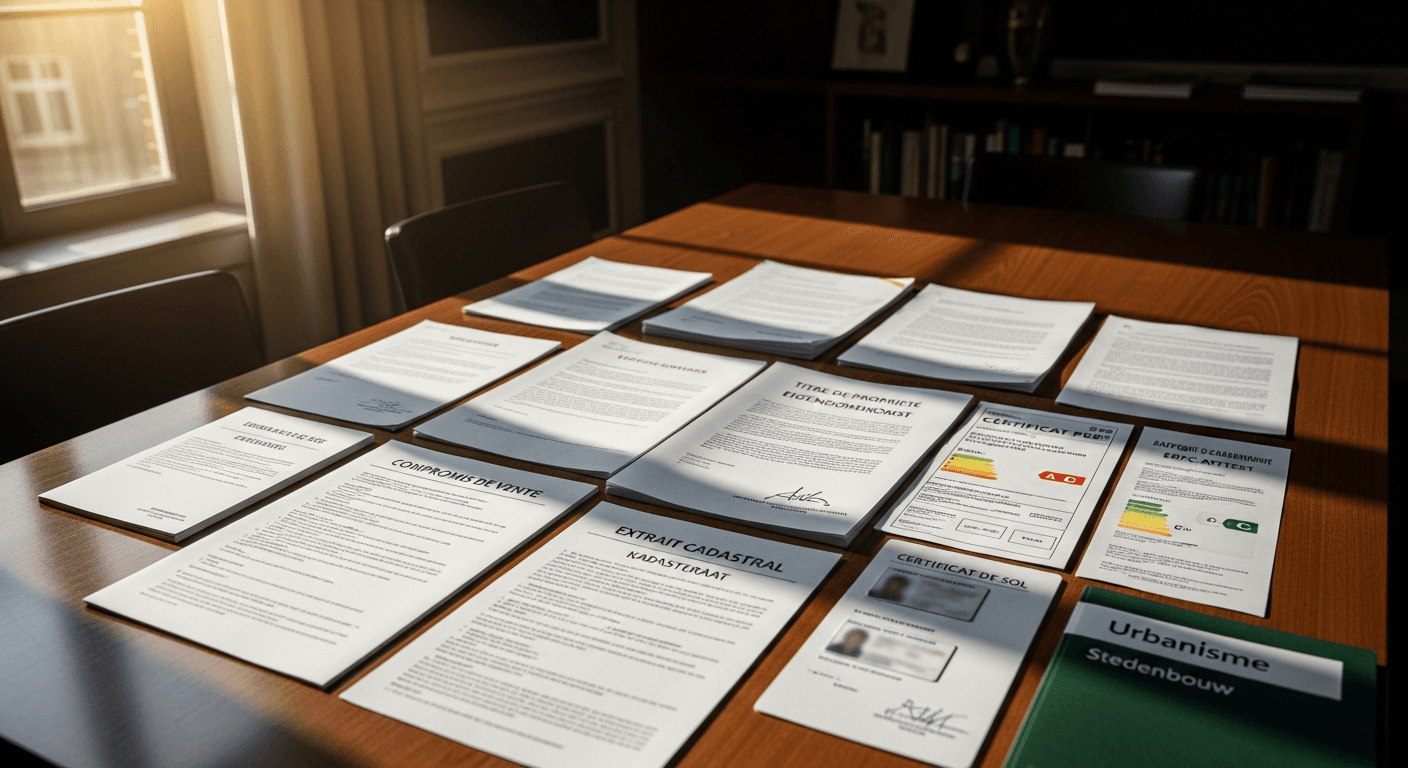
Before you put a listing online, it pays to know which documents you need to sell your home. In Flanders, part of that file is tied to the advertising, another part to the preliminary sales agreement and the rest to the notarial deed. Start too late and you easily lose a few weeks. Below you can read which paper you need where, who requests it and roughly how long you have to wait for it.
The base file you already have at home
A large part of the paperwork is already sitting in your own cupboard. Gather this together before your first appointment with an estate agent or notary:
- The title deed, meaning the notarial deed from when you bought, inherited or were gifted the property.
- The cadastral extract with the parcel number, the surface area and the cadastral income.
- Your identity details and, where applicable, your marriage contract or cohabitation contract. That helps determine who is allowed to sign.
- The outstanding balance of your mortgage loan, to be requested from your bank. The notary needs this to pay off the credit and have the mortgage cancelled.
- Invoices and warranty certificates for work carried out: roof, windows, boiler, solar panels, kitchen.
- The most recent property tax assessment for the precompte immobilier, for the settlement with the buyer.
Those invoices are more than a formality. They show a prospective buyer what has been renewed in recent years and support your asking price. Not sure yet which price bracket your home falls into? First request a free valuation of your home and build your file around that figure.
The mandatory certificates in Flanders
Alongside your own papers, Flemish regulations impose a series of certificates. Without these documents the sale cannot go ahead, or you run the risk that the buyer challenges the agreement.
- The energy performance certificate (EPC). Mandatory as soon as you advertise. The label and the index figure must appear in every listing. An EPC remains valid for ten years, so first check whether you still have a valid one.
- The asbestos certificate. Mandatory when selling a building dating from before 2001. You provide it to the buyer at the latest when signing the preliminary sales agreement. A certified asbestos expert comes on site for this.
- The soil certificate. To be requested from OVAM, and required before you conclude an agreement. If there is a risk activity on the parcel, the procedure is heavier and takes longer.
- The inspection report for the electrical installation. An approved inspection body checks the installation. If it is not compliant, that does not block the sale, but the buyer gets eighteen months after the deed to put everything in order.
- The inspection of a fuel oil tank, if you have one, plus the certificates for your gas installation or boiler.
- The post-intervention file for work carried out since 1 May 2001. If it is missing, the notary records that in the deed.
Planning information and the water assessment
A buyer wants to know what they may do with the property. That is why you request the property information from your municipality, which in Flanders runs through the Vastgoedinformatieplatform. That package tells you, among other things:
✦ 100% free & No obligation
Sell your property with the best agent
Compare the top 3 agents in your region for free and save on commission.
Compare agents →- what the planning designation of the parcel is;
- which permits have been issued and whether any building violations are known;
- whether a right of pre-emption or a summons rests on it;
- whether the property is listed or appears on an inventory.
In addition, your listing must state the flood sensitivity by means of the P score for the parcel and the G score for the building. Between your request to the municipality and the delivery of the file there are often several weeks. This is usually the slowest part of the entire paperwork, so request it first.
Selling an apartment? Then this is added
For a unit in a co-ownership, the managing agent provides a separate information package. Request it in good time, because a statutory deadline applies to it and the managing agent usually charges a fee for it. It concerns:
- the base deed and the co-ownership regulations;
- the minutes of the general assemblies of recent years;
- an overview of the ordinary and extraordinary charges of the most recent financial years;
- the status of the reserve fund and the working capital fund;
- the ongoing disputes and the decisions on planned works.
That last point in particular causes discussion at the negotiating table. If a facade renovation or a lift replacement has been approved but not yet carried out, the buyer wants to know who pays the bill. Put that arrangement in writing in the preliminary sales agreement. Compare up to 3 BIV-accredited estate agents from your municipality and ask each candidate how they factor such ongoing works into the price.
Brussels and Wallonia: different names, the same logic
If you do not live in Flanders, the list changes in part. The energy certificate is called the PEB certificate in Brussels and Wallonia and is drawn up by a different certifier. The asbestos certificate currently exists only in Flanders. For the soil, Wallonia issues an extract from the soil condition database, while in Brussels you request a soil certificate from Brussels Environment. The inspection of the electrical installation applies throughout the country, as does the post-intervention file. You always request the planning information from the municipality, but the processing time varies considerably from one municipality to another. If you are selling a second residence or a property in a different region from the one where you live, get guidance from someone who works there daily and knows the local waiting times.
When does each document need to be ready?
The order matters more than the list itself. Work in three blocks:
- Before the advertising. The EPC with its label and index figure, the flood scores and the permit situation belong in your listing. Without an EPC you strictly speaking cannot place a listing.
- Before the preliminary sales agreement. The soil certificate, the asbestos certificate and the managing agent documents must be there before you sign. The buyer partly bases their offer on that information.
- Before the notarial deed. The electrical inspection report, the post-intervention file, the balance of your loan and the definitive property information from the municipality.
On timing: an EPC or an electrical inspection can usually be scheduled within one to two weeks, and a soil certificate for an ordinary parcel follows quickly. For an asbestos certificate and for the property information from your municipality you had better count on several weeks. Start with those two as soon as you have decided to sell, and not only once a buyer is already waiting.
Your next step
The paperwork involved in a sale is extensive, but it is predictable. Start with the documents that have the longest waiting time, the asbestos certificate and the property information from your municipality, and gather your own documents in the meantime. An estate agent who knows your municipality knows how long each service takes over a request and applies for most certificates on your behalf. Compare up to 3 BIV-accredited estate agents from your municipality, free and without obligation, and ask at the introduction which documents they arrange themselves, what you need to supply and which costs are attached to that.
Frequently asked questions
Which documents do I need before I can place a listing for my home in Flanders?
Before advertising, you need a valid Energy Performance Certificate (EPC) showing the label and index figure, the flood scores (P score and G score), and the permit situation from your municipality. Without an EPC you cannot legally place a listing.
Is an asbestos certificate required when selling my home in Belgium?
In Flanders, an asbestos certificate is mandatory when selling a building built before 2001. You must provide it to the buyer at the latest when signing the preliminary sales agreement, and a certified asbestos expert must visit the property to draw it up.
What extra documents do I need if I am selling an apartment in Belgium?
When selling an apartment in a co-ownership, you need to request a separate information package from the managing agent. This includes the base deed, co-ownership regulations, minutes of recent general assemblies, an overview of charges, the status of the reserve fund, and any ongoing disputes or planned works.
What is the slowest part of gathering the paperwork when selling a home in Flanders?
The property information requested from your municipality through the Vastgoedinformatieplatform is typically the slowest step, often taking several weeks between your request and delivery. The asbestos certificate also takes several weeks, so the blog advises requesting both as soon as you decide to sell.
Does a non-compliant electrical installation prevent me from selling my home in Belgium?
No, a non-compliant electrical installation does not block the sale. However, the buyer receives eighteen months after the notarial deed to bring the installation up to standard.
"Tech entrepreneur and strategist focused on digital transformation in the real estate sector."