
Selling an unfinished house: finish the work or sell as is?

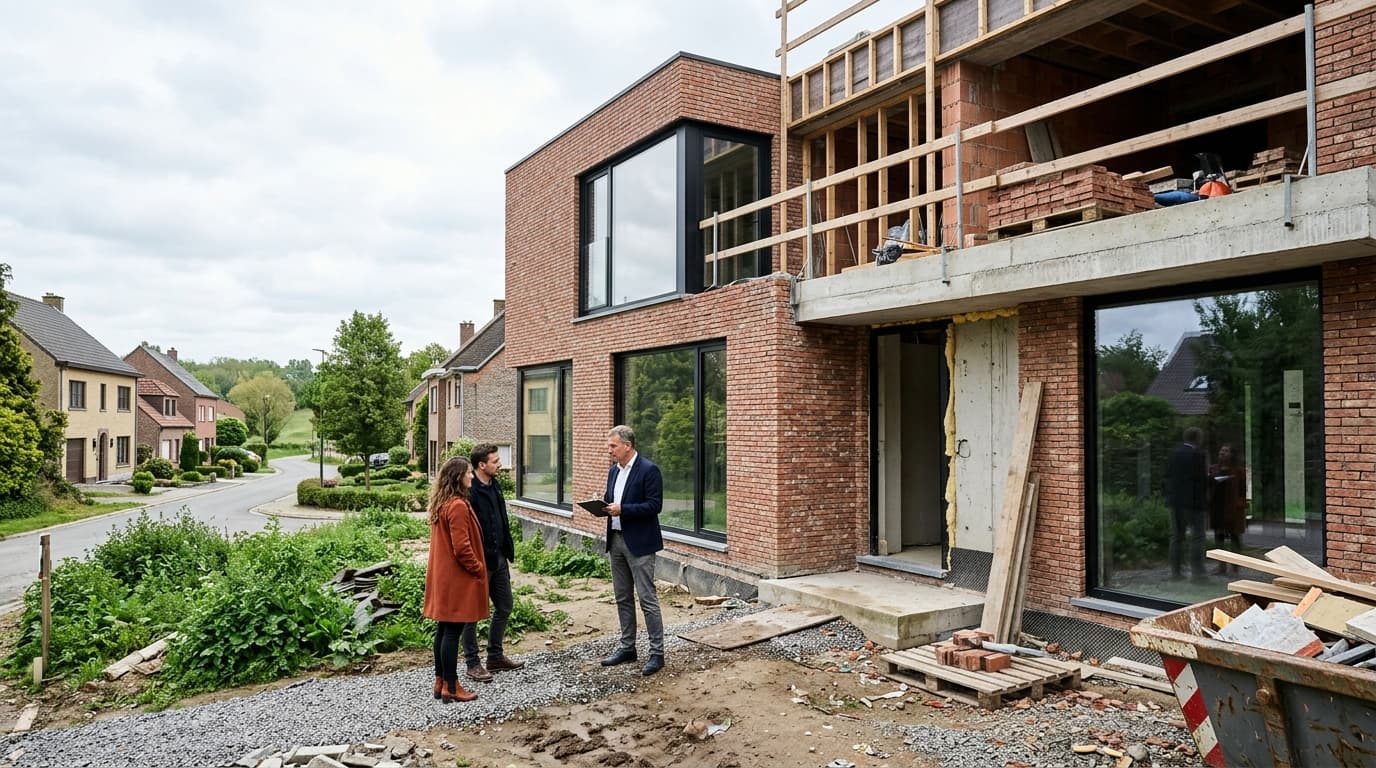
Selling an unfinished house is perfectly possible, but it calls for a different approach than selling a home that is ready to move into. Maybe a renovation ran over, your family situation changed or the budget ran out. In a house like that, buyers mainly see risk and work. In this article you will read when finishing the work pays off, which papers the notary will ask for and how to arrive at a price that buyers take seriously.
When is a house considered unfinished?
The term covers a wide range. At one end is the shell house: the structure, roof and windows are done, but inside there are no pipes or wiring, no plastering, no kitchen and no bathroom. At the other end is the house that is almost finished, where only the floors, the painting or a terrace were still on the schedule. In between are the many houses where a renovation came to a halt halfway through.
For the sale, that difference matters a lot. The more work that remains, the smaller the group of buyers. A family that wants to move quickly will drop out when faced with a shell house. Those who are interested are often buyers with renovation experience, contractors or investors. They do their sums carefully and will not pay full price for uncertainty. So start by mapping out precisely what is finished, what is half finished and what still has to be done from scratch. You will use that list at every step of the sale.
Finish the work or sell the house as it is?
The first question is usually whether you will still complete the work. There is no fixed answer, but a few questions help you decide.
Does finishing bring in more than it costs? Have one or two quotes drawn up for the remaining work. Compare that cost with the difference between the value in its current state and the value once finished. If the added value is barely above the cost, you gain little and you do lose time.
✦ 100% free & No obligation
Sell your property with the best agent
Compare the top 3 agents in your region for free and save on commission.
Compare agents →Do you have the time and money to carry the work? A house that stands empty during works costs money: the mortgage, insurance, property tax and energy keep running. If you already live elsewhere, you pay twice.
Is the finishing a matter of taste? A kitchen, a bathroom or a floor is something every buyer prefers to choose themselves. Technical work such as the roof, insulation and electrics usually does increase the value, because buyers find it hard to assess themselves.
A middle course is often the wisest: finish what is needed for technical or safety reasons, and leave the finishing to the buyer. The same trade-off applies to a house with a weak energy rating, which we discuss in more detail in our article on selling a house with a poor EPC rating.
Permits and the post-intervention file
With a house under renovation, the notary takes a closer look at the planning situation. Work that requires a permit, such as an extension, a new roof shape or a change in the number of housing units, must be permitted. In Flanders this means an environmental permit (omgevingsvergunning). If you are working under a permit, check that it is still valid. A permit can lapse if the work does not start in time or is stalled for too long. Your municipality can confirm its current status.
If the house is sold with a permit for work that is still in progress, the buyer needs to know what has been permitted and what they still have to carry out. So add the plans and the permit to the sale file. If work was done without a permit, first read our article on selling a house without a planning permit, because that calls for its own approach.
A second document that is often forgotten is the post-intervention file. This file brings together the technical information on work carried out by contractors: materials used, plans of the pipes and wiring, and points to watch for future maintenance. When the house is sold, it must be handed over to the buyer, and the notary mentions this in the deed. Request it in good time from the safety coordinator of your building site, even if the work is not finished.
Certificates: EPC, electrics and what the buyer takes over
An unfinished house also needs the usual sale certificates. An energy performance certificate (EPC) is mandatory as soon as you put the house up for sale. For a house under works, the rating often turns out low, because the energy assessor only takes into account what is actually present today. In Flanders, a buyer of a home with a weak rating must also renovate within a set period. The Flemish Energy and Climate Agency publishes the current rules. That weighs on what buyers are willing to pay.
The electrical installation requires an inspection report. If the installation is not finished or not compliant, the buyer is given a deadline to bring it up to standard. In a house that will be fully renovated anyway, a negative report is not a disaster, provided you disclose it in advance.
Be honest about what you know. A buyer of an unfinished house accepts a lot, but not finding out after the purchase that there is damp in the cellar or that a load-bearing wall was removed without a structural study. Whatever you keep quiet about may later count as a hidden defect. In our article on hidden defects when selling a house you can read how far your liability extends.
The right price and convincing buyers
The price of an unfinished house is usually not the value once finished minus the cost of the work. Buyers also factor in a margin for risk, for their own time and for the uncertainty about what they might still run into. The better you remove that uncertainty, the smaller that margin.
You do that with a clear file: a list of the work carried out with invoices, the plans, the permit, the quotes for the remaining work and photos of hidden parts such as pipes, wiring and insulation before they were covered up. A buyer who can see what is inside the walls dares to offer more.
Also keep in mind that financing can be harder for buyers. A bank lends on the basis of the property's value and, for major works, often asks for a valuation or a renovation loan. A buyer who knows this in advance plans better and is less likely to pull out after the preliminary sale agreement.
Start with a realistic picture of the current value. A free valuation of your home gives you a first starting point. An estate agent who regularly sells homes in need of renovation also knows the profile of buyers looking for such properties and how best to present your house. Through ImmoMakelaarVergelijker.be you can compare up to three accredited estate agents in your area, with no obligation.
In summary
Selling an unfinished house works best with a clear picture of what is finished and what is not. Work out whether finishing pays off, preferably complete the technical and safety-related part, and leave the matters of taste to the buyer. Make sure the permit, the post-intervention file and the certificates are in order, and disclose what you know about the condition of the house. That way you shrink the risk margin buyers build in. Want to know how an estate agent would approach your home? Compare local estate agents for free.
Redactie ImmoMakelaarVergelijker
"We write about selling, valuing and costs in Belgium. Articles are drafted with the help of AI from official sources and checked by our team."