
Heating oil tank when selling a house in Flanders: what do you need to arrange as a seller?

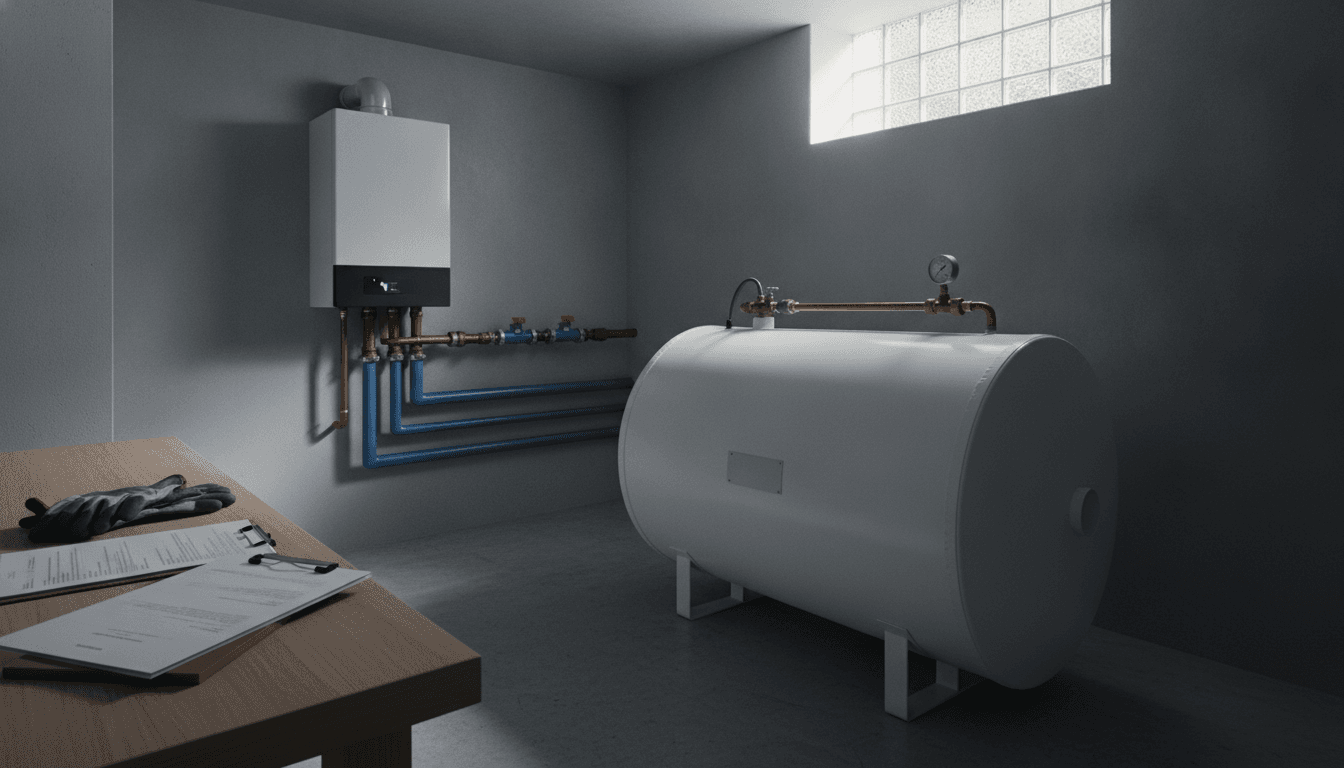
Heating oil tank when selling a house in Flanders: what do you need to arrange as a seller?
A heating oil tank when you sell your home immediately raises questions for buyers: is the tank in order, is it leaking, and what will it cost if it has to go? As a seller, you are better prepared if you already have those answers on paper. This article explains which inspections apply in Flanders, which documents the notary and the buyer ask for, and how a tank affects the negotiation on price.
Why buyers and notaries ask about the heating oil tank
For a buyer, a heating oil tank is not a neutral part of the property. There are three concerns. The first is safety and proper working: in Flanders, a tank that has not been inspected cannot simply be refilled. The second is the risk of soil contamination. A leaking underground tank can pollute the ground, and a clean-up quickly costs far more than the tank itself. The third concern is the future: many buyers want to switch to a heat pump or another system, and factor the cost of decommissioning the tank into their offer.
The notary will ask about the tank when preparing the deed of sale, because the condition of the tank and the soil can have consequences for the buyer. A well-drafted sales agreement (compromis) therefore contains a clause about the heating oil tank: is there a tank, where is it, is it in use, and which inspection documents go with it. The more fully you can answer these questions in advance, the less room there is for doubt or a lower offer.
The tank inspection and the inspection label
In Flanders, a heating oil tank must be inspected periodically by an accredited technician. How often depends on the type of tank (above ground or underground) and its capacity. The exact intervals are set out in Flemish environmental regulations and explained on vlaanderen.be; have them confirmed for your own tank by an accredited technician, because the rules have been changed several times in the past.
After the inspection, the tank receives a label with a colour code. A green label means the tank is in order. An orange label points to defects that must be repaired within a set period. A red label means the tank may no longer be filled until the problems are solved. The technician also gives you an inspection certificate.
✦ 100% free & No obligation
Sell your property with the best agent
Compare the top 3 agents in your region for free and save on commission.
Compare agents →For the sale, that certificate is your most important piece of evidence. A recent certificate with a green label reassures the buyer and removes a negotiating argument. If the last inspection was a long time ago or the certificate is missing, it pays to have the inspection done before you put the house on the market. That way you know where you stand yourself, and you are not caught off guard if the buyer brings an expert along.
Tank out of use: emptying, cleaning, filling or removing
Many homes still have an old tank that has not been used for years, for example because the owner switched to natural gas. Under the Flemish rules, a tank that is permanently out of use must be formally decommissioned. This is done by an accredited technician: the tank is emptied and cleaned, and an underground tank is then usually filled with an inert material or removed completely. You receive a decommissioning certificate.
For a seller, the difference is big. A tank that sits in the ground without a certificate is an unknown risk for a buyer. A tank that has been properly decommissioned, with a certificate, is a closed file. If you no longer have the certificate from an earlier decommissioning, ask the company that did the work or the previous owner. If that fails, a technician can assess the situation again.
Whether you should still have the tank removed yourself depends on the situation. Sometimes it is cheaper to reflect the cost in the price than to have the work done. Discuss this with your estate agent before you set the asking price. A local agent knows how buyers in your municipality react to a tank like this. By comparing estate agents on ImmoMakelaarVergelijker.be you get free, no-obligation contact with up to three accredited agents in your area.
Heating oil tank and soil certificate
Every sale of land in Flanders requires a soil certificate (bodemattest) from OVAM. That certificate states what OVAM knows about the soil of your plot. It is important to understand what it does not do: a soil certificate without remarks does not prove that your heating oil tank has never leaked. It only says that OVAM has no data on contamination.
A buyer who has doubts about an old underground tank can therefore ask for a soil survey or a leak test. How you deal with such a request is a negotiating choice. With a recent inspection certificate or a decommissioning certificate you are in a stronger position. You can read more about the procedure and the costs in our article on the soil certificate when selling your home. An overview of all the certificates you need to provide as a seller can be found under the cost of certificates when selling a house.
If you live in Brussels or Wallonia, different rules apply to heating oil tanks and soil. In that case, check with Brussels Environment or the Walloon public service (SPW), or ask your notary which documents are needed in your region.
What the tank means for your asking price
A heating oil tank does not make a house unsellable, but buyers do the maths. They think about the cost of having the tank inspected, decommissioned or removed, and sometimes about a new heating system. The Flemish EPC label also plays a role: a home heated with oil often scores less well, and in Flanders a renovation obligation applies to certain purchases. Buyers factor these costs into their offer.
Before you set the asking price, it is therefore worth knowing how much the tank counts as an argument, positively or negatively. A free valuation of your home gives you a first idea of the market value. An agent who visits the property can then estimate how much room buyers will ask for because of the tank and the heating.
In any case, be open about the tank. If you keep quiet about a known underground tank, you run the risk that the buyer later invokes a hidden defect. Transparency in the listing and the sales agreement protects you more than a slightly higher price.
Checklist for sellers with a heating oil tank
- Find out where the tank is, how big it is and whether it is above ground or underground.
- Collect the latest inspection certificate and check the colour of the label.
- Have an accredited technician carry out an inspection if the certificate is missing or out of date.
- No longer using the tank? Have it properly decommissioned and keep the certificate.
- Request the soil certificate from OVAM in good time.
- Discuss with your agent how to mention the tank in the listing and the sales agreement.
Want to know how agents in your region handle a file like this? Compare up to three accredited estate agents and choose the one who will guide you best.
Frequently asked questions
Do I need to have my heating oil tank inspected before I sell my home?
The periodic inspection is an obligation that exists separately from the sale, but a recent inspection certificate is the best proof at the time of sale that the tank is in order. The notary and the buyer almost always ask for it.
Do I need to remove an old underground tank before the sale?
A tank that is no longer used must be properly decommissioned by an accredited technician. Removal is not always necessary; filling it is also an option. The decommissioning certificate is the most important document for the buyer.
Does a blank soil certificate prove that my heating oil tank is not leaking?
No. The soil certificate only states what OVAM knows about the land. A buyer can therefore ask for a soil survey or leak test if they have doubts about an old tank.
Does a heating oil tank lower the sale price of my home?
Buyers factor the cost of inspection, decommissioning and a new heating system into their offer. With complete certificates and open communication you keep that discount to a minimum.
In conclusion
A heating oil tank does not have to slow down your sale, as long as your paperwork is in order. Make sure you have a recent inspection certificate or a decommissioning certificate, request the soil certificate in good time and be open with buyers. That takes away the most commonly used negotiating argument. An experienced local estate agent helps you mention the tank correctly and set a realistic asking price.
"Real estate expert focused on quality control and strategic partnerships."