
Selling a home in a flood-prone area in Flanders: what must you disclose?

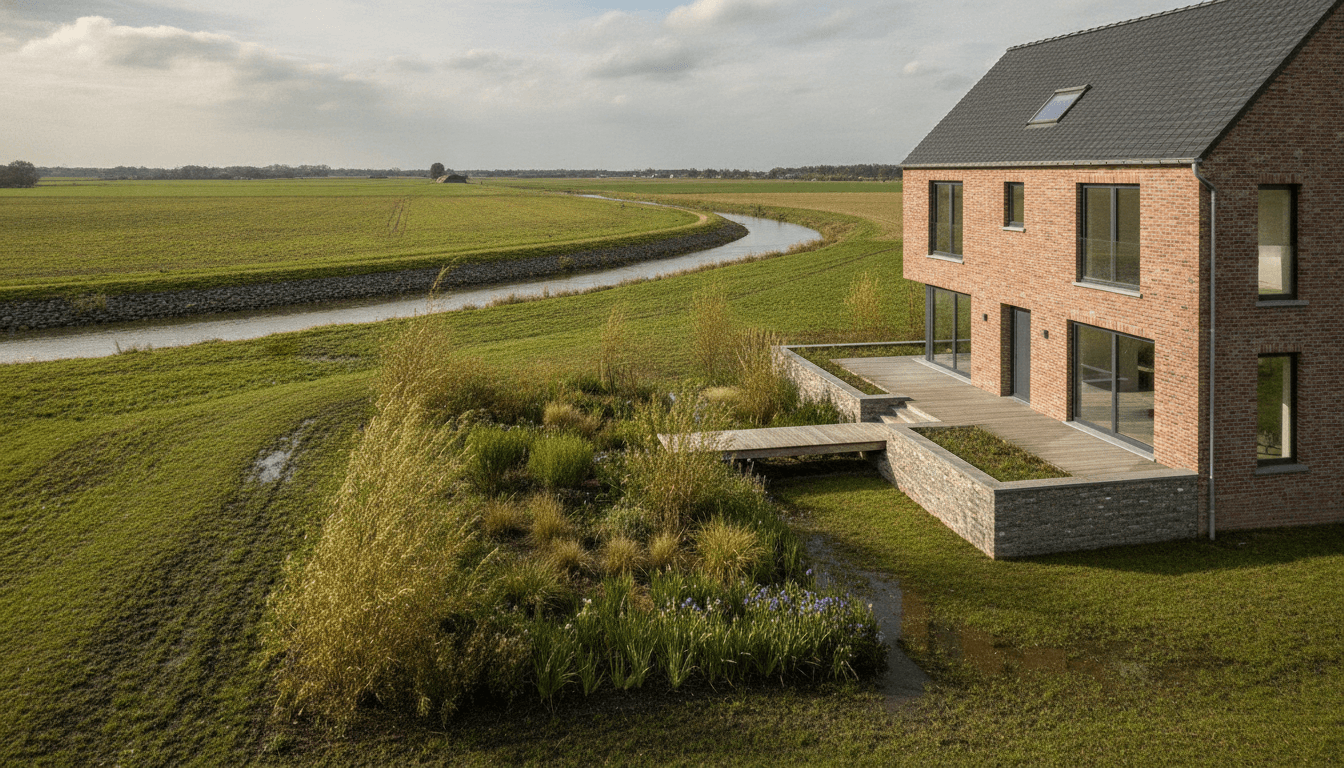
If you are selling a home in a flood-prone area, it pays in Flanders to take one extra step before the first viewing. The authorities assign a water score to every plot and every building, and that score belongs in your listing and later in the deed. Prospective buyers will see it either way. How you handle it decides whether the conversation is about your asking price or only about the risk.
What does flood-prone mean in Flanders?
Through the water assessment (watertoets), Flanders maps how likely it is that water will stand in a particular place. Two scores follow from this: a P-score for the plot and a G-score for the building. Both run from A to D, where A is the most favourable situation and D points to a repeated and real risk. That distinction between plot and building is not a detail. It regularly happens that part of the garden floods during heavy rain while the house itself sits higher and stays dry. Your plot can then carry a less favourable score than the building.
Important: the scores follow from models and from the history of the area, not from the condition of your home. You cannot have them adjusted by carrying out works. What you do influence is the actual chance of damage and the evidence that you have done something about it. You will find the official maps and explanations at the Departement Omgeving and on waterinfo.be. Consult that source for the situation at your address, because the maps are revised periodically.
What information must you provide as a seller?
Flanders imposes a duty to inform. The water scores belong in every publication of your home, so also in the listings on the property portals and on a notice in the window. They then return in the private sale agreement and in the notarial deed. In practice your estate agent and your notary fill this in, but the data does need to be available in time. So ask for it as soon as you decide to sell, not only when you sign.
The water score comes on top of the other documents you need anyway when selling in Flanders, such as the EPC, the soil certificate and the asbestos certificate. You will find an overview of those in our article on the cost of the certificates when selling a house. If you are selling in Wallonia or Brussels, different maps and different disclosures apply. In that case, check with your notary what is required there exactly.
✦ 100% free & No obligation
Sell your property with the best agent
Compare the top 3 agents in your region for free and save on commission.
Compare agents →Where do you find your P-score and G-score?
The quickest route is the Woningpas, where you log in with your address and see the details of your home in one place. Geopunt also shows the map layers on water safety, so you immediately see how your street and your neighbourhood score. If you want the full picture, request the property information from the municipality. Besides the water information, that file also contains planning data, and your notary or estate agent requests it themselves in most cases.
Look this up before you set a price, not after. A seller who only learns at the private agreement stage that the plot has a D-score has to change position in the middle of a negotiation. That costs money. Map out your own history straight away as well: have you ever had water in the cellar or the garage, how often, and what did you do about it? Invoices, photos and reports from your insurer carry more weight than reassuring words. Put them together with the certificates in one file for prospective buyers.
What does such a score do to your sale price?
There is no fixed percentage that you deduct from your price. The effect differs strongly per situation. A B-score on a plot where the building sits high and dry weighs lightly for most buyers. A D-score in a street with a known flooding history weighs heavily, certainly after recent damage. In both cases buyers check two things: will they be able to insure the home, and how does their bank look at it?
For insurance, cover against natural disasters in Belgium sits within the ordinary fire insurance for simple risks. Limitations are possible for buildings put up after a zone was designated as a risk zone. Request your policy and your claims history from your insurer, so that you can answer that question concretely.
How much the score weighs in your case can be read from what comparable properties in your street and municipality have fetched. That is the work of an estate agent who knows the neighbourhood. A free valuation of your home gives you a first guide price, and by comparing estate agents you hear straight away from several agencies how they would put this property on the market.
This is how you prepare the sale
With a well prepared file, the conversation shifts from uncertainty to facts. Work through these points before the first viewing takes place:
- Look up the P-score and the G-score and note the date of your consultation.
- Put your damage history honestly on paper, even if it is empty. No damage in twenty years is a selling point.
- Collect evidence of protective measures: a non-return valve, a waterproofed cellar finish, a pump installation, raised thresholds or a garden layout that lets rainwater soak away.
- Ask your insurer for the details of your policy and of any claims files.
- Take photos after a heavy rainfall period showing that the home stayed dry.
- Have the price supported by sales of comparable homes in the same situation.
Then choose an estate agent who is active in your municipality and has answered this question many times before. The difference shows during the viewing: an agency that knows the neighbourhood explains the score with figures from the street, while an agency from far away often gets no further than referring you to the notary. Energy performance calls for the same approach, as you can read in our article on the impact of a poor EPC rating on the sale price.
Your next step
You will not change a flood-prone location, but you can do something about it. Look up the scores, build your file and have your price supported by sales in your neighbourhood. That way the conversation with buyers is about facts instead of assumptions. Do you want to know what your home is worth today? Then request a free valuation. Do you want to see which agency handles this type of sale best in your municipality? Then compare estate agents without obligation and discuss your situation with a maximum of three agencies.
Frequently asked questions
What are the P-score and G-score in Flanders?
The P-score rates the flood risk for the plot and the G-score rates the flood risk for the building itself. Both run from A to D, where A is the most favourable and D indicates a repeated and real risk.
Where can I find the water scores for my property?
The quickest route is the Woningpas, where you log in with your address and see the details of your home in one place. Geopunt also shows map layers on water safety, and you can request the full property information from your municipality.
Am I required to include the water scores in my property listing?
Yes, Flanders imposes a duty to inform and the water scores must appear in every publication of your home, including listings on property portals and window notices. They also return in the private sale agreement and in the notarial deed.
Can I improve my water score by carrying out works on my home?
No, the scores follow from models and the history of the area, not from the condition of your home, so you cannot have them adjusted by carrying out works. What you do influence is the actual chance of damage and the evidence that you have taken protective measures.
How much does a bad water score reduce my sale price?
There is no fixed percentage - the effect differs strongly per situation. A less favourable score on a plot where the building sits high and dry weighs lightly for most buyers, while a D-score in a street with a known flooding history weighs heavily.
"Real estate expert focused on quality control and strategic partnerships."