
Property donation: what happens if the donor dies within 3 years?

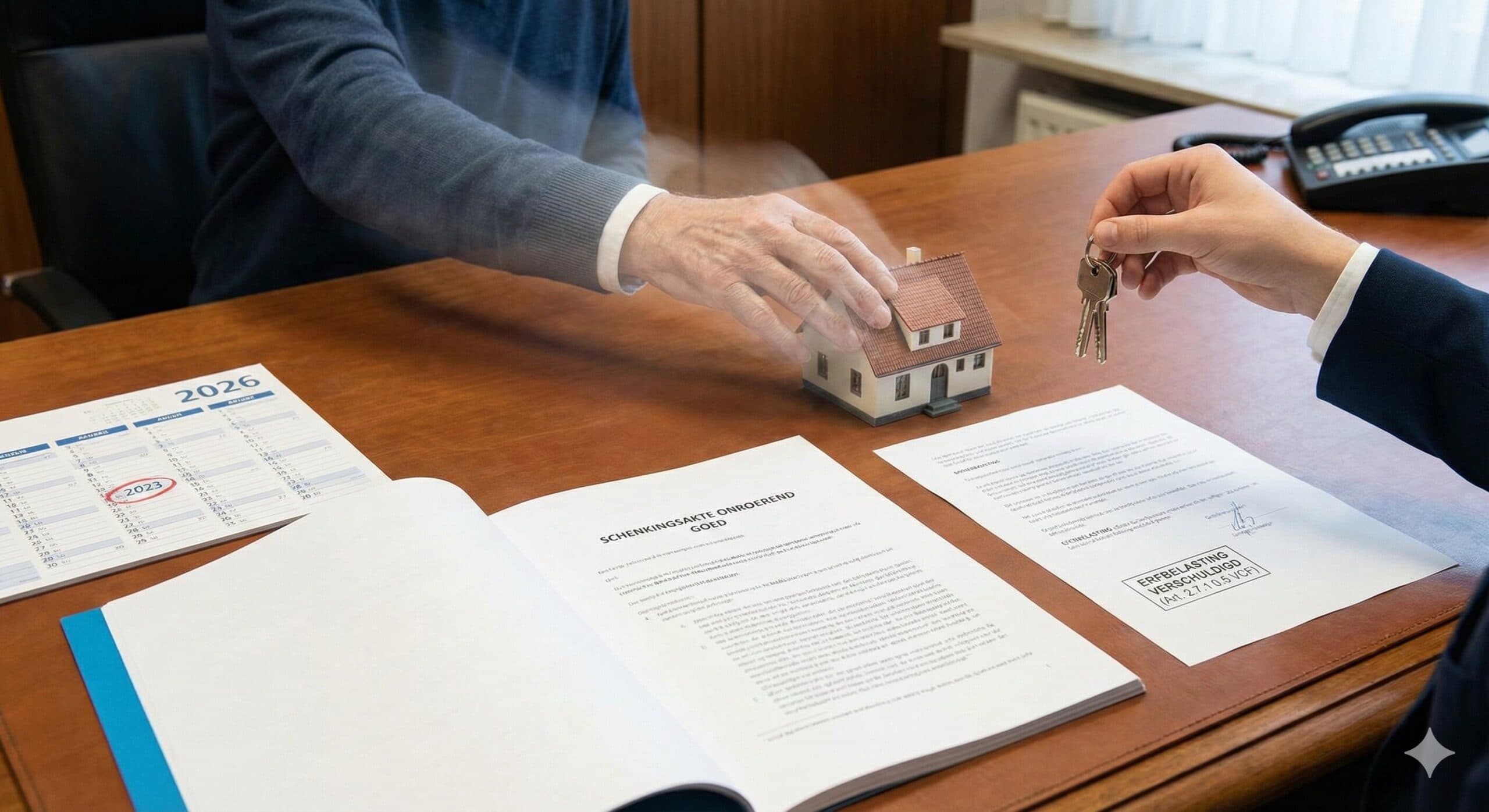
In real estate estate planning, the same question keeps coming up sooner or later: what happens with a property donation if the donor dies within 3 years? Parents may give an apartment or house to their children, but want to avoid that donation being fiscally "penalised" if they die shortly afterwards. In Belgium, different rules apply depending on the region, and concepts such as gift tax, inheritance tax and the so-called "push-up effect" all come into play. This guide gives you a clear overview in plain language, focused on real estate donations.
1. The basics: gift tax vs. inheritance tax on property
For a donation of real estate (a house, apartment or building plot, for example), a notarial deed is always mandatory in Belgium. That deed is registered and gift tax is due to the region where the donor has their fiscal domicile.
Key principles:
- On the property donation itself, you pay gift tax immediately.
- When the donor later dies, that same donated property is in principle no longer subject to inheritance tax: it is no longer part of the estate.
- The question of a property donation and death within 3 years is therefore not about double taxation on the same property, but about the impact on the rest of the estate.
In Wallonia, a "progressivity reserve" or "push-up effect" applies when the donor dies within three years of the donation: the donated value counts towards the rate of inheritance tax on the rest of the estate. The Brussels-Capital Region abolished this rule for property donations made from 1 January 2016. In Flanders, the well-known three-year period for property concerns two successive donations between the same people.
2. Flanders: the three-year period between two donations
In Flanders, the three-year period for property is first and foremost a rule of gift tax itself: the progressivity reserve. If the same donor gives property to the same recipient again less than three years after an earlier donation, the value of the first donation is added to the second. The progressive rate on the second donation then starts where the first one ended.
✦ 100% free & No obligation
Sell your property with the best agent
Compare the top 3 agents in your region for free and save on commission.
Compare agents →Gift tax on property in the direct line and between partners in Flanders is 3% up to 150,000 euros, 9% from 150,000 to 250,000 euros, 18% from 250,000 to 450,000 euros and 27% above 450,000 euros. Giving an apartment worth 300,000 euros to one child therefore costs 22,500 euros in gift tax.
Example:
- Parents give their child an apartment worth 150,000 euros. Gift tax is 3%, or 4,500 euros.
- Two years later they give the same child a second property worth 150,000 euros.
- Because less than three years separate the two donations, the second one is taxed as though it comes on top of the first: 9% on 100,000 euros and 18% on 50,000 euros, 18,000 euros in total instead of 4,500 euros.
If the second donation waits at least three years, the rate starts again from the lowest bracket. A registered donation of property is no longer part of the estate. Only Wallonia still counts its value for the rates if the donor dies within three years (see section 4). Have your notary confirm whether a death shortly after the donation still has consequences for inheritance tax in your situation.
3. Brussels: no more push-up effect for property donations
In the Brussels-Capital Region, different rules apply to property donations. Since 1 January 2016, the donor's death within 3 years of the donation no longer has any impact on the calculation of inheritance tax for donated real estate.
In brief:
- Gift tax is paid on the property donation.
- If the donor subsequently dies, the donated value is no longer "pushed up" into the brackets for inheritance tax on the rest of the estate.
- There is therefore no longer any push-up effect for recent property donations in Brussels, which makes planning somewhat simpler.
Note: for donations made before 1 January 2016, older rules may still apply, meaning the push-up effect could still be relevant.
4. Wallonia: the timeline and push-up effect for donations
In Wallonia the rule does apply: in the case of a property donation and death within 3 years, the value of the donated property is added fictitiously to the other assets in the estate to determine the rate of inheritance tax on those assets. The donated property itself is not subject to inheritance tax.
For unregistered donations of movable assets (a hand-to-hand gift or bank transfer), Wallonia applies a five-year period to donations made from 1 January 2022: if the donor dies within that period, inheritance tax is due on the donation. Flanders applies this five-year period to donations made from 1 January 2025, and Brussels to donations made from 1 January 2026.
5. Registration and the three-year period: why proof matters
Because the moment of donation is so important in cases of property donation and death within 3 years, you must be able to prove that date beyond doubt. For property donations, this is the default, since they are registered by notarial deed. The date of the deed of donation is then the reference point.
For movable donations (cash, securities), a separate discussion exists around registered versus unregistered donations and the three- or five-year periods, but that is a different topic. Here we focus on real estate.
Key points:
- In Wallonia, the three-year period for the push-up effect starts from the date of the registered deed of donation.
- If the donor dies within that period, the push-up effect applies (not in Brussels for property donations made from 1 January 2016).
- In Wallonia, if the donor dies after that period (for example 3 years and 1 day), the donated property value is no longer counted for inheritance tax rate calculations.
6. Staggered donations: planning over time
Because gift tax is progressive (higher brackets as the value increases), it can be fiscally advantageous to donate a large property portfolio in several stages, with at least three years between each donation.
Typical strategy:
- You donate a portion of your real estate every three years, for example.
- With each deed of donation, gift tax is recalculated starting from the lowest bracket, rather than on one large total amount.
- In Wallonia, a donation made more than three years before your death also no longer counts towards the push-up effect on the rest of the estate.
In this way you can gradually transfer real estate, reduce the inheritance tax burden and respect the three-year period at the same time. Bear in mind: this requires careful planning and must be aligned with your own life expectancy, family situation and care needs.
7. Common misconceptions
A number of persistent misconceptions circulate around property donation and death within 3 years:
- "If I die within 3 years, my children will pay inheritance tax on the donated house again."
That is not correct: no inheritance tax is levied on the donated property itself, but in Wallonia its value can push up the rate on the rest of the estate. - "The three-year rule applies the same way everywhere."
Not true. The push-up effect on death within three years applies in Wallonia. In Brussels it was abolished for property donations made from 1 January 2016. In Flanders, the three-year period for property concerns successive donations. - "A donation is always fiscally better than doing nothing."
Donating can reduce inheritance tax, but ill-considered donations - especially just before death - can, through the push-up effect, deliver less benefit than expected and jeopardise your own financial security.
8. Practical considerations for owners and families
Anyone thinking about a property donation with the risk of dying within 3 years should bear in mind:
- Regional rules: where is your fiscal domicile (Flanders, Brussels or Wallonia)? The impact differs by region.
- The full picture of your assets: not only the donated property counts, but also the other real estate in your estate.
- Flexibility vs. control: are you donating full ownership or with a reserved usufruct? This determines your income and control after the donation, but also has an impact on valuation and planning.
- Timing: if your health is fragile, the risk of dying within three years is higher; you need to weigh carefully whether a large property donation is advisable right now.
9. Link to your property strategy
A property donation is not just a fiscal move - it is also a strategic decision about your real estate portfolio. It determines:
- who manages and maintains which property;
- who receives rental income;
- who bears which risks (renovation, vacancy, value fluctuations).
It is therefore wise to link donation questions to the broader question: which properties do you want to keep yourself, which can better pass to the next generation now, and which might you be better off selling first?
A local estate agent can help you determine the current market value of a property and help shape the sale or donation strategy around it. If you want to know what impact a donation today will have on your assets and on the future inheritance, it all starts with an accurate valuation of the real estate. With a free valuation, you get a concrete figure for your property, so that together with your notary or planner you can better assess whether, when and how best to donate - especially with the three-year period in mind.
Frequently asked questions
Do my children have to pay inheritance tax again on a donated property if I die within 3 years?
No, the donated property itself is not subject to inheritance tax again. However, in Wallonia its value is added fictitiously to the rest of the estate, which can push other assets into higher tax brackets. This is called the push-up effect. In Brussels this no longer applies to property donations made from 1 January 2016.
Does the 3-year rule work the same way in every Belgian region?
No. Wallonia applies the push-up effect when the donor dies within 3 years of the donation. The Brussels-Capital Region abolished this effect for property donations made from 1 January 2016. In Flanders, the three-year period for property concerns two successive donations between the same donor and recipient.
When does the 3-year period start for a property donation?
The period starts from the date of the registered notarial deed of donation. Because property donations always require a notarial deed in Belgium, this date is automatically recorded and provable.
What happens if the donor survives the 3-year period after the donation?
In Wallonia, if the donor dies more than 3 years after the donation, the donated property value is no longer counted for inheritance tax rate calculations and the push-up effect no longer applies. In Brussels the push-up effect no longer applies to property donations made from 1 January 2016.
Is it always better to donate property than to leave it as part of your estate?
Not necessarily. Donations made shortly before death can, through the push-up effect, deliver less tax benefit than expected. Ill-considered donations may also affect your own financial security, so careful planning is needed.
"Real estate expert focused on quality control and strategic partnerships."