
Registration Duties When Buying a Home: What Do You Pay in Belgium?

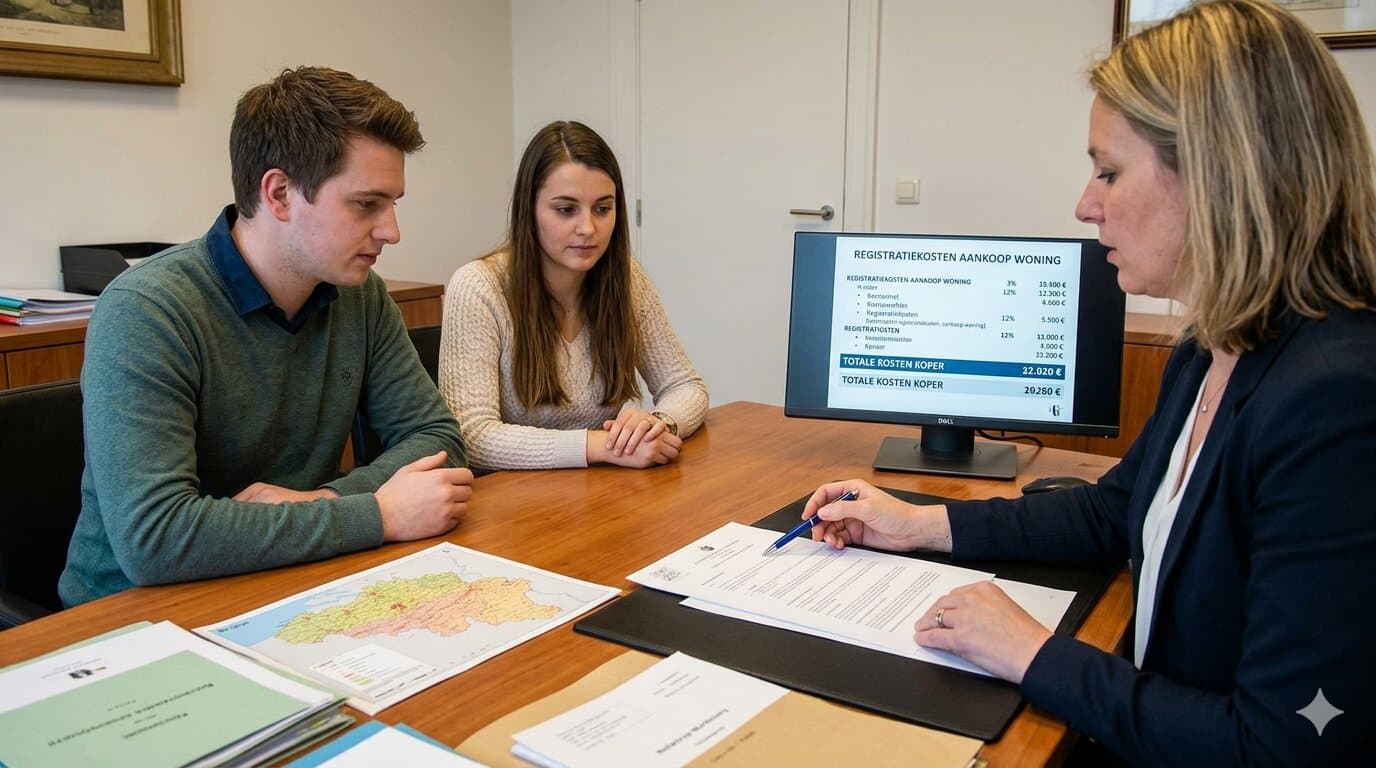
When buying a property, registration duties are added on top of the purchase price, and they should certainly not be underestimated. In Belgium, they represent one of the largest additional expenses alongside notary fees and any financing costs. Calculating correctly in advance prevents the budget from becoming too tight or unpleasant surprises emerging afterwards.
Registration duties also vary considerably depending on the region and the buyer's situation. In Brussels and Wallonia, the basic rate is in principle 12.5% on the purchase of a property or land, although specific preferential schemes also exist in both regions. In Flanders, the system works differently: since 1 January 2025, a rate of 2% registration tax applies in principle to the purchase of one's sole own home.
What are registration duties?
Registration duties are essentially the tax you pay on the registration of the deed of purchase. In Belgium, they are variously called registration duties, transfer duties or registration tax, depending on the region and the context. They are not part of the purchase price itself, but are added on top of it.
For many buyers, this is the largest additional cost when buying a home. That means you should not only look at the asking price, but also at the region in which the property is located and at your personal situation. Whether it is your sole own home in particular plays a major role.
Flanders in 2026
In Flanders, the system has been clearly reformed in recent years. For the purchase of your sole own home, a rate of 2% registration tax has applied since 1 January 2025 on the authentic deed of purchase. For those who do not meet the conditions, a higher rate generally applies, depending on the type of purchase.
✦ 100% free & No obligation
Sell your property with the best agent
Compare the top 3 agents in your region for free and save on commission.
Compare agents →Additional benefits also exist for a modest home, within certain price limits. According to available information, an additional reduction can apply in Flanders under certain conditions for properties below a particular threshold value. This means the effective amount can turn out to be lower than the standard percentage suggests.
Brussels and Wallonia
In the Brussels-Capital Region and the Walloon Region, the base level is different. There, you generally pay 12.5% registration duty on the purchase of a property or land. The calculation basis is typically the agreed price and the charges associated with the sale.
Exceptions and preferential schemes exist there too, but they work differently from those in Flanders. Brussels, for example, has an abatement on the first bracket of the purchase price, while Wallonia has its own reduced rates and preferential rules. As a result, the final cost can differ considerably from one file to the next.
Sole home or second residence
A crucial question when it comes to registration duties is whether the property is your sole own home. In Flanders, this distinction is particularly important today, because the rate there is considerably lower for a first and sole family home. If you buy a second home or an investment property, you generally pay a higher rate.
This difference has a direct impact on your budget. A buyer intending to purchase a property at 300,000 euros therefore needs to plan not only for the purchase price, but also for several thousand euros extra in registration duties. For second residences or additional properties, that amount can be noticeably higher still.
When do you pay?
Registration duties do not have to be paid upfront at the signing of the preliminary agreement, but must be paid within the legal deadline after the signing of the agreement. According to available information, that deadline is four months after the signing of the private agreement. This gives buyers a little breathing room, but the amount must be available in time.
In practice, this means you need to have your budget fully in order before the purchase. Registration duties are not an expense for which you can easily find a solution later. They must come from your own funds, on top of the other purchase costs.
What counts towards your budget?
When buying a property, people often think first of the price of the property itself. But in reality you also need to account for registration duties, notary fees and other purchase costs. Registration duties carry the greatest weight, because they are calculated directly on the purchase value.
It is therefore wise to always think of a purchase budget as broader than just the sale price. A property at 300,000 euros actually costs more than 300,000 euros, and that difference can be significant. Especially for young buyers and families, that extra margin is essential to avoid creating financial pressure before the move.
How do you calculate them?
The calculation depends on three factors: the region, the type of property and your personal situation. In Flanders, a rate of 2% is applied in many cases for a sole own home, while in Brussels and Wallonia the basic percentage is often 12.5%. On that basis, you can quickly estimate how much extra you need.
A notary can assist with a practical simulation. According to available sources, calculation tools exist that let you estimate the purchase costs of a property, though these always remain indicative. For anyone who is seriously considering making an offer, this is a useful first step.
Why this matters even more now
The Belgian property market has become more sensitive to total housing costs in recent years. Buyers are not only looking at the price of the property, but also at energy, renovation, financing and taxes. As a result, registration duties play an even greater role in the final decision.
A well-informed buyer has more control over their financial margin. This is especially important if you later also need to invest in renovations or energy upgrades. A realistic overall calculation makes the difference between buying comfortably and finding yourself financially stretched.
Link with selling and negotiation
Sellers too should keep registration duties in mind. The higher the additional purchase costs for the buyer, the more sensitive that buyer often is to the asking price. In a market where budgets are under pressure, a correctly priced property can attract interest more quickly.
Anyone who wants to know where their property stands in the market today would do well to request a free valuation. This helps to set a more realistic price and to better gauge how buyers will view the total cost picture. That way you can align selling and buying more effectively.
Common mistakes
A common mistake is that buyers look only at the repayment amount of their loan. In reality, registration duties are added on top of that, and often so are notary fees and any loan file costs. Those who forget these items quickly overestimate their purchasing power.
Another mistake is assuming that every region applies the same rules. That is not the case: Flanders, Brussels and Wallonia each work with different rates and conditions. As a result, the same property in a different region can have a completely different tax impact.
Practical conclusion
Registration duties are one of the most important cost items in Belgian real estate. They vary considerably by region and situation, and can significantly influence your purchase budget. Those who do the right calculation in advance buy with more confidence and less stress.
Would you like to better align your purchase or sale plan with the market? Start with a free valuation so you know exactly where your property or budget really stands.
Frequently asked questions
What rate of registration tax applies in Flanders when buying your sole own home?
Since 1 January 2025, a rate of 2% registration tax applies in Flanders for the purchase of your sole own home. For buyers who do not meet these conditions, a higher rate generally applies.
How much are registration duties in Brussels and Wallonia?
In both the Brussels-Capital Region and the Walloon Region, the base rate is 12.5% on the purchase of a property or land. Both regions do have preferential schemes, but these work differently from those in Flanders.
When do you have to pay registration duties in Belgium?
Registration duties must be paid within four months after the signing of the private agreement. They are not due at the signing of the preliminary agreement, but the amount must come from your own funds and cannot be arranged later.
Does it matter whether a property is your sole home or a second residence?
Yes, this distinction has a direct impact on the rate you pay - especially in Flanders, where the 2% rate only applies to a first and sole family home. Buying a second home or investment property generally means paying a higher rate.
What costs should buyers include in their budget beyond the purchase price?
On top of the purchase price, buyers need to account for registration duties, notary fees, and any loan file costs. Registration duties carry the greatest weight because they are calculated directly on the purchase value.
"Real estate expert focused on quality control and strategic partnerships."