
Renting or buying in Belgium: full financial comparison

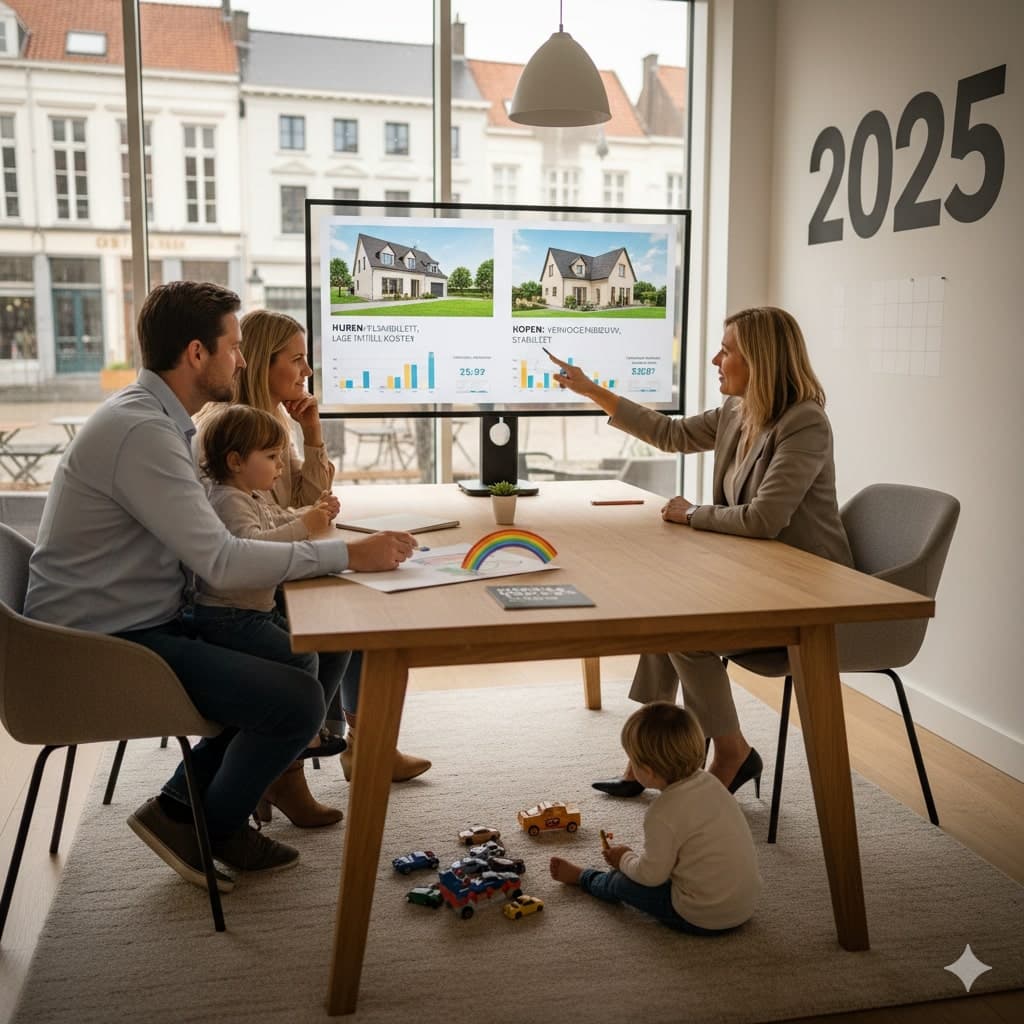
Renting or buying in Belgium in 2025: this question keeps millions of Belgians up at night. With mortgage rates currently sitting at 3.1-3.4%, soaring rents and an uncertain economy, the choice feels more complicated than ever. Yet the facts speak clearly: buying remains financially advantageous in the long run for most Belgians. But "long run" is the key phrase. This article gives you the complete financial picture - monthly costs, wealth building, flexibility - so that You can make the right choice for Your situation.
The core question: who benefits from what?
Renting or buying is not one-size-fits-all:
- Renting is better if: You want flexibility, plan to stay fewer than 5-7 years in the same place, do not have €30-50k in starting capital, or prefer not to deal with maintenance
- Buying is better if: You want long-term stability, want to build wealth, aim for home ownership, or plan to stay in the same place for more than 7 years
Let me work through both sides using current Belgian figures.
Finances: Monthly costs - Buying vs. Renting in 2025
This is where the decision really comes into focus. Renting or buying - which costs more per month?:
Practical example: Flanders, property worth €350,000
This is what buying with a mortgage looks like.
✦ 100% free & No obligation
Sell your property with the best agent
Compare the top 3 agents in your region for free and save on commission.
Compare agents →- Property: €350,000
- Own contribution (10%): €35,000 (you must have this!)
- Mortgage: €315,000
- Interest rate: 3.2% (current 2025 rate)
- Term: 25 years
- Gross monthly mortgage payment: €1,459/month
Additional costs (annual):
- Property taxes: €150-300/month
- Maintenance (1-2% of value per year): €290-580/month
- Insurance: €30-50/month
- Total monthly cost of buying: ~€1,900-€2,100
Renting (private market, equivalent property):
- Rent (comparable €350k property): €1,600-€1,900/month
- Maintenance: Landlord's responsibility
- Risk: Yours alone
- Total monthly cost of renting: ~€1,600-€1,900
First impression: Renting is cheaper! But:
The decisive factor: wealth building
This is where buying has a fundamental advantage:
After 15 years as a tenant:
- Total paid: €1,750 × 12 × 15 = €315,000 (all gone!)
- Net worth: €0
- Housing situation: Uncertain (landlord can terminate the lease)
After 15 years as an owner (same property):
- Total paid in monthly costs: €2,000 × 12 × 15 = €360,000
- Net worth: €350,000 (property) + €50,000-100,000 (appreciation) = €400,000-€450,000
- Housing situation: 100% secure (you are the owner!)
Net wealth difference: Owner: €400k-€450k | Tenant: €0
This is why researchers (Kremer & van Dijk, esb July 2025) conclude: buying is financially more advantageous in the long run for virtually everyone.
Scenarios: who is best off buying or renting?
Scenario 1: Young first-timer (25-30 years old), single, uncertain future
Best option: Renting
- Reason: Not enough savings yet (buying requires €35-50k of your own money)
- Flexibility is important (job may change, moving to another country is possible)
- No maintenance obligations or large repair bills
- Avoids the risk of owner-related debt
Timeline: Rent for 5-7 years, save in the meantime, buy later
Scenario 2: Family (35-45 years old), dual income, stable jobs
Best option: Buying
- Reason: Mortgage payments more affordable than rent for a comparable home
- Wealth building is essential (retirement is getting closer)
- Children need stability (not moving every year)
- The mortgage becomes part of a long-term life strategy (paying over 15-25 years)
Advantage: Every repayment = more equity
Scenario 3: Investor, renting out via Airbnb or long-term letting
Best option: Buying (to let)
- Reason: Rental income exceeds monthly costs (building a return)
- Property appreciates in value (inflation + scarcity)
- Rental income taxed on cadastral income (if you let to a private individual who lives there, you are taxed on the indexed cadastral income plus 40%, not on the actual rent)
- Passive income potential
Practical checklist: renting or buying - what suits You?
Answer these questions honestly:
| Question | Answer = Rent | Answer = Buy |
|---|---|---|
| How long will you stay in this location? | < 5 years | > 7 years |
| Do you have €40-50k in savings? | No | Yes |
| Do you want flexibility (career changes)? | Yes | No |
| Is stability important to you? | No (flexibility > stability) | Yes (ownership > flexibility) |
| Do you want to build wealth? | Not a priority | Yes, essential |
| Are you comfortable with maintenance responsibilities? | No | Yes |
| Is your income stable? | Variable | Very stable |
Score: More "Rent" answers = renting is the better option for now. More "Buy" answers = buying is probably the smarter move.
Regional differences: renting or buying by region
Flanders: buying usually the better deal
- Average property price: €379,737 (2025)
- Average rent (comparable property): €1,600-€1,900/month
- Monthly mortgage payment: €1,459-€1,650 + costs
- Verdict: Buying and renting are roughly comparable at the outset, but the buyer wins in the long run through wealth building
Wallonia: buying clearly the better option
- Average property price: €281,069 (2025)
- Average rent: €1,300-€1,600/month
- Monthly mortgage payment: €1,100-€1,300 + costs
- Verdict: Buying is clearly cheaper than renting. The wealth-building advantage is even more pronounced
Brussels: buying is expensive, renting offers more flexibility
- Average property price: €589,280 (2025)
- Average rent: €1,800-€2,200/month
- Monthly mortgage payment: €2,200-€2,500 + costs
- Verdict: Renting offers more flexibility for most people. Buying only makes sense for long-term investors with significant capital
Pros & Cons: Summary
Renting: Advantages
✓ Flexibility (easy to move)
✓ No maintenance responsibilities
✓ Lower initial costs (deposit + first month)
✓ No financial risk from market crashes
✓ Predictable monthly costs (no surprises)
Renting: Disadvantages
✗ No wealth building
✗ Rents rise annually with inflation
✗ Insecurity (landlord can terminate the lease)
✗ No sense of ownership
✗ No say over home modifications
Buying: Advantages
✓ Wealth building (mortgage = forced saving)
✓ Capital appreciation (in normal market conditions)
✓ Stability & permanence
✓ Complete freedom to customise your home
✓ Tax advantages (depending on region)
Buying: Disadvantages
✗ High upfront costs (€30-50k + registration duties)
✗ Maintenance & repairs (unexpected expenses)
✗ Less flexibility (selling a home takes time and money)
✗ Mortgage debt over decades
✗ Value can fall (market risk)
Buying advantages that renters miss out on
These are the real financial benefits of buying:
1. Your repayments = your wealth
Every mortgage payment reduces your debt and increases your equity. Renters build zero wealth.
2. Inflation works in your favour
Your mortgage rate is fixed (for example 3.2%). Inflation rises (say 2-3% per year). This makes your debt relatively smaller over time - you win! Renters lose out: rent rises in line with inflation.
3. Property appreciation
In normal market conditions, house prices grow by 2-4% per year. That gain is 100% yours as the owner. Renters benefit not at all.
4. Tax advantages
For mortgage loans taken out from 1 January 2025 there is no longer any tax benefit. If you borrowed earlier, you may still have a regional benefit under certain conditions. Today the main tax advantage of buying is the reduced registration duty on a home you live in yourself: 2% in Flanders, 3% in Wallonia, and in Brussels no duty on the first 200,000 euros if the price is no more than 600,000 euros. Renters have no equivalent benefit.
Practical guide: buying checklist
For those considering Buying:
- ✓ Build up €40-50k in savings (minimum 10% + costs)
- ✓ Check your borrowing capacity using the loan simulator
- ✓ Request a free property valuation via immomakelaarvergelijker.be
- ✓ Compare estate agents - not all give the same advice
- ✓ Make sure you plan to stay in the same place for at least 7 years with a mortgage (otherwise it is not cost-effective)
- ✓ Understand fixed vs. variable interest rates (fixed is better given current rates)
For those choosing to Rent:
- ✓ Negotiate the rent (many landlords are flexible)
- ✓ Take out tenant insurance (protects against unexpected costs)
- ✓ Savings goal: €40-50k over 5-7 years, then switch to buying
- ✓ Make sure the rental contract is clear (notice periods, renovation responsibilities)
- ✓ Build an exit plan: what will you do if the landlord stops renting out the property?
Conclusion: renting or buying in Belgium in 2025?
Renting or buying in Belgium in 2025, the answer is: Both, depending on your situation.
- Buying is in the long run (>7 years) almost always financially advantageous because wealth building works exponentially. Ownership = freedom, stability, capital.
- Renting offers a short-term advantage if you want flexibility, do not yet have enough savings, or face an uncertain future. Use your time as a tenant to save!
The scientific consensus (Kremer & van Dijk 2025): buying wins in the long run.
But your personal situation matters. If you are staying fewer than 5 years in the same place, or do not have starting capital, rent. Save in the meantime. In 5-7 years - once you want stability and want to build wealth - then buy.
Ready for the next step? Assess your situation using the questions above, and request a free estate agent comparison and property valuation - no obligation, just information.
Frequently asked questions
How much savings do I need before buying a home in Belgium?
You need at least €40,000 to €50,000 in savings before buying. This covers the minimum 10% own contribution plus additional purchase costs like registration duties.
Is renting cheaper than buying in Belgium?
On a monthly basis, renting is often cheaper - roughly €1,600 to €1,900 per month versus €1,900 to €2,100 for buying a comparable €350,000 property. However, buyers build wealth over time while renters end up with nothing to show for their payments.
How long do I need to stay in a property for buying to make financial sense?
You should plan to stay in the same place for at least 7 years when buying with a mortgage. If you move sooner, the upfront costs and reduced flexibility make buying less cost-effective.
Is buying or renting a better deal in Wallonia compared to other Belgian regions?
Wallonia offers the clearest financial case for buying, with average property prices at €281,069 and monthly mortgage payments often lower than comparable rents. The wealth-building advantage is more pronounced there than in Flanders or Brussels.
What are the main financial disadvantages of renting long-term in Belgium?
Renters build zero wealth, face annual rent increases tied to inflation, and have no security if the landlord decides to end the lease. After 15 years, a renter paying €1,750 per month will have spent €315,000 with nothing left to show for it.
"Real estate expert focused on quality control and strategic partnerships."