
Selling the family home before death: what are your options?

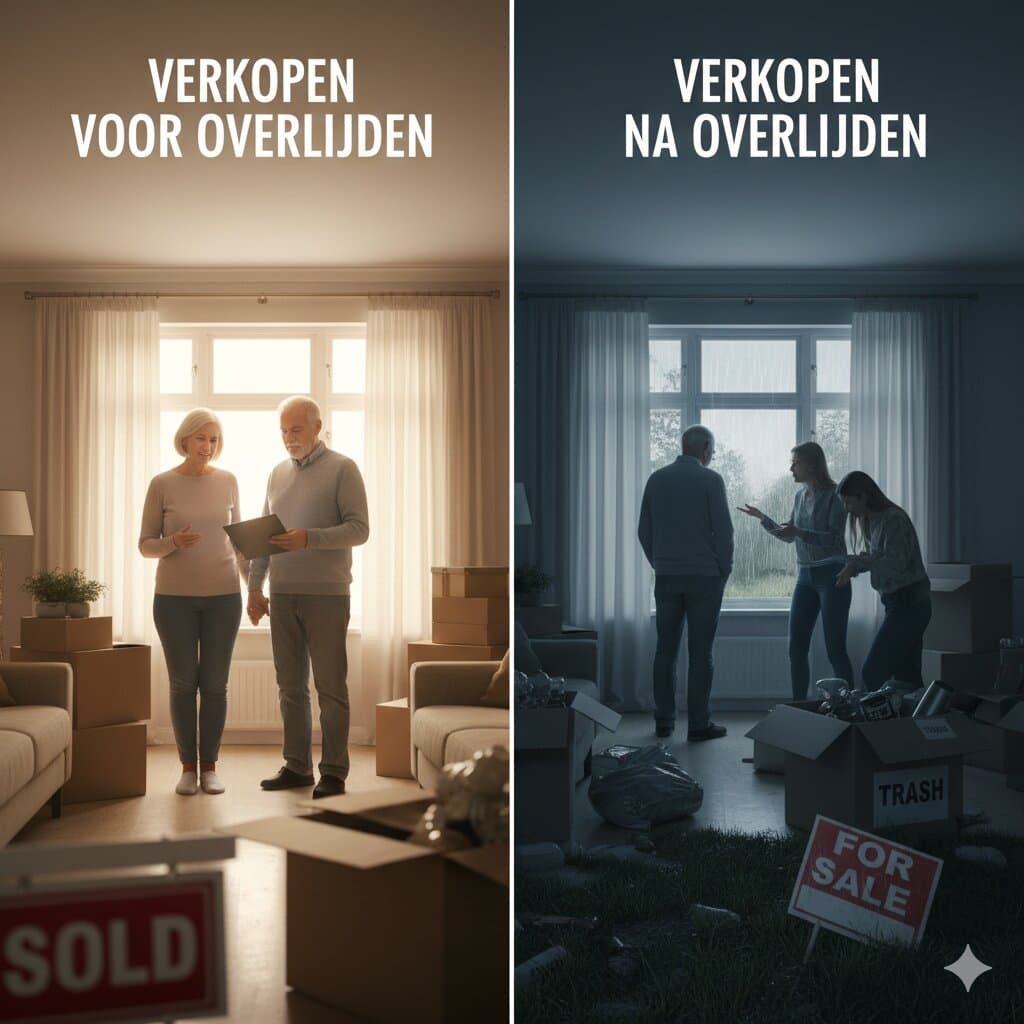
Many families reach a point where they ask themselves whether it makes sense to sell the family home before death. Sometimes the property has become too large or too difficult to maintain, sometimes parents want to restructure their assets during their lifetime, sometimes children want to avoid having to settle an estate under time pressure later on. At the same time, the issue is a sensitive one: it is not just about money, but also about memories, expectations and family relationships. In this article we look at the main options available, the key fiscal and legal points to bear in mind, and how to approach the conversation within the family in a constructive way.
Is it legally possible to sell the family home before death?
If both parents are still alive and legally capable, it is they who decide what happens to their property. They are the owners and can therefore in principle freely decide to sell the family home, keep it, rent it out or take out a loan against it. Children have no claim on the estate at that point; their rights only come into play after death.
In practical terms, this means:
- parents may sell the family home and spend the proceeds as they see fit;
- they may donate all or part of the proceeds to the children;
- they may also reinvest in a smaller home, a serviced residence or a care apartment.
Legally, the decision-making power lies with the parents. In practice, it is still wise to communicate openly as a family: this helps to prevent later arguments about one heir being treated less favourably than another.
Selling the family home before death: possible scenarios
The question of selling the family home before death usually arises in one of the situations below.
✦ 100% free & No obligation
Sell your property with the best agent
Compare the top 3 agents in your region for free and save on commission.
Compare agents →- The house has become too large or too demanding for the parents (stairs, a big garden, high energy bills).
- The parents want to move to a flat, a serviced residence or a care home.
- The children already know that they will not use the house themselves later on.
- The family wants to try to limit future inheritance tax by restructuring assets in good time.
Depending on the family situation, several avenues are possible.
Scenario 1: parents sell to a third party and keep the proceeds
This is the simplest and most common option. The parents sell their property on the open market and move to a smaller or better-suited home. The proceeds remain part of their assets. They may choose to make gifts from those proceeds, but there is no obligation to do so.
Advantages:
- practical relief for the parents (less maintenance, lower running costs);
- more liquidity for care, support or a better quality of life;
- a simpler estate later on (no property left to divide).
Points to consider:
- getting the pricing right and timing the sale well;
- emotional impact: saying goodbye to the family home;
- any gifts made afterwards should be balanced fairly between all children.
Scenario 2: parents sell the house to one of the children
Sometimes one child would like to live in the family home themselves or keep it as an investment. The question then arises: can the family home be sold before death to just one child, and on what terms?
Yes, this is possible, provided that:
- the price reflects the market value, or
- any "favourable" terms are later offset against that child's share of the estate.
In practice, two variants are seen:
- a sale at a market-conforming price, financed by a loan taken out by the child;
- a sale at a lower price, where the "benefit" is treated as a gift to that child which must later be brought back into the estate.
This prevents the other children from feeling that one sibling has been unjustifiably favoured. It is wise to have this properly framed from a legal and tax perspective by a notary or estate planning adviser.
Scenario 3: sale followed by an immediate (or later) gift of all or part of the proceeds
Parents can sell the house and donate all or part of the proceeds to the children. This can be done in one go or spread over time. This approach is often considered with inheritance tax in mind: by transferring assets in advance, the taxable estate is reduced.
Important points to bear in mind:
- gifts must in principle be equal or offset between children (reserved share of the estate);
- in some cases an "extra share" gift is chosen and explicitly designated as such;
- in Belgium, the rules on gift tax and the period within which a gift can still be clawed back into the estate apply - the relevant look-back periods vary depending on the technique used.
This is tailor-made work: without proper advice, a well-intentioned gift can have unexpected fiscal or family consequences later on.
Scenario 4: combined with a lasting power of attorney or incapacity
If a parent's mental capacity declines - for example due to dementia - they may at some point be declared legally incapacitated. In that case, major legal acts such as the sale of a property can no longer be carried out by the person themselves.
In such a situation, there are three possibilities:
- a lasting power of attorney was drawn up in advance: the appointed representative can act on the parent's behalf (sometimes with the approval of the justice of the peace as an additional safeguard);
- there is no power of attorney: a court-appointed administrator or guardian must then be designated by the court;
- for major transactions (such as selling the family home), the explicit authorisation of the justice of the peace is often required.
If you want as a family to retain the flexibility to still be able to sell the family home before death, it is strongly advisable for parents to arrange a lasting power of attorney while they are still legally capable.
Inheritance tax and other fiscal considerations
One important reason to sell the family home before death is the wish to limit inheritance tax. A few broad principles:
- When parents sell during their lifetime and keep the proceeds, inheritance tax will later be levied on those savings, not on the house itself. The nature of the asset changes, but not its taxability.
- If parents give away all or part of the proceeds, gift tax is due according to the rules of the relevant Belgian region. Gift tax rates are often lower or more straightforward than inheritance tax rates, but this depends on the amounts involved, the timing and the technique used.
- If one child buys the house below market value, the "benefit" is often treated as an advance on their inheritance, to be offset later. This prevents other children from seeking a reduction through the courts.
In Belgium, partition duties, registration duties and notary fees all play a role in the transfer of real estate. The applicable rates vary by region - for example, reduced registration duty rates exist in certain situations in both Wallonia and Brussels - and specific partition duty rates apply when exiting a succession co-ownership. Every scenario - selling, inheriting, buying out, gifting - has its own costs, which makes it well worth thinking carefully about the sequence.
Family relationships: at least as important as the tax implications
A great deal is legally and fiscally possible, but the biggest risks are often on the relational side. Selling the family home before death touches on deep emotions: the house is a symbol of childhood memories, security and family history. If one child wants to stay in the house while others do not, or if there are large differences in financial capacity, tensions can run high.
A few good practices:
- make decisions as transparent as possible, with clear agreements and documentation;
- involve all children in the communication, even those who do not appear to be directly affected financially;
- record in writing how any price advantages or gifts will be offset against the estate later;
- bring in a notary early on as a neutral third party.
This reduces the risk that disputes - when the estate is eventually opened - will still lead to conflicts and legal proceedings.
The role of the estate agent: objective valuation and sales strategy
Whether you are selling to a third party or to a child: an objective valuation of the family home is important. The current market value is the reference point for:
- a fair selling price;
- a correct calculation of any gift component;
- the later offset against the estate.
Especially when emotions run high, it is valuable to have an independent party assess the property on the basis of location, condition, surface area, energy performance and local market prices. Via a platform where you can easily compare estate agents, you can quickly find an expert who knows both the local market and the sensitivities around family sales.
If you want to know what makes sense in your situation - selling now, selling later, or letting a child buy the property - it is logical to start with an objective valuation. Via a free valuation by a local estate agent, you get a clear picture of the current market value of the family home and can, together with your notary and family, make well-considered decisions about selling, gifting and estate planning.
Frequently asked questions
Can parents sell the family home without the children's consent?
Yes, as long as both parents are legally capable, they are the owners and can freely decide to sell, rent or keep the property. Children have no claim on the estate until after death.
What happens if a parent is diagnosed with dementia - can the house still be sold?
If a parent loses mental capacity, they can no longer carry out major legal acts like selling a property themselves. If a lasting power of attorney was arranged in advance, the appointed representative can act on their behalf, often with approval from the justice of the peace.
Can parents sell the family home to just one child at a lower price?
Yes, but the price difference is then treated as a gift to that child, which must later be brought back into the estate. This prevents other children from being unfairly disadvantaged and potentially seeking a reduction through the courts.
Does selling the family home before death eliminate inheritance tax?
Not entirely - when parents sell and keep the proceeds, inheritance tax will later be levied on those savings instead of the property. The nature of the asset changes, but not its taxability.
What are the benefits of donating the sale proceeds to the children instead of leaving the property as an inheritance?
Gifting the proceeds reduces the taxable estate, and gift tax rates in Belgium are often lower or more straightforward than inheritance tax rates. However, the exact advantage depends on the amounts, timing and technique used, so tailored legal advice is recommended.
"Tech entrepreneur and strategist focused on digital transformation in the real estate sector."