
Selling a parent's home while mum is still alive: what are your rights?

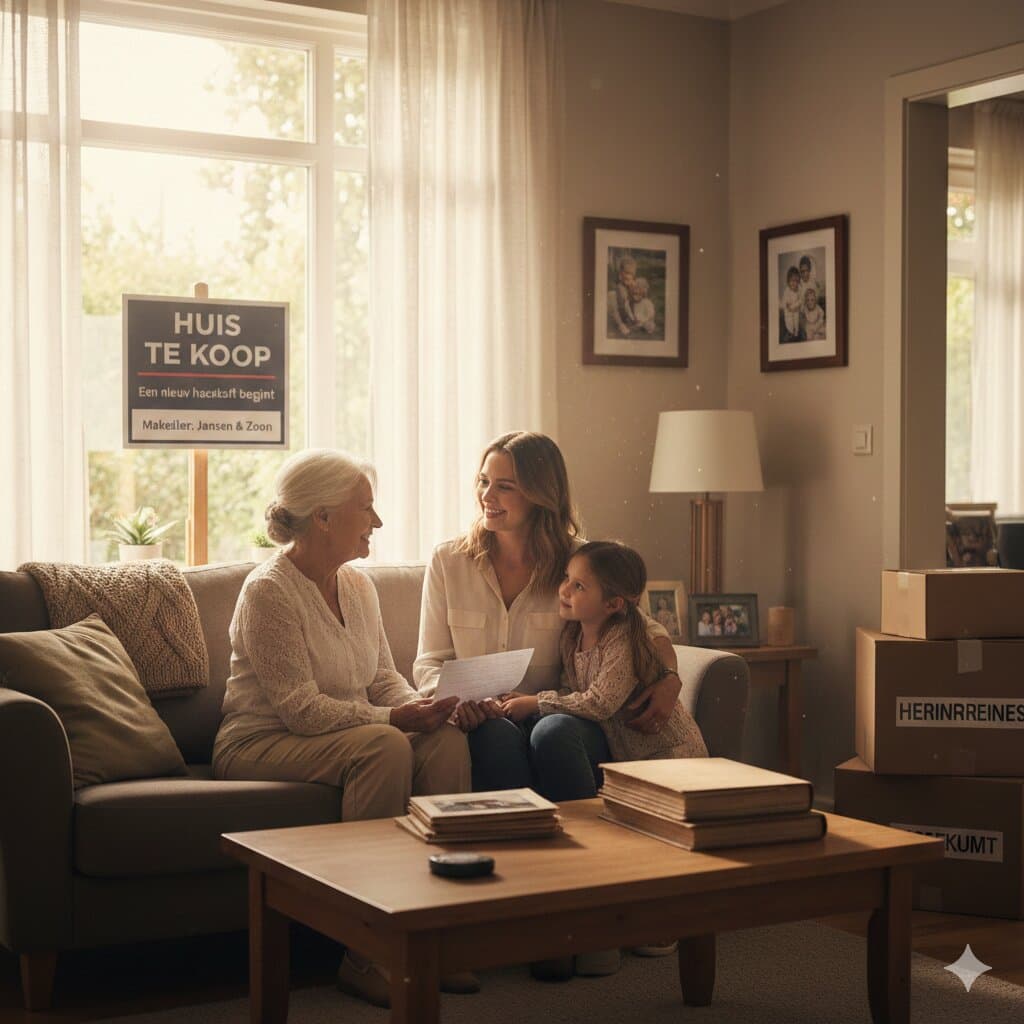
Many families face the same question sooner or later: can you sell a home while mum is still alive, and do the children have any say in the matter? The family home is emotionally charged and is often instinctively seen as "our inheritance". Legally, however, it is a different story. As long as your mother is alive and has legal capacity, she holds decision-making power over her property in the vast majority of cases. There are, however, important nuances - especially if your father has already passed away and there is a split between usufruct and bare ownership. In this guide, we set out the main principles in the Belgian context.
1. Selling a home while mum is still alive: the basic principle
The starting point is straightforward: whoever holds full ownership of a property may freely sell, rent or give it away - without the children's consent. As long as your mother is the sole full owner, she alone decides:
- whether the house is sold;
- to whom it is sold;
- what happens to the proceeds.
Children only acquire a legally enforceable right to the estate at the moment of death, not before. The phrase "that is our inheritance" resonates emotionally, but it only carries legal weight once the estate is formally opened.
2. Situation 1: mum is the full owner
In the first scenario, your mother is today the sole owner of the house. This may be because:
- she bought the house on her own at some point;
- upon your father's death, she received full ownership through a marriage contract or specific clause;
- the house was entirely allocated to her in a previous division of assets.
In that case, the following applies.
✦ 100% free & No obligation
Sell your property with the best agent
Compare the top 3 agents in your region for free and save on commission.
Compare agents →- your mother may sell the house on her own, without the children's signatures;
- the entire sale proceeds belong to her;
- if she then wishes to give a portion of the proceeds to the children, that is entirely her own choice.
In this situation, children cannot go to court to block the sale simply because they have moral objections to it. Only in cases of abuse - for example when the parent is clearly lacking legal capacity and is being misled - can protection through administration or other measures come into play.
3. Situation 2: mum has usufruct, children hold bare ownership
It is very common for your father to have already passed away, leaving your mother with usufruct over the family home while the children inherit the bare ownership. This means:
- mum may continue to live in the house or rent it out (right of use and right to income);
- the children are legally the "underlying owners", but have no right of use for as long as the usufruct continues.
If you wish to sell the home while mum is still alive in this situation, cooperation is essential:
- your mother, as the usufructuary, must agree to the sale;
- all children holding bare ownership must also agree and sign at the notary's office.
At the time of sale, two things typically happen:
- Mum's usufruct is converted into a monetary value (based on actuarial age tables).
- The sale proceeds are divided between mum and the children according to the rules governing usufruct and bare ownership.
Each party's share is thus correctly calculated. Your mother can then, for example, retain part of her share to cover her living expenses and possibly give a portion away.
4. Who must sign when selling?
Whether you need to sign as a child depends entirely on the ownership situation:
- Mum is the full owner:
Only your mother signs the deed of sale. The children are not legally parties to the transaction. - Mum is a co-owner together with the children (for example 50% mum, 50% divided among the children):
All co-owners must agree and sign. - Mum holds only usufruct, children are bare owners:
Both the usufructuary (mum) and all bare owners (the children) must sign.
If minor children are involved as co-owners or bare owners, the authorisation of the justice of the peace is often also required before a sale can proceed.
5. What about "our inheritance" and equal treatment?
The fact that you can legally enforce very little while your mother is still alive does not mean that how she manages her home and assets is irrelevant. Belgium recognises the principle of reserved heirs: children are entitled to a protected minimum share of the estate. If a parent substantially advantages one child or a third party - or depletes their estate to their benefit - during their lifetime, this can be challenged when the estate is settled.
A few important points:
- Gifts (for example from a portion of the sale proceeds) are generally brought back into the estate and offset between the children at a later stage.
- If a parent goes "too far" in giving assets away to the point of infringing the children's reserved share, a reduction can be sought after death.
- To avoid family disputes, it is wise to discuss major transactions openly and, if necessary, have them recorded at the notary's office.
In other words: you cannot simply block the sale, but there are legal mechanisms to ensure that one child is not excessively advantaged at the expense of the others.
6. Selling the home while mum is still alive - and the question of legal capacity
An important exception to the rule that "mum decides" arises when she is no longer legally capable - for example due to dementia, a serious accident or another condition. In that case, she can no longer independently sell a property from a legal standpoint.
Two options then exist:
- there is a lasting power of attorney that she drew up earlier, granting one or more persons (a partner, a child, a trusted person) the authority to act on her behalf, possibly under the supervision of the justice of the peace;
- there is no power of attorney: the justice of the peace must appoint an administrator, who may make decisions under supervision, potentially including the sale of the house.
In both cases, the guiding principle remains the same: the decision must be in the mother's best interest, with a view to her care and financial security.
7. The emotional dimension: talking helps
Beyond the legal rules, selling the home while mum is still alive is often an emotionally difficult process. The family home represents the family's history and shared memories. As a child, it is perfectly natural to have questions:
- Does mum really need the money?
- Will everyone be treated fairly in the end?
- What if the house is sold "for a song"?
It helps to:
- start the conversation openly, coming from a place of concern rather than entitlement;
- encourage your mother to discuss her wishes around inheritance, gifts and the property with a notary;
- have family agreements put in writing if necessary, so that everyone knows where they stand.
That way, you avoid frustrations simmering beneath the surface and only erupting into conflict after a death.
8. A practical step: objective property valuation
Whether your mother is selling to a third party or possibly to one of the children, an objective valuation of the property is essential. This matters:
- to avoid disputes about selling "too cheaply" or "too expensively";
- to make clear, when selling to a child, which portion constitutes the sale price and which portion may be regarded as a gift;
- to allow a fair accounting at the time of the estate settlement of what has already taken place.
An experienced estate agent can assess the market value based on location, condition, energy performance certificate (EPC), floor areas and recent transactions in the area. Your mother thus gets a realistic picture of what her home is worth today, and any gifts or arrangements can be placed on a more solid footing.
If you would like to explore with your mother what a sale would actually yield today and how that fits into her financial and family plans, a thorough valuation is a logical first step. A free valuation by a local estate agent will quickly give you a clear idea of the property's market value. That brings peace of mind to family discussions and provides a solid starting point for any further decisions about selling, gifting and estate planning.
Frequently asked questions
Can children block the sale of their mother's home if she is the full owner?
No, children cannot go to court to block the sale simply because they have moral objections. As long as your mother is the sole full owner and has legal capacity, she alone decides whether to sell and to whom.
Who needs to sign when selling a home where mum has usufruct and the children hold bare ownership?
Both your mother as the usufructuary and all children holding bare ownership must agree and sign at the notary's office. The sale proceeds are then divided between mum and the children based on actuarial age tables.
What happens if one child receives more than others from the sale proceeds?
Belgium recognises the principle of reserved heirs, which gives children a protected minimum share of the estate. If a parent gives too much to one child or a third party, a reduction can be sought after death to correct the imbalance.
What happens if mum can no longer make decisions due to dementia or another condition?
If she previously drew up a lasting power of attorney, the designated person can act on her behalf. If there is no such document, the justice of the peace must appoint an administrator who can make decisions - including a possible sale - under supervision.
Why is an objective property valuation recommended before selling?
A valuation helps avoid disputes about selling too cheaply or too expensively, and makes clear which portion of the price counts as a sale and which may be considered a gift. It also provides a solid basis for estate planning and fair accounting among the children later on.
"Real estate expert focused on quality control and strategic partnerships."