
Selling your house in Belgium: sell it yourself or use an estate agent?

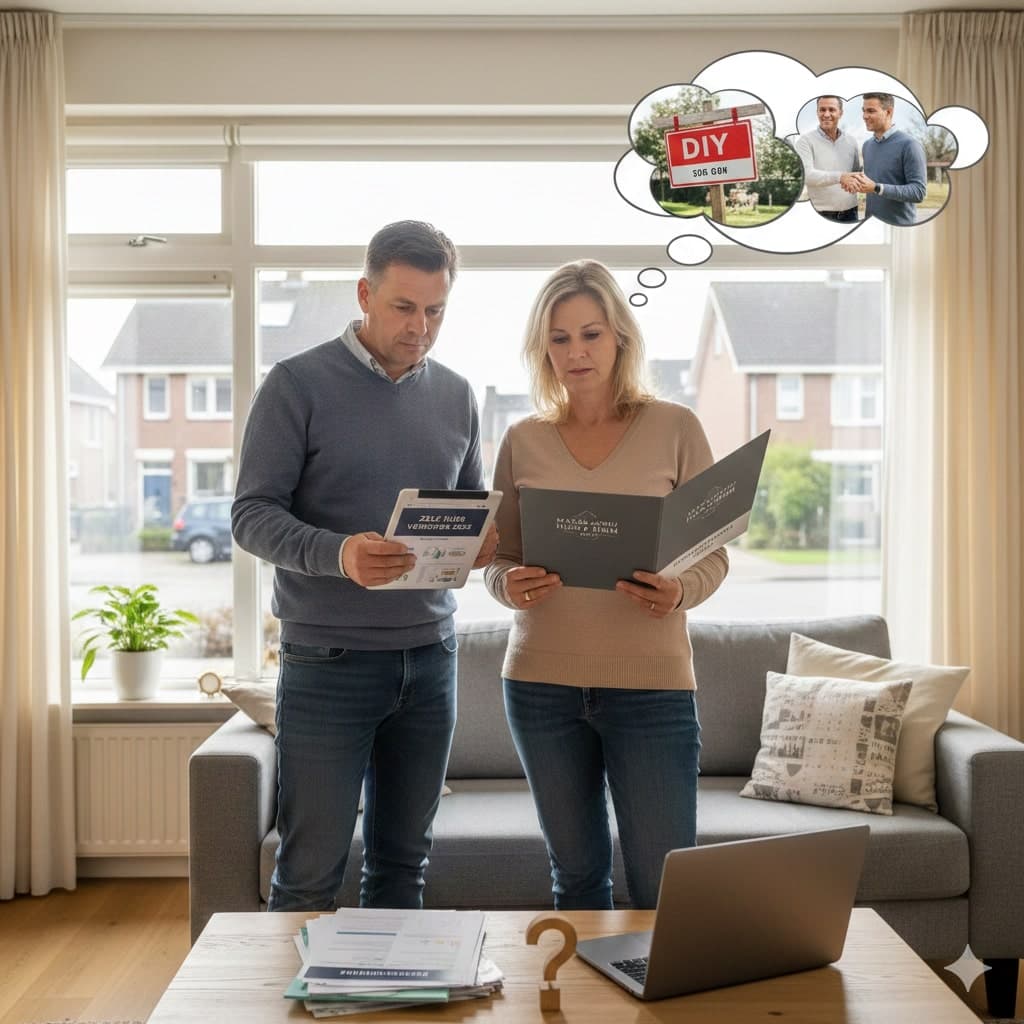
Selling your house in 2025: go it alone or use an estate agent?
With today's property prices, an estate agent's commission can weigh heavily. With an average commission of 3-4% of the sale price, excluding VAT, you're quickly looking at tens of thousands of euros on a standard property. No wonder more and more owners are asking themselves: is it better to sell my house myself or through an estate agent?
Both options can work - provided you fully understand the differences in time, risk, return and stress levels. This guide will help you make a well-informed decision.
What does an estate agent cost in Belgium?
In Belgium, most estate agents work with a commission on the sale price:
- On average 3-4% commission, excluding VAT
- Often within a range (for example 2.5-3.5%) depending on the type of property, price bracket and service package
- Some agencies work with a fixed fee or a different model, but that is more the exception
Example at a sale price of €350,000:
- 3% commission = €10,500 (excl. VAT)
- 21% VAT = total €12,705 in agency fees
That is a significant amount, but it covers a full package of services: valuation, marketing, viewings, negotiations, file management and contractual handling.
✦ 100% free & No obligation
Sell your property with the best agent
Compare the top 3 agents in your region for free and save on commission.
Compare agents →Selling your house without an agent: what does it involve?
A growing number of platforms explain how to sell your property yourself and offer tools, coaching or fixed-price packages. The step-by-step guide to selling without an estate agent looks broadly like this:
1. Valuation
You need to determine the right asking price yourself:
- Compare recent sales in the area (not just asking prices)
- Take into account the habitable surface area, finishes, energy performance certificate (EPC) label and location
- Consider bringing in an independent valuer
A price that is too high - few viewings and a long time on the market.
A price that is too low - an immediate loss of tens of thousands of euros.
2. Mandatory certificates and documents
Without a complete file, you cannot legally put your property on the market. You will need to arrange, among other things:
- Energy performance certificate (EPC)
- Asbestos certificate (in Flanders, for properties built before 2001)
- Electrical inspection
- Soil certificate
- Town planning information
- Cadastral extract and title deed
- Flood risk assessment, post-intervention file, ... (depending on the property)
Some certificates are obtained quickly, while others involve a waiting time of several weeks.
3. Marketing and viewings
You are personally responsible for:
- Photos (preferably professional) and an attractive listing description
- Online publication (Immoweb, Zimmo, social media, your own network)
- Scheduling and conducting viewings
- Answering phone calls, emails and questions from prospective buyers
For a popular property, that can mean dozens of contacts.
4. Negotiating and accepting an offer
You need to:
- Negotiate the price, suspensive conditions and handover date
- Keep your emotions in check and remain businesslike
- Make the most of opportunities for competing bids or open-house days, without putting buyers off
For many private sellers, this is precisely the hardest part.
5. The sales agreement and legal formalities
The sales agreement (compromis de vente) is legally binding and at least as important as the notarial deed. Without an agent, you need to keep a close eye on:
- Correct description of the property and moveable items
- Suspensive conditions (financing, town planning, soil, ...)
- Deadlines for the deed, payment and handover of keys
- Tax implications and clauses in case of non-performance
In practice, many private sellers therefore still call on a notary or lawyer to draft or review the sales agreement.
Advantages of selling your house yourself
1. No agent commission
The biggest advantage is clear: you save the 3-4% commission. On a sale of €350,000, that represents a saving of around €10,000-€13,000.
2. Full control
You decide:
- How you market the property
- When you schedule viewings
- Which offers you take seriously
- How far you are willing to negotiate
For owners who like to keep things in their own hands, that is a real plus.
3. Direct contact with buyers
You know your home best. You can often tell the story of the property, the neighbourhood and its strengths better than anyone else - and some buyers appreciate dealing directly with the owner.
Disadvantages and risks of selling without an estate agent
1. Time-consuming and stressful
You have to do everything yourself: putting together the file, obtaining certificates, marketing, viewings, follow-up and negotiations. Hellohome and other guides emphasise that this can mean months of work for an inexperienced seller.
2. A pricing mistake can quickly cost more than the commission
The biggest pitfall: getting the price wrong.
- Priced too high - the property sits on the market for a long time, buyers assume something is wrong and eventually come in with low offers.
- Priced too low - you sell quickly but potentially leave tens of thousands of euros on the table.
Professional estate agents and notaries point out that every percentage point below market value on a standard property can easily exceed their commission.
3. Legal mistakes can be costly
A poorly worded clause, a failure to disclose a defect or an incomplete file can lead to:
- Disputes after the sale
- Price revisions
- In extreme cases, the dissolution of the sale
A recognised estate agent operates within the rules and code of ethics of the IPI/BIV, which limits this risk.
4. Emotions get in the way
Sellers are often emotionally attached to their property. That makes rational negotiation harder:
- You take a low offer personally
- You underestimate objective negatives (busy street, poor EPC rating)
- You overvalue the "charm" that the buyer may not value at all
The agent then acts as a buffer between you and the buyer.
Selling through an agent: what do you get in return?
Professional estate agents point to several structural advantages:
1. Professional valuation
Agents know the local market, recent sale prices and what buyers are looking for. They help you to:
- Avoid over- or undervaluation
- Choose a pricing strategy (for example slightly below market to attract offers)
2. A large network and marketing power
An estate agent promotes your property through:
- The major property platforms
- Their own website and mailing lists
- Social media and possibly the local press
- Their network of other agents and prospective buyers
Result: more visibility and more often the right candidates.
3. Time saved and less stress
The agent:
- Schedules and supervises viewings
- Answers questions from interested parties
- Filters out "property tourists"
- Follows up offers and negotiations
- Drafts the necessary documents (in consultation with the notary)
Especially if you work full time or do not live nearby, that is a considerable advantage.
4. Negotiation expertise
An experienced agent:
- Knows the usual bidding strategies
- Is less driven by emotion
- Defends your interests in negotiations on price and conditions (conditions precedent, timing, taking over movable items)
That can easily make a difference of a few percentage points in price: enough to recover (part of) the commission.
5. Legal and administrative certainty
A CIB-recognised agent:
- Must follow professional rules and is insured
- Makes sure all mandatory certificates are available in time
- Ensures that no important clause is missing from the sale agreement
That limits the risk of disputes or proceedings after the sale.
Selling yourself or through an agent? An honest comparison
| Aspect | Selling yourself | Through an agent |
|---|---|---|
| Cost | No commission, but fixed costs | Commission 3-4% + fixed costs |
| Sale price | Risk of over- or undervaluation | Market-rate price, chance of a better result |
| Time invested | Very high | Limited for the owner |
| Stress level | High | Lower: delegated to a professional |
| Legal certainty | Depends on your own knowledge | Professional guidance |
| Control | 100% with the owner | Shared with the agent |
So the fundamental question is not only: "Do I want to pay a commission?" but above all:
"Am I sure that without an agent I will keep more in my pocket, once price, time, mistakes and stress are taken into account?"
A hybrid approach: how to combine the best of both worlds
You do not have to make a hard choice. A few smart combinations:
- Test on your own first, then bring in an agent
- You put your property on the market yourself for 4-6 weeks at a realistic asking price.
- No serious interest? Then switch to an estate agent.
- Free valuation + comparing agents
- Ask one or more agents for a free valuation to assess the market value.
- Use agent comparison to set rates, approaches and contract terms side by side.
- Negotiate the commission based on the expected sale amount and the length of the mandate.
- An agent for the difficult parts
- You handle the marketing and the first selection of buyers yourself.
- You bring in an agent for the negotiations, the sale agreement and following up the file (some agencies offer this kind of "light" package).
When is an agent the better choice?
Using an agent is often the best choice if:
- You have neither the time nor the inclination to handle everything yourself.
- Your property is in a complex niche (apartment building, investment property, mixed use).
- There are legal or planning particularities (regularisations, easements, co-ownership).
- You are very emotionally attached to the property and easily lose your footing in negotiations.
- You think a higher sale price could (partly) offset the commission.
When is selling yourself more realistic?
Selling yourself can work very well if:
- You are strong on the legal and administrative side, or have good support (notary, lawyer).
- You have the time and energy to really commit to the process.
- Your property is relatively simple (a standard house or apartment, without major defects or disputes).
- You are willing to look critically at your asking price and possibly have an independent valuation done.
Even then, it is worth asking for at least one or two free valuations, so that you do not set your price blindly.
Conclusion: choose the sales route that fits your situation
Selling your house without an agent in 2025 can save you thousands of euros in commission, but it takes knowledge, time and discipline. Selling through an agent costs 3-4% commission, but often brings:
- A higher final price
- Less stress
- Fewer legal risks
- And a considerable time saving
The best choice depends on your time, experience, risk tolerance and type of property.
Want to know what your property is worth and what prices are achieved in your neighbourhood? Start with an objective free valuation and use agent comparison to set agents side by side on commission, services and approach.
That way you decide not on gut feeling but on facts, and you maximise what stays in your pocket after the sale.
Frequently asked questions
What does an estate agent typically charge in Belgium?
Most Belgian estate agents charge a commission of 3-4% of the sale price, excluding VAT. On a sale of 350,000 euros at 3%, that works out to 12,705 euros including VAT.
What documents do I need to sell my house in Belgium?
You need several mandatory certificates, including an energy performance certificate (EPC), asbestos certificate (in Flanders, for properties built before 2001), electrical inspection, soil certificate, and town planning information, among others. Some of these can take several weeks to obtain.
How much can I save by selling my house without an estate agent?
By skipping the agent, you avoid the 3-4% commission. On a sale of 350,000 euros, that represents a saving of roughly 10,000 to 13,000 euros.
What are the biggest risks of selling your house yourself?
The main risks are pricing mistakes, legal errors in the sales agreement, and the emotional difficulty of negotiating. Setting the price too low or too high can cost more than the agent's commission, and a poorly worded clause in the sales agreement can lead to disputes or even the dissolution of the sale.
Do I still need a notary if I sell my house without an estate agent?
In practice, many private sellers still hire a notary or lawyer to draft or review the sales agreement, since it is legally binding and at least as binding as the notarial deed.
"Tech entrepreneur and strategist focused on digital transformation in the real estate sector."