
Splitting a property in Belgium: student rooms or apartments and rental yield

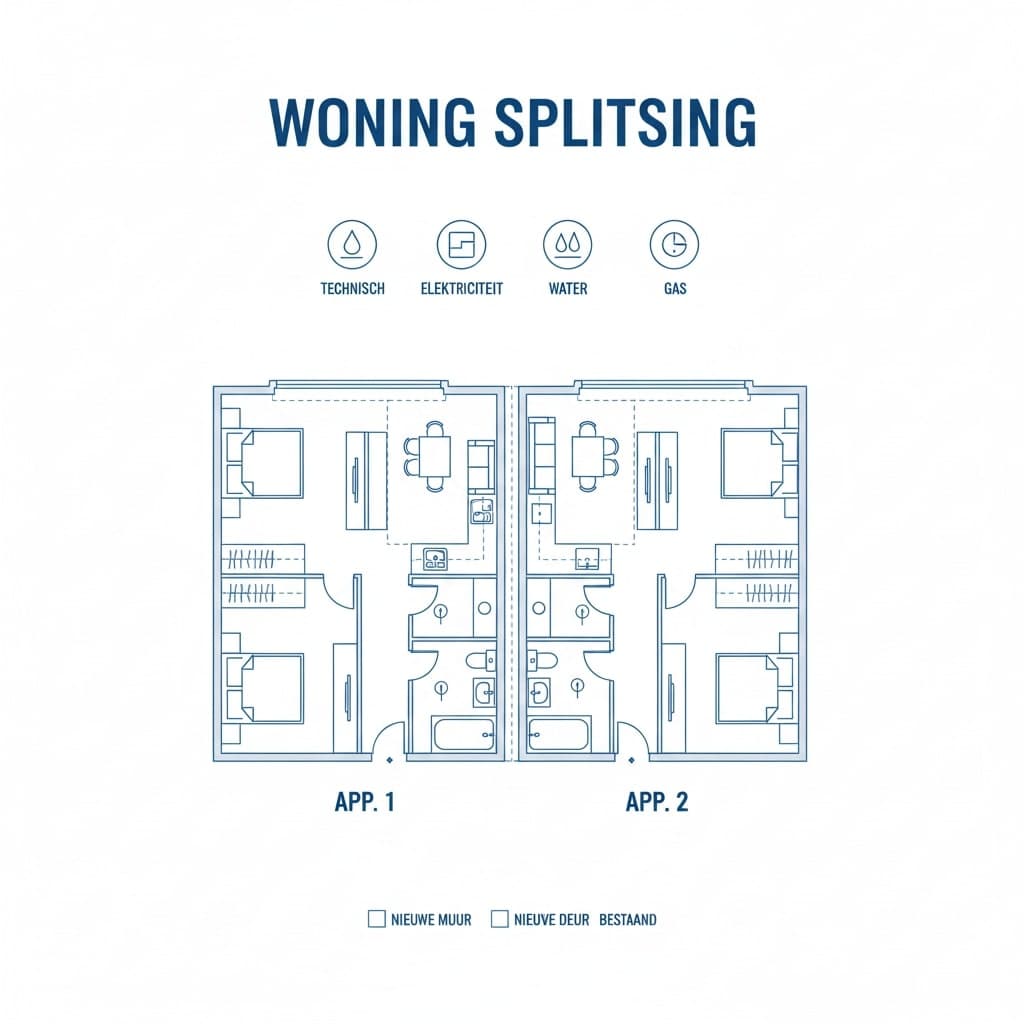
Why splitting a property in 2025 is interesting for investors
Converting a large house or apartment into several separate rentable units is a smart strategy for anyone who sees real estate as an investment. Instead of one tenant per property, you collect multiple rental incomes. When the split is well executed - especially in university cities - the yield can be considerably higher than standard residential letting.
The student housing market remains under pressure in 2025: a student room costs an average of €590/month and prices rise every year. At the same time, professional investors like Xior report rental growth of more than 5% per year with a 98% occupancy rate. That points to solid demand.
But splitting a property is not straightforward. Permits, legal procedures, construction costs and tax rules all determine whether the project is truly profitable. This guide gives you the complete roadmap.
Two types of split: architectural vs. cadastral
When you split a house, you can distinguish two legal forms, each with its own requirements.
1. Architectural split: for renting out apartments
This is the most common type. You convert one house into several self-contained rentable units.
✦ 100% free & No obligation
Sell your property with the best agent
Compare the top 3 agents in your region for free and save on commission.
Compare agents →Requirement: planning permit mandatory.
What you need to arrange:
- Each apartment gets its own entrance, toilet, bathroom, kitchen and street number.
- Acoustic insulation between units.
- Emergency exits and fire safety provisions.
- Lighting, ventilation and heating per unit.
- An energy performance certificate (EPC) per unit in accordance with energy performance regulations.
Procedure:
- Application submitted to the relevant planning authority (in Flanders: via the omgevingsloket; in Wallonia: via urbanisme.wallonie.be; in Brussels: via urban.brussels)
- Standard procedure (with public inquiry): up to 6 months
- Simplified procedure (without inquiry): up to 3 months
- Can be refused if the municipality does not permit it.
2. Cadastral split: for selling as separate units
This is the route to take if you want to eventually sell the apartments individually (not just rent them out).
Requirement: planning permit + notarial deed of division.
This is more complex:
- Each unit receives a separate plot number in the cadastre.
- Sometimes additional external works are required (separate entrance, parking space per unit).
- Municipal planning conditions may apply.
In this guide we focus on architectural splitting for rental purposes, which is the most feasible option for most investors.
Legal requirements: what does the municipality look at?
Before you put money into a project, you need to know: is splitting permitted in your municipality?
Check this in advance:
- Consult the local spatial planning document (RUP in Flanders, Plan de Secteur in Wallonia, PRAS in Brussels): this shows what is and is not permitted on your plot.
- Check the applicable building regulations: look at the requirements for insulation, fire safety, ventilation and acoustics.
- Ask for information at your municipal planning office: can they already indicate whether a split is likely to be approved?
General requirements for an architectural split:
- Fire safety: Smoke and fire detectors per unit, emergency and escape routes.
- Sound insulation: Minimum insulation between dwelling units (for example between ground floor and upper floor).
- Ventilation: Each apartment has its own ventilation or is connected to a central system.
- Sanitary facilities: Each unit must have its own toilet and bathroom.
- Kitchen: Independent kitchen per unit (not shared).
- Energy performance: Each apartment must comply with the applicable energy performance standards (EPC).
- Accessibility: Depending on the municipality and region, specific standards may apply.
Note: Many municipalities have a cautious or restrictive policy on splitting. Particularly in areas already dense with apartment buildings, getting approval can be difficult. A preliminary consultation is essential.
Construction costs for splitting a property: calculating realistically
This is where many investors underestimate the project. Splitting requires far more than simply building a partition wall.
Typical construction costs in 2025:
- Demolition/alterations: €800-€2,000 (removing doors, walls, sanitary fittings)
- Partition walls (with acoustic insulation): €3,000-€8,000 per partition
- Two separate entrances: €2,000-€5,000
- Splitting electrical circuits: separate meter board per unit, rerouting cables: €3,000-€7,000
- Heating: replacing the central boiler with individual systems or radiators per unit: €4,000-€10,000
- Sanitary fittings (bathroom/toilet per unit): €5,000-€12,000 per unit
- Kitchen: basic fitted kitchen per unit: €3,000-€6,000
- Ventilation: central system or windows: €1,000-€3,000
- Painting and finishing: €2,000-€5,000
Total estimate for splitting one house into 2 apartments: €25,000-€65,000, depending on the condition and level of insulation.
If energy renovation is carried out at the same time (roof insulation, windows, floor): +€15,000-€40,000.
Do not forget: VAT and architect fees (where required) are on top of these totals.
The permit procedure step by step
A realistic process from splitting to letting:
- Month 1: Consult the municipality, check local planning rules, decide whether splitting is feasible.
- Months 2-3: Develop the architectural design (often required).
- Month 4: Submit the planning permit application.
- Months 4-10: Wait for the planning permit (3-6 months).
- Months 11-18: Construction works (timing depends on the scale of the project).
- Months 19-20: Final finishing, inspections, outstanding details.
- Month 21+: Market the property, find tenants.
Total: a minimum of 18-24 months from start to first tenant.
This is much longer than most investors plan for. As a result, you will likely go at least a year - sometimes longer - without rental income while your mortgage repayments continue as normal.
Yield: student rooms vs. apartments
What does the rental yield look like in practice? It depends on what you build.
Student rooms
Splitting a house into 4-6 student rooms (each with a private bathroom, shared kitchen and living room):
- Rent per room: €500-€700/month (depending on the city)
- 4 rooms × €600: €2,400/month = €28,800/year
- Purchase price of house: €200,000
- Gross rental yield: 28,800 / 200,000 = 14.4%
This looks very attractive, but:
- Net yield is lower: deduct running costs, vacancies, replacements, technical maintenance and communal charges.
- Xior Student Housing reports a gross yield of around 4.5-5.5% and works with leases of 5+ years. That is far more realistic than the 14% figure calculated above.
- Student rooms require good management: frequent pets, noise, high turnover between academic years.
Practical net yield for student rooms: 3-4% after all costs.
Two separate apartments
Splitting a house into 2 apartments of 70 m² each:
- Rent per apartment: €850-€1,000/month
- 2 apartments × €900: €1,800/month = €21,600/year
- Purchase price: €200,000
- Gross rental yield: 21,600 / 200,000 = 10.8%
Net (slightly lower due to less fragmentation and lower vacancy with family tenants): 3-3.5% practical yield.
Key tax considerations when splitting a property
This is important and many investors overlook it:
1. Registration duties: When you buy a whole property with the intention of splitting it, you pay registration duties. The rate varies by region: in Flanders it is 12%, in Wallonia 12.5% (the 3% rate only applies to your own and only home), and in Brussels 12.5% (the abatement on the first €200,000 only applies to an own and only home priced at most €600,000). If you later plan to sell the units individually, the tax picture may change - ask your accountant in advance.
2. EPC per unit: Each newly created dwelling unit must have its own energy performance certificate. There is no fixed price: each certifier sets their own fee. Insufficient insulation can result in the split application being refused.
3. Cadastral income (revenu cadastral): After splitting, your cadastral income may increase, which in turn raises your property tax (précompte immobilier).
4. Grants and premiums: Some renovation grants apply per unit after splitting. This can be financially interesting - check what is available in your region.
Practical checklist: is splitting the right choice for you?
Before you start, check these points:
- ✓ Is your property in a university city or a growing neighbourhood with strong rental demand?
- ✓ Is your house large enough (minimum 120 m² for 2 units)?
- ✓ Are you willing to wait 18-24 months without rental income?
- ✓ Do you have €30,000-€70,000 available for construction costs?
- ✓ Do you understand that managing multiple tenants is more complex?
- ✓ Have you checked the local planning rules and consulted the municipality in advance?
- ✓ Can your property meet the fire safety, insulation and sanitary requirements?
Three “no” answers → Reconsider. Five “yes” answers → Serious option worth pursuing.
Alternatives: why not buy a property that is already split?
Instead of splitting yourself, you could also:
- Buy an already-split property without the permit hassle (but potentially at a higher price).
- Invest in established student housing projects (lower risk, lower yield).
- Classic letting of the whole house: simpler, slightly lower yield (3-3.5%).
Splitting makes sense if you:
- Are patient (long timeline)
- Can manage the property well yourself or have a budget for professional management
- Are investing in an up-and-coming university town or working-class city
Conclusion: splitting a property can pay off - with proper preparation
Splitting a property in Belgium in 2025 can be a powerful strategy to boost rental yield and make real estate a more attractive investment. Student rooms and apartments are earning more than ever - but only with solid planning.
Combine a thorough cost estimate with realistic financing using a loan simulator. Find an architect and notary with experience in property splitting. And consult your municipality and your accountant before making an offer on a property.
That way, splitting a property becomes not a risky improvisation, but a well-considered investment project with a clear return.
Well prepared = success; unprepared = expensive.
Frequently asked questions
How long does it take to split a property and find the first tenant?
The entire process takes a minimum of 18 to 24 months from start to first tenant. This includes the permit procedure, construction works, finishing, and marketing the units.
Do I need a planning permit to split a house into apartments in Belgium?
Yes, an architectural split always requires a planning permit. Depending on the procedure, approval can take between 3 and 6 months, and the application can be refused if the municipality does not allow it.
What does it cost to split one house into 2 apartments?
A realistic estimate for splitting one house into 2 apartments is between 25,000 and 65,000 euros, depending on the condition of the property. If you also carry out an energy renovation at the same time, add another 15,000 to 40,000 euros on top of that.
What is the realistic net rental yield after splitting a property?
For student rooms, the practical net yield after all costs is around 3 to 4%. For two separate apartments, investors can expect a net yield of roughly 3 to 3.5%.
What is the difference between an architectural split and a cadastral split?
An architectural split converts one property into several rentable units and requires only a planning permit. A cadastral split goes further - it gives each unit a separate plot number in the cadastre and requires both a planning permit and a notarial deed of division, which is the route to take if you want to sell the units individually.
"Tech entrepreneur and strategist focused on digital transformation in the real estate sector."