
What does home insurance not cover? 7 common exclusions

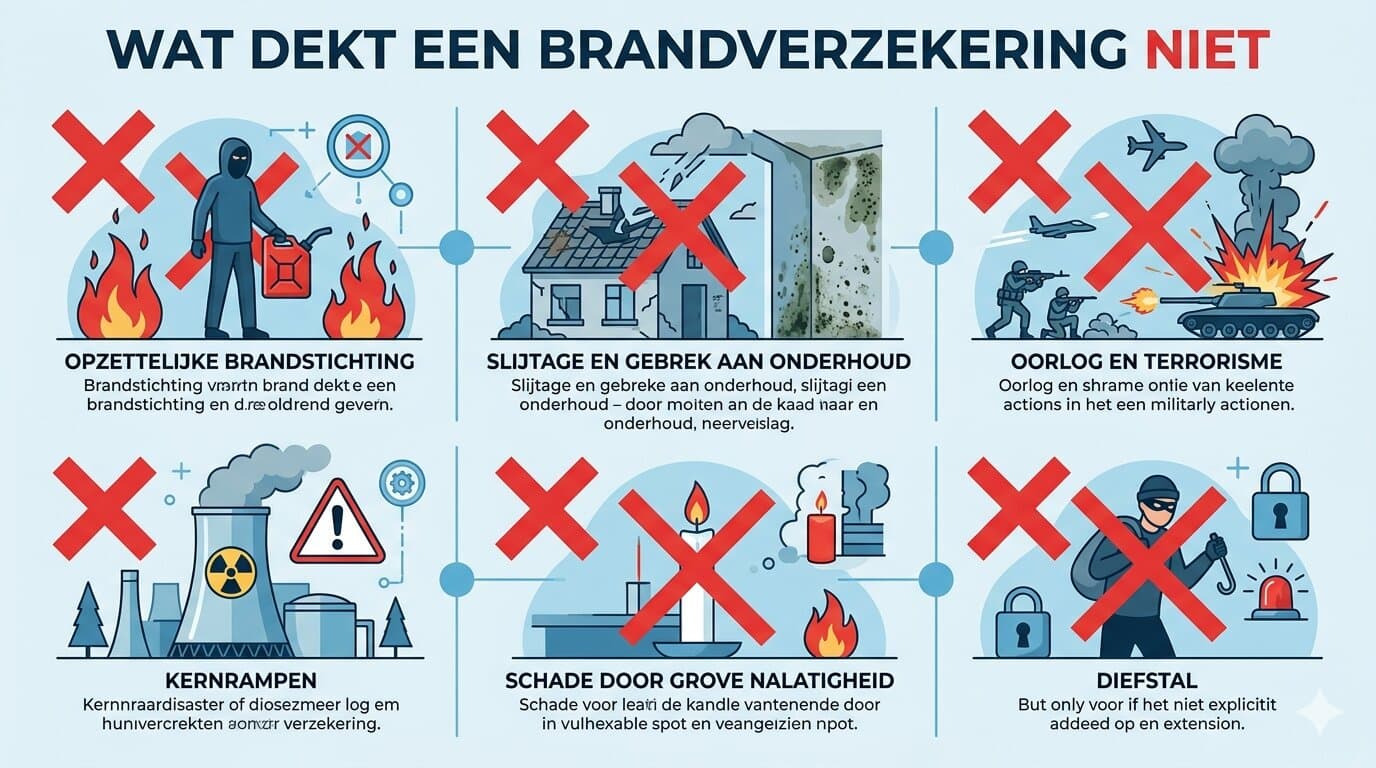
A fire insurance policy (home insurance) covers far more than fire damage alone: water damage, storm, glass breakage and sometimes theft can also be insured. Yet the cover is not unlimited, because every policy contains clear exclusions and situations in which the insurer does not (or only partially) step in. It is therefore important to know what a fire insurance policy does not cover, so you are not caught off guard when a claim arises.
1. Intentional damage
Damage you deliberately cause yourself is not covered by your fire insurance policy.
- If you start a fire yourself or intentionally cause a loss, you forfeit your right to compensation.
- The insurer must be able to prove the intent, but the basic rule is clear: intentional damage is never covered.
This principle appears in virtually all fire and home insurance policies.
2. Wear and tear, ageing and lack of maintenance
Fire insurance is designed for sudden and unforeseen damage, not for problems caused by gradual wear and tear or poor maintenance.
The typical examples are listed below.
✦ 100% free & No obligation
Sell your property with the best agent
Compare the top 3 agents in your region for free and save on commission.
Compare agents →- a worn pipe that has been in poor condition for years;
- a roof that has not been maintained for a long time;
- damage caused by rising damp or condensation.
The insurer will often cover the consequential damage (for example, damp walls), but not the repair of the worn component itself, such as the old pipe or the entire roof.
3. Repairing the defect itself
Many policies draw a distinction between:
- the consequential damage (for example, water damage to walls, floors or furniture);
- the defective component that caused the damage (the pipe, washing machine, boiler…).
The fire insurance policy then covers:
- the damage caused by the water leak,
- but not the repair or replacement of the broken pipe or the appliance itself.
This can come into play with, for example:
- a burst water pipe;
- a faulty washing machine that started leaking;
- an electrical installation that caused a short circuit.
4. Failure to meet contractual obligations
Insurers sometimes impose additional safety or prevention requirements, for example an alarm system when the contents are of high value.
- If you fail to meet those requirements,
- and the insurer can show that this contributed to the loss,
the insurer may refuse or reduce the payout. Think, for instance, of a theft claim at a property where the policy required an alarm that was never installed.
5. Your vehicle and certain items outside the home
Fire insurance does not automatically cover everything that happens to be on your property.
- Your car in the driveway or garage: fire damage to a vehicle generally needs to be claimed through your car insurance (comprehensive cover), not your fire insurance.
- Garden items such as loose garden furniture, a barbecue or certain garden accessories are often covered only to a limited extent or not at all, unless you have taken out a specific extension or option.
Always check your policy carefully to see exactly what falls under "building" and "contents", and what does not.
6. Certain forms of pollution and special risks
Fire and home insurance policies usually also contain exclusions for pollution and special risks.
Examples:
- pollution or soil contamination that already existed before the policy was taken out;
- loss of value after remediation;
- pollution that does not fall under a specific cover.
Damage caused by war, armed conflict or certain exceptional events may also be excluded.
7. Damage from normal use
Damage caused by normal use or wear is generally not compensated.
- Think of scratches, light signs of wear or the ageing of materials.
- "Minor" cosmetic damage that does not result from a covered claim is usually excluded from cover as well.
At its core, fire insurance remains insurance against unforeseen and sudden damage, not against the normal wear that comes with everyday life in a home.
Why the small print matters
Every insurer works with its own conditions, covers and exclusions.
- What one insurer covers may be limited or excluded by another.
- Extra options (garden, theft, outbuildings, valuables, and so on) can make all the difference.
- That is why specialists recommend reading your policy and the information sheet carefully, or asking an insurance broker or adviser for advice.
Summary
If you are wondering what fire insurance does not cover, it is mainly intentional damage, wear and poor maintenance, repairing the defect itself, failing to meet safety obligations, damage to certain items such as your car, certain forms of pollution and damage from everyday use. Knowing the small print of your policy saves you a lot of unpleasant surprises when you need to make a claim.
Frequently asked questions
Does home insurance cover damage caused by wear and tear?
No, fire insurance is designed for sudden and unforeseen damage only. Gradual wear and tear, ageing, or lack of maintenance are not covered - though consequential damage caused by a worn component may still be partially covered.
If a pipe bursts and damages my walls, does my insurance cover both the pipe and the water damage?
Most policies cover the water damage to walls, floors or furniture, but not the repair or replacement of the broken pipe itself. This distinction between consequential damage and the defective component is common in Belgian fire insurance policies.
Is my car covered by my home insurance if it is damaged in my garage?
No, fire damage to a vehicle needs to be claimed through your car insurance with comprehensive cover, not your home insurance. Home insurance does not automatically cover vehicles even when they are on your property.
Can my insurer refuse to pay out if I did not install the alarm system required by my policy?
Yes, if your policy required an alarm system and you never installed one, the insurer may refuse or reduce the payout - especially if they can show that this contributed to the loss. Always make sure you meet the safety requirements stated in your policy.
Is garden furniture covered by my home insurance?
Garden items like loose garden furniture or a barbecue are often covered only to a limited extent or not at all under a standard policy. You may need to take out a specific extension or option to get coverage for these items.
"Tech entrepreneur and strategist focused on digital transformation in the real estate sector."