
Whole-house energy renovation: how to calculate the return on investment?

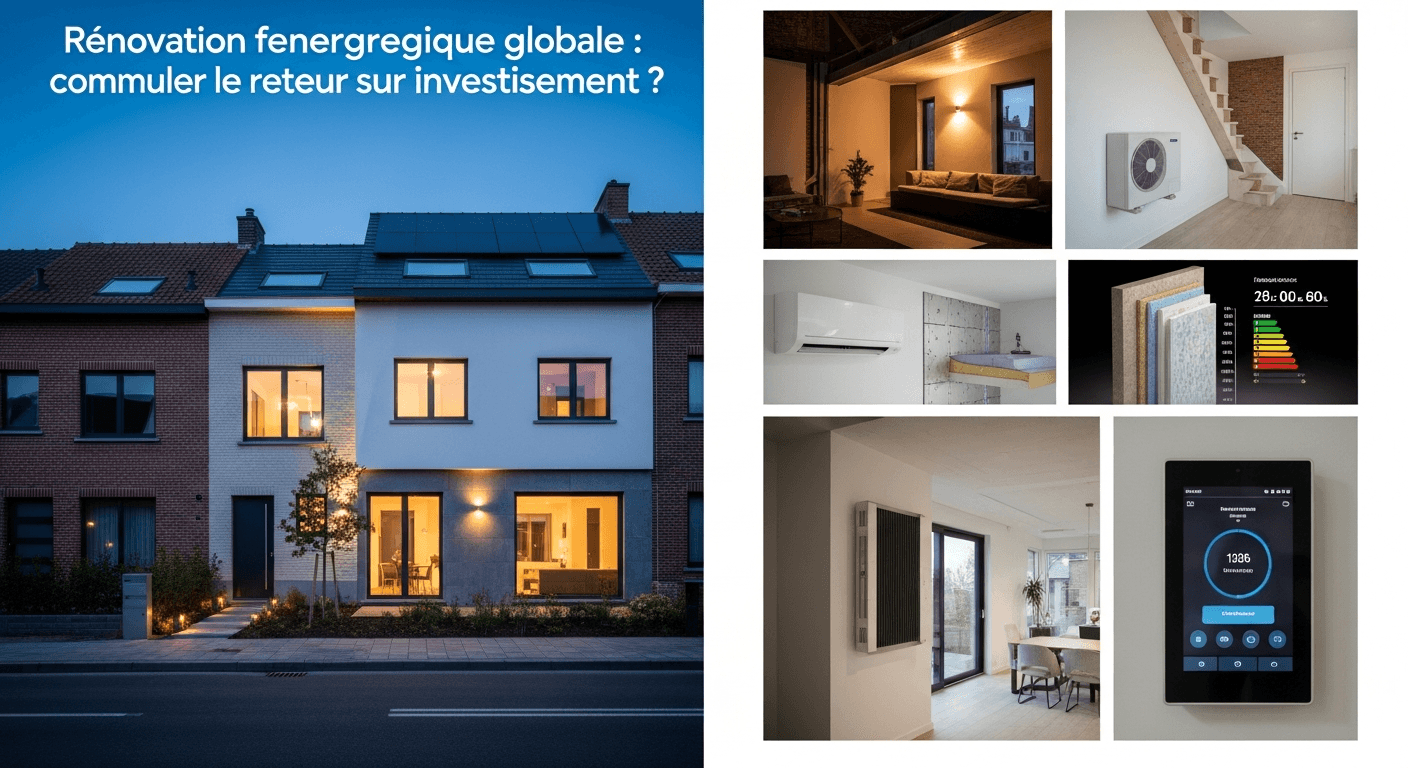
Whole-house energy renovation: how to calculate the return on investment?
A whole-house energy renovation can turn an energy-hungry property into a high-performing home, but it typically requires an investment of between 30,000 and 80,000 euros depending on the size and condition of the house. Before you commit, it is worth calculating what you will actually get back - whether through energy savings, regional grants or added value at resale. This guide gives you a practical method.
What does a whole-house energy renovation actually mean?
A whole-house energy renovation is a coordinated approach that addresses several elements of the building at the same time: roof, wall and floor insulation, window and door frame replacement, installation of a new heating system (heat pump or condensing boiler), and sometimes the addition of photovoltaic panels or a mechanical ventilation system with heat recovery.
The goal is to achieve a sufficiently high EPC (Energy Performance Certificate) rating to bring about a significant reduction in energy consumption. In Wallonia and Brussels, the target labels are generally A or B. In Flanders, the equivalent is an EPC label of A or A+. A partial renovation can improve the rating by one notch, but it is the whole-house approach that maximises the impact on property value.
In Flanders, a home bought with label E or F must reach label D within six years of the deed. Wallonia and Brussels have no such obligation for buyers: a Walloon draft plan proposes one for purchases from 2028, but it is not law yet, and Brussels requires every home to reach at least class E (PEB 275) by 1 January 2033, whether or not it is sold. These constraints fall directly on buyers and therefore weigh on the resale value of poorly rated properties.
How to estimate the total cost of a full renovation
To calculate a return on investment, you first need a clear picture of the costs involved. In Belgium, here are realistic ranges for 2026.
✦ 100% free & No obligation
Sell your property with the best agent
Compare the top 3 agents in your region for free and save on commission.
Compare agents →- Roof insulation: between 4,000 and 12,000 euros for a standard three-facade house.
- Wall insulation (external): between 10,000 and 25,000 euros.
- Window and door frame replacement: between 8,000 and 20,000 euros depending on the number of windows.
- Air-to-water heat pump: between 10,000 and 18,000 euros, installation included.
- Photovoltaic panels (6 kWp): between 8,000 and 12,000 euros.
- Mechanical ventilation with heat recovery (double-flow VMC): between 3,000 and 6,000 euros.
A complete renovation can therefore reach 50,000 to 80,000 euros before grants. This gross figure is your starting point for calculating your ROI.
Deducting regional grants and subsidies
Belgium offers substantial support mechanisms. In Wallonia, regional renovation support for insulation and heating depends on household income. In Flanders, the Mijn VerbouwPremie covers a portion of insulation and glazing work. In Brussels, no Renolution grants are open for new works: the scheme only covered works with a final invoice dated 2024 and that filing period is closed, and no new support has been decided.
You should also factor in the federal tax deduction on green loans and VAT reductions. In 2026, certain work carried out on homes more than ten years old still benefits from the reduced VAT rate of 6% rather than 21%.
In practice, subsidies can reduce the net cost by 15 to 30% depending on the region and the owner's situation. A gross investment of 60,000 euros can therefore come down to 42,000 euros net after deductions.
Calculating annual energy savings
This is the element that is most often underestimated. Take a concrete example: a four-facade house of 180 m² with an EPC rating of F consumes around 45,000 kWh per year for heating. After a full renovation with a heat pump and enhanced insulation, that consumption can fall to 12,000 kWh per year.
With an average electricity price of around 0.28 euros per kWh in Belgium in 2026, the annual saving amounts to approximately 9,240 euros. Over ten years, that represents more than 92,000 euros, without factoring in the likely rise in energy prices.
To calculate your own estimate:
- Check your current EPC certificate to find out the theoretical consumption figure.
- Request a simulation from an accredited energy auditor.
- Multiply the reduction in consumption by the current energy price.
- Project this over 10 or 20 years using a conservative energy inflation rate of 2 to 3% per year.
The impact on resale value: what the Belgian market shows
Recent studies show that in Belgium, a house rated A or B sells on average 10 to 20% more than an equivalent property rated D or E in the same municipality. In Ghent, Leuven or Namur, that gap can represent 30,000 to 60,000 euros on an average-priced house.
It is not just a question of the asking price: well-rated properties sell faster, attract more buyers and generate fewer downward negotiations. A buyer who knows they will need to invest 40,000 euros to renovate an F-rated property will systematically negotiate that amount off the sale price - often with an additional margin for risk.
If you are planning to sell within three to five years, a whole-house energy renovation can be a profitable strategy. To find out whether it is the right choice for your property, consult a local estate agent who knows the price trends in your area. You can compare recognised IPI-registered estate agents for free via ImmoMakelaarVergelijker and get their view on the expected added value after renovation work.
Calculating the overall ROI: the simple formula
The return on investment of an energy renovation is calculated as follows:
ROI = (Cumulative energy savings + Added value at resale - Net cost of works) / Net cost of works x 100
Let us return to our example:
- Gross cost of works: 60,000 euros
- Grants deducted: 15,000 euros
- Net cost: 45,000 euros
- Energy savings over 10 years: 92,000 euros
- Estimated added value at resale: 35,000 euros
- Total gain: 127,000 euros
- ROI: (127,000 - 45,000) / 45,000 x 100 = 182%
This calculation remains an estimate, but it clearly illustrates why a well-planned whole-house renovation can be a profitable investment, especially if you stay in the property for a few years after the work is completed.
To go further before making a decision, a free property valuation will give you a solid basis for comparing your property's current value with its projected value after renovation.
Prioritising works for the best ROI
If the budget does not allow everything to be done at once, some works offer a better cost-to-gain ratio:
- Roof insulation is generally the first cost-effective step, reducing heat loss by 20 to 30% at a relatively limited cost.
- Replacing single-glazed windows and frames is highly valued by buyers and delivers a visible improvement in comfort.
- A heat pump combined with good insulation gives the best results in terms of actual consumption.
An experienced estate agent can tell you which works are most valued in your municipality. Compare local estate agents via ImmoMakelaarVergelijker to get advice tailored to your market.
Conclusion
Calculating the return on investment of a whole-house energy renovation requires you to bring together several pieces of data: the cost of the works, available grants, energy savings and added value at resale. In Belgium in 2026, the regulatory environment and market trends make this investment particularly relevant for owners who plan to sell in the coming years. Take the time to cost each item carefully, consult an accredited energy auditor and discuss the matter with a local estate agent before making your decision.
Frequently asked questions
What is the average payback period for a whole-house energy renovation investment in Belgium?
Taking into account energy savings and regional grants, the payback period generally falls between 8 and 15 years. If you sell the property after the work is done, the added value can shorten that period to 3 to 5 years in active property markets.
Can regional grants be combined with the 6% VAT rate?
Yes, in principle. In 2026, the reduced 6% VAT rate applies to work on homes more than ten years old and can be combined with regional EPC grants (regional support in Wallonia, Mijn VerbouwPremie in Flanders; in Brussels no grant is open for new works). It is advisable to check the specific conditions with an accredited energy adviser.
Does a fully energy-renovated house always sell faster?
In the vast majority of cases, yes. Data from 2025 and 2026 shows that properties rated A or B spend less time on the market on average than properties rated D, E or F in the same areas. Buyers are increasingly sensitive to energy costs and future renovation obligations.
How do I know whether my house needs a full renovation rather than a partial one?
An energy audit carried out by an accredited auditor is the best way to get an objective picture of the situation. It identifies the building's weak points and proposes a renovation scenario with an estimate of the expected gains. In Wallonia and Brussels, this audit is partially subsidised.
Frequently asked questions
How much does a whole-house energy renovation typically cost in Belgium?
A complete renovation generally costs between 30,000 and 80,000 euros before grants, depending on the size and condition of the property. After regional subsidies, the net cost can be reduced by 15 to 30%.
What grants are available in Belgium for energy renovation work?
Support varies by region - Wallonia offers income-based renovation support, Flanders has the Mijn VerbouwPremie for insulation and glazing, and Brussels has no grants open for new works. A reduced VAT rate of 6% also applies to work on homes more than ten years old.
How much can I save on energy bills after a full renovation?
The savings depend on your starting point, but the blog gives a concrete example of a 180 m² house dropping from 45,000 kWh to 12,000 kWh per year after full renovation with a heat pump. At current Belgian electricity prices, that represents savings of around 9,240 euros per year.
Does a better EPC rating actually increase the resale value of my home?
Yes - Belgian market data shows that homes rated A or B sell on average 10 to 20% more than equivalent properties rated D or E in the same municipality. In cities like Ghent, Leuven or Namur, that difference can amount to 30,000 to 60,000 euros.
Which renovation works offer the best return on investment if I cannot do everything at once?
Roof insulation is generally the most cost-effective first step, reducing heat loss by 20 to 30% at a relatively limited cost. Replacing single-glazed windows and adding a heat pump combined with good insulation are also highlighted as high-impact choices.
"Real estate expert focused on quality control and strategic partnerships."