
Inheritance tax for a partner or a child in Belgium: rates and exemptions by region

The short answer
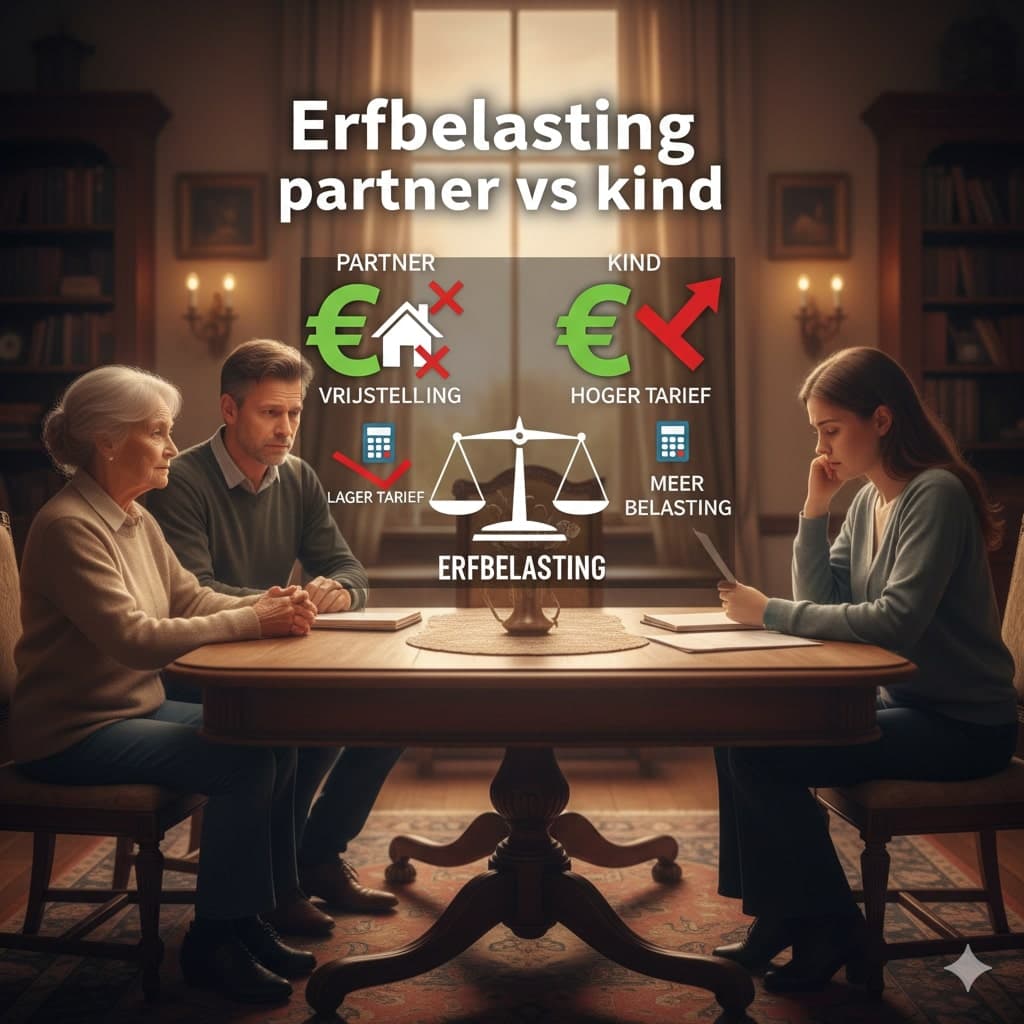
In Flanders, a partner and a child pay inheritance tax on the same scale: 3%, 9% and 27%. The difference lies in the exemptions. Under certain conditions the surviving partner pays nothing on the family home and gets an exemption on the first €75,000 of movable assets. A child has neither of these advantages.
Brussels and Wallonia work differently. There, only spouses and legal cohabitants get the favourable treatment. A de facto cohabiting partner is taxed at the rate for "other persons", which is much higher. Children, on the other hand, get a reduced rate on the family home in those two regions.
What you end up paying therefore depends less on "partner or child" than on the region and the form of the relationship. Below you will find the rules per region, with worked examples for a death in 2026.
Which region sets the inheritance tax?
What counts is not where the house is, but the tax residence of the deceased. If they lived in more than one region during the five years before death, the region where they lived longest applies. Someone who lived in Antwerp and owned a holiday home in the Ardennes therefore falls entirely under Flemish inheritance tax.
Flanders collects inheritance tax itself through the Flemish Tax Administration. For Brussels and Wallonia, the FPS Finance still does so.
✦ 100% free & No obligation
Sell your property with the best agent
Compare the top 3 agents in your region for free and save on commission.
Compare agents →Flanders: same scale, different exemptions
In Flanders, children and partners fall in the same rate group. The scale applies per heir, and separately to the movable part (money, investments, contents) and the immovable part (home, land).
| Bracket per heir | Rate for child or partner |
|---|---|
| €0 to €50,000 | 3% |
| €50,000 to €250,000 | 9% |
| Above €250,000 | 27% |
The Flemish government announced a reform of inheritance tax in its 2024-2029 coalition agreement and its September 2025 policy statement. According to vlaanderen.be, nothing has been decided yet. The current rates still apply.
Who counts as a partner?
For Flemish inheritance tax, you are the partner of the deceased if, on the day of death, you were married to them, were their legal cohabitant, or had lived with them uninterrupted for at least one year in a joint household. A de facto cohabitant therefore pays the same rate as a spouse after one year of living together. Anyone who lived together for a shorter period falls under the rate for others: 25% up to €35,000, 45% from €35,000 to €75,000 and 55% above that.
Family home exemption
The surviving partner pays no inheritance tax on their share of the family home, meaning the main residence where both partners lived together at the time of death. The exemption applies to spouses, legal cohabitants and de facto cohabitants. De facto cohabitants must, however, have lived together for at least three years before the death. A second home does not qualify, and the exemption does not apply if the cohabiting partner is a relative in the direct line, such as a child living at home. There is no condition about not remarrying.
Partner allowance on movable assets
For deaths from 1 January 2026, the first €75,000 of the partner's net movable share is exempt (€50,000 for earlier deaths). Anything above that is taxed at 9% and possibly 27%. An unused part of the allowance cannot be carried over to the home.
What a child gets
In Flanders, a child has no family home exemption and no general exemption on the first bracket. There are two reductions, though:
- A child under 21 gets a €75 reduction for each full year remaining until age 21. The surviving partner gets half of the reduction that the common children receive together.
- If the net share is no more than €50,000, a tax credit of €500 minus the share divided by 100 applies. For a share of €12,500 or less, this brings the tax down to zero. The credit also applies to partners.
Children under 21 who have lost both parents are exempt on their share of the family home and on the first €75,000 of movable assets.
Worked example for Flanders
For a death in 2026. One heir receives a €250,000 share in the family home and €50,000 in savings. We compare three situations.
| Heir | Home (€250,000) | Savings (€50,000) | Total |
|---|---|---|---|
| Child aged 25 | €50,000 x 3% = €1,500 plus €200,000 x 9% = €18,000, together €19,500 | €50,000 x 3% = €1,500 | €21,000 |
| Spouse, legal cohabitant or de facto cohabitant (3 years or more) | exempt: €0 | within the €75,000 partner allowance: €0 | €0 |
| De facto cohabitant (between 1 and 3 years) | no family home exemption: €19,500 | within the €75,000 partner allowance: €0 | €19,500 |
If the child were 16 years and 3 months old, there would be 4 full years left until 21. The reduction would then be 4 x €75 = €300, bringing the tax down from €21,000 to €20,700.
The example shows where the gap comes from: not the scale, but the two partner exemptions. For the child's side, read how much inheritance tax a child pays, and for the partner's side how much inheritance tax a spouse pays.
Brussels: only spouses and legal cohabitants
In the Brussels-Capital Region, children, spouses and legal cohabitants pay the same rate. There is no split between movable and immovable assets: the scale runs over the whole net share. The first €15,000 is exempt, and children under 21 get an additional €2,500 exemption for each full year until 21.
| Bracket per heir | Rate |
|---|---|
| €0 to €50,000 | 3% |
| €50,000 to €100,000 | 8% |
| €100,000 to €175,000 | 9% |
| €175,000 to €250,000 | 18% |
| €250,000 to €500,000 | 24% |
| Above €500,000 | 30% |
The spouse or legal cohabitant pays no inheritance tax on their share of the dwelling that served as the family home at the time of death. Children do not get that exemption, but they do get a reduced rate on their share of the building where the deceased had their main residence for at least five years, up to €250,000: 2%, 5.3%, 6% and 12% instead of 3%, 8%, 9% and 18%. In Brussels, a de facto cohabitant gets neither the partner rate nor the family home exemption.
Wallonia: five years of main residence
In Wallonia too, children, spouses and legal cohabitants fall under the same scale, applied to the whole net share: 3% up to €12,500, then 4%, 5%, 7%, 10%, 14%, 18% and 24%, and 30% above €500,000. The first €12,500 is exempt. If the net share is no more than €125,000, a further €12,500 is exempt. Children under 21 get an extra €2,500 for each full year until 21.
The surviving spouse or legal cohabitant is fully exempt on their share of the dwelling that had been the deceased's main residence for at least five years before death. Children get a reduced rate on that family home, starting at 1% up to €25,000, if the deceased had their main residence there for at least five years. De facto cohabitants get neither the partner rate nor the family home exemption. They pay the rate for other persons.
Worked example for Brussels and Wallonia
For a death in 2026. One heir receives a net share of €250,000 that does not include the family home, for example savings and a rented flat. The exemption comes off the lowest brackets first.
| Heir | Brussels | Wallonia |
|---|---|---|
| Child, spouse or legal cohabitant | €15,000 exempt; €35,000 x 3% = €1,050; €50,000 x 8% = €4,000; €75,000 x 9% = €6,750; €75,000 x 18% = €13,500; total €25,300 | €12,500 exempt; €12,500 x 4% = €500; €25,000 x 5% = €1,250; €50,000 x 7% = €3,500; €50,000 x 10% = €5,000; €50,000 x 14% = €7,000; €50,000 x 18% = €9,000; total €26,250 |
| De facto cohabiting partner (rate for other persons, sole heir in that group) | €50,000 x 40% = €20,000; €25,000 x 55% = €13,750; €100,000 x 65% = €65,000; €75,000 x 80% = €60,000; total €158,750 | €12,500 x 30% = €3,750; €12,500 x 35% = €4,375; €50,000 x 60% = €30,000; €175,000 x 80% = €140,000; total €178,125 |
If the share does include the family home, the spouse or legal cohabitant pays nothing on it and a child gets the reduced family home rate. Your notary calculates the exact amount. For a fuller overview per region, see inheriting a property in Belgium.
Who actually inherits?
Inheritance tax determines how much you pay on what you receive. Who receives what is governed by federal inheritance law. According to the Belgian notaries' site notaris.be, a surviving spouse always inherits at least the usufruct of the family home and its contents, and a legal cohabitant inherits the usufruct of the family home and its contents unless a will provides otherwise. De facto cohabitants do not inherit from each other unless there is a will. The worked examples above assume a share the heir actually receives, by law or by will.
Giving during your lifetime
If you give assets away during your lifetime, gift tax applies instead of inheritance tax, with its own rates. A registered gift of movable assets costs 3% in Flanders and Brussels in the direct line and between partners (including de facto cohabitants after one year of living together), and 3.3% in Wallonia in the direct line and between spouses and legal cohabitants. For a gift of real estate in the direct line and between partners, all three regions apply a scale of 3%, 9%, 18% and 27%, with thresholds at €150,000, €250,000 and €450,000. In Wallonia, only spouses and legal cohabitants count as partners. Which region applies depends on the donor's tax residence.
If a manual gift or bank transfer gift is not registered and the donor dies within five years, the gift still falls under inheritance tax. That five-year period applies to gifts made from 1 January 2025 in Flanders, from 1 January 2026 in Brussels and from 1 January 2022 in Wallonia. For older gifts it is three years. More in how much is gift tax in Belgium.
Selling the inherited house
Inheritance tax is calculated on the value of what you inherit, including when that is a home. If you are unsure what the house is worth, or you want to sell it together with the other heirs, get a free valuation first. That way you know where you stand before you finalise the estate declaration with your notary.
Frequently asked questions
Does a partner pay less inheritance tax than a child in Flanders?
The scale is the same: 3% up to €50,000, 9% up to €250,000 and 27% above that, applied separately to movable and immovable assets. The partner does get two exemptions a child does not have: no tax on their share of the family home, and an exemption on the first €75,000 of movable assets for deaths from 1 January 2026.
How much does a child pay in Flanders on a €250,000 share in the family home and €50,000 in savings?
For a death in 2026, a child pays €1,500 (3% on €50,000) plus €18,000 (9% on €200,000) on the home, together €19,500. On the savings it is 3% on €50,000, or €1,500. The total is €21,000. A partner who meets the conditions pays €0 on the same share.
Does a de facto cohabitant get the same advantages as a spouse in Flanders?
After at least one year of uninterrupted cohabitation in a joint household, a de facto cohabitant pays the same rate as a spouse and gets the partner allowance on movable assets. For the family home exemption, a de facto cohabitant must have lived with the deceased for at least three years before the death.
Does the partner lose the family home exemption on remarriage?
No. The Flemish family home exemption has no condition about remarriage. The conditions concern the relationship on the day of death and the property: it must be the main residence where both partners lived together, not a second home.
What about de facto cohabitants in Brussels and Wallonia?
In Brussels and Wallonia, only spouses and legal cohabitants get the direct line rate and the family home exemption. A de facto cohabiting partner pays the rate for other persons. On a €250,000 share without the family home, for a death in 2026 that comes to €158,750 in Brussels (as the sole heir in that group) and €178,125 in Wallonia.
Does a child get any advantage on the family home in Brussels or Wallonia?
Yes, a reduced rate, but not a full exemption. In Brussels it applies up to €250,000 on the building where the deceased had their main residence for at least five years, with rates of 2%, 5.3%, 6% and 12%. In Wallonia the reduced rate on the family home starts at 1% up to €25,000, also with a five-year main residence condition.
Is a lifetime gift always taxed at 3%, like an inheritance?
No. A registered gift of movable assets in the direct line and between partners costs 3% in Flanders and Brussels and 3.3% in Wallonia, where only spouses and legal cohabitants count as partners. Real estate gifts follow a scale of 3%, 9%, 18% and 27%. Inheritance tax itself is progressive and rises to 27% in Flanders and 30% in Brussels and Wallonia.
"Real estate expert focused on quality control and strategic partnerships."