
How to justify the asking price of an unusual property

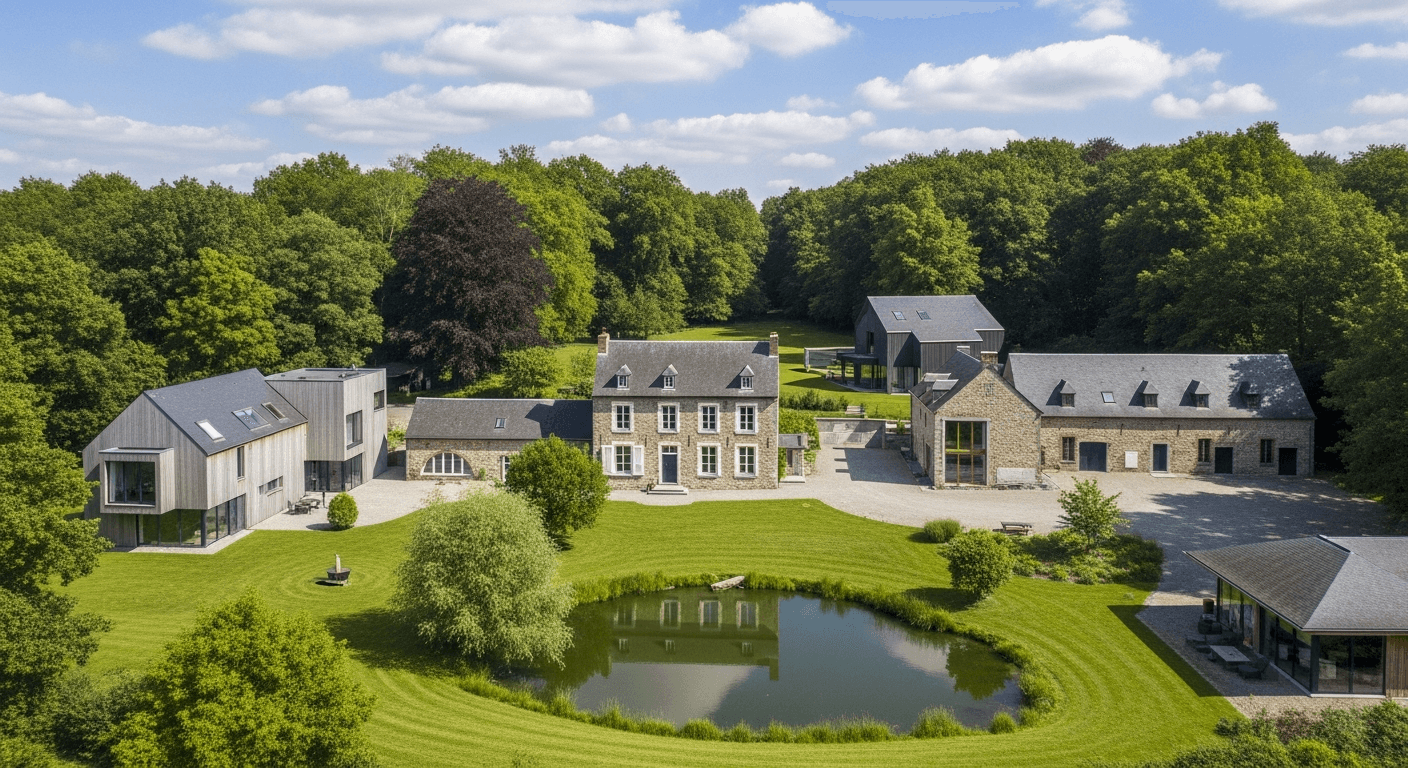
Justifying the asking price of an unusual property takes far more than a comparison with the house across the street. A loft converted from an old workshop, a maison de maître, a renovated square farmhouse or a home burdened with an easement have no direct equivalent in the statistics. Automated tools are then often tens of thousands of euros off the mark, and the buyer starts to doubt. Here is how to build a price you can defend, backed by figures and documents.
Why an unusual property escapes the valuation models
Automated valuation models reason by comparison. They gather recent sales in the same postcode, with a similar surface area and property type, then apply a weighted average. For a standard three facade house, that logic gives a reasonable order of magnitude. For a property outside the norm it collapses, because the comparison sample simply does not exist.
A property becomes unusual as soon as one element falls outside the local norm. It can be the surface area, for example 400 m² in a neighbourhood where the average is around 130 m². It can be the layout: open spaces, a mezzanine, no closed bedrooms. It can also be mixed residential and professional use, renovation work still in progress, a landlocked plot with a right of way, or a listed facade that comes with maintenance obligations.
The consequence is concrete. Two online valuations of the same property can differ by 15% to 25%, and the prospective buyer has no way of deciding between them. So it is up to you, the seller, to provide the proof. A price without justification gets negotiated down. A documented price can be defended.
The methods that produce a defendable price
Three approaches complement each other for a property outside the norm, and it is where they converge that the price becomes credible.
✦ 100% free & No obligation
Sell your property with the best agent
Compare the top 3 agents in your region for free and save on commission.
Compare agents →The widened comparison means stepping outside the neighbourhood. Instead of looking for other houses in your street, look for other lofts, other renovated farmhouses or other character properties across Belgium, then correct for the market gap between the two municipalities using local median prices. That gives you a realistic bracket based on a relevant sample.
The replacement cost method starts from the value of the land, to which you add the current construction cost of an equivalent property, then deduct depreciation. It is particularly useful for a recent property, a very well insulated one, or one that could not be rebuilt for the price on the listing. It gives you a strong argument: rebuilding would cost more.
The income capitalisation method applies when the property generates or could generate income, for example a commercial ground floor, a practice or a secondary dwelling. You start from the realistic net annual rent and divide it by a market yield rate. An investor reasons in exactly this way, and speaking their language changes the conversation.
A free valuation of your property remains an excellent starting point for framing the bracket before refining it with these methods.
Building the file that supports your price
For an unusual property, the file is worth as much as the listing. Every euro above the neighbourhood average has to correspond to a verifiable document. So gather the following before going to market:
- the invoices for major works, with dates and contractors;
- the planning permit and, where relevant, the certificate confirming the permitted use;
- the energy performance certificate (PEB in Wallonia and Brussels, EPC in Flanders), together with actual consumption over the past two years;
- the inspection of the electrical installation and any available technical reports;
- the plans, the exact surface area and photographs taken before and after renovation;
- the grants obtained and the materials used, particularly where they are not standard.
This file has a double effect. It reassures the buyer, who always fears unpleasant surprises with an out of the ordinary property, and it saves time for their banker, who also has to validate the value before granting the loan. On an unusual property, a financing refusal caused by a valuation that came in too low is one of the most common reasons a sale falls through.
The mistakes that cost the most
The first mistake is adding the renovation budget to the value the property had before. A renovation is never recovered in full. A kitchen, a bathroom or insulation work done well largely finds its way back into the price, but an indoor swimming pool, a recording studio or a highly personal fit-out are rarely worth what they cost.
The second mistake is the emotional price. You know the sentimental value of every detail; the buyer does not. A property overpriced from the start stays online, collects viewings without offers, then goes through two or three successive reductions. It almost always ends up below the price a correct launch would have achieved.
The third mistake is underestimating the weight of the energy score. In Wallonia as much as in Brussels and Flanders, a poor certificate weighs directly on the negotiation, because the buyer works out the budget needed to bring the property up to standard. On an unusual property, often old or large, that argument comes up at the table every time.
The fourth mistake is a generic presentation. Weak photographs and an off the shelf description destroy precisely what gives a character property its value.
Having your price validated by professionals on the ground
An unusual property sells above all on the quality of the targeting. The buyer you need to convince is not the one from your neighbourhood, but the one looking for exactly this kind of space, sometimes fifty kilometres away. An agent who has already sold this type of property has a list of potential buyers, knows which arguments land during a viewing and knows the price an offer actually came in at, not just the advertised price.
That is why it pays to compare several estate agents before signing a mandate. Ask each of them which sales their bracket is based on, how they intend to present the property and what timescale they are quoting. An IPI licensed professional who backs up their valuation with concrete references will teach you more about the market than a dozen simulators.
In practice, the differences between agents concern the recommended price as much as the commission and the marketing plan. Receiving up to three independent opinions lets you cross-check the figures and set aside the overly optimistic valuation, the one that mainly serves to win the mandate.
In summary
For a property outside the norm, a price is not declared, it is demonstrated. Combine at least two valuation methods, put together a file of evidence, stay realistic about what a renovation really returns and test your figure against the opinion of professionals active in your region. You can compare up to three estate agents free of charge and set their valuations side by side before fixing your starting price. It is the simplest way to bring your property to market with a figure you can defend, line by line.
Frequently asked questions
Why do automated valuation tools often fail for unusual properties?
Automated tools work by comparing your property to recent similar sales in the same postcode. When a property falls outside the local norm, for example due to its size, layout or mixed use, there is no relevant comparison sample and the estimate can be off by 15% to 25%.
What valuation methods work best for an unusual property?
Three methods complement each other: a widened comparison using similar property types across Belgium, the replacement cost method based on land value plus construction cost minus depreciation, and the income capitalisation method if the property generates or could generate rental income. Where these methods converge, the price becomes credible.
What documents should I prepare before listing an unusual property?
You should gather invoices for major works with dates and contractors, the planning permit, the energy performance certificate with two years of actual consumption data, electrical inspection reports, floor plans, exact surface area measurements, and details of any grants obtained or non-standard materials used.
Can I simply add my renovation costs to the previous property value?
No - a renovation is never fully recovered in the sale price. Work like a kitchen, bathroom or insulation tends to return well, but highly personal additions such as an indoor swimming pool or a recording studio rarely recoup what they cost.
How can getting multiple estate agent opinions help me price an unusual property?
Comparing up to three independent valuations lets you cross-check figures and identify any overly optimistic estimate that mainly serves to win the mandate. Ask each agent which comparable sales their bracket is based on, how they plan to present the property and what realistic timescale they expect.
"Tech entrepreneur and strategist focused on digital transformation in the real estate sector."