
How to value a house with building land

How to value a house with building land
To work out how to value a house with building land, you need to calculate two scenarios: selling everything as one lot, and selling the house with a smaller garden plus a separate building plot. The right price depends on what planning rules allow, the cost of dividing the plot and the local market. This article is for owners selling a house where part of the land could take a new build.
Why a house with building land needs its own valuation
A standard house is mainly valued by comparison: you look at recent sales of similar homes in the area, then adjust for condition, living space and energy performance. With a large plot where part of the land can be built on, that method is no longer enough.
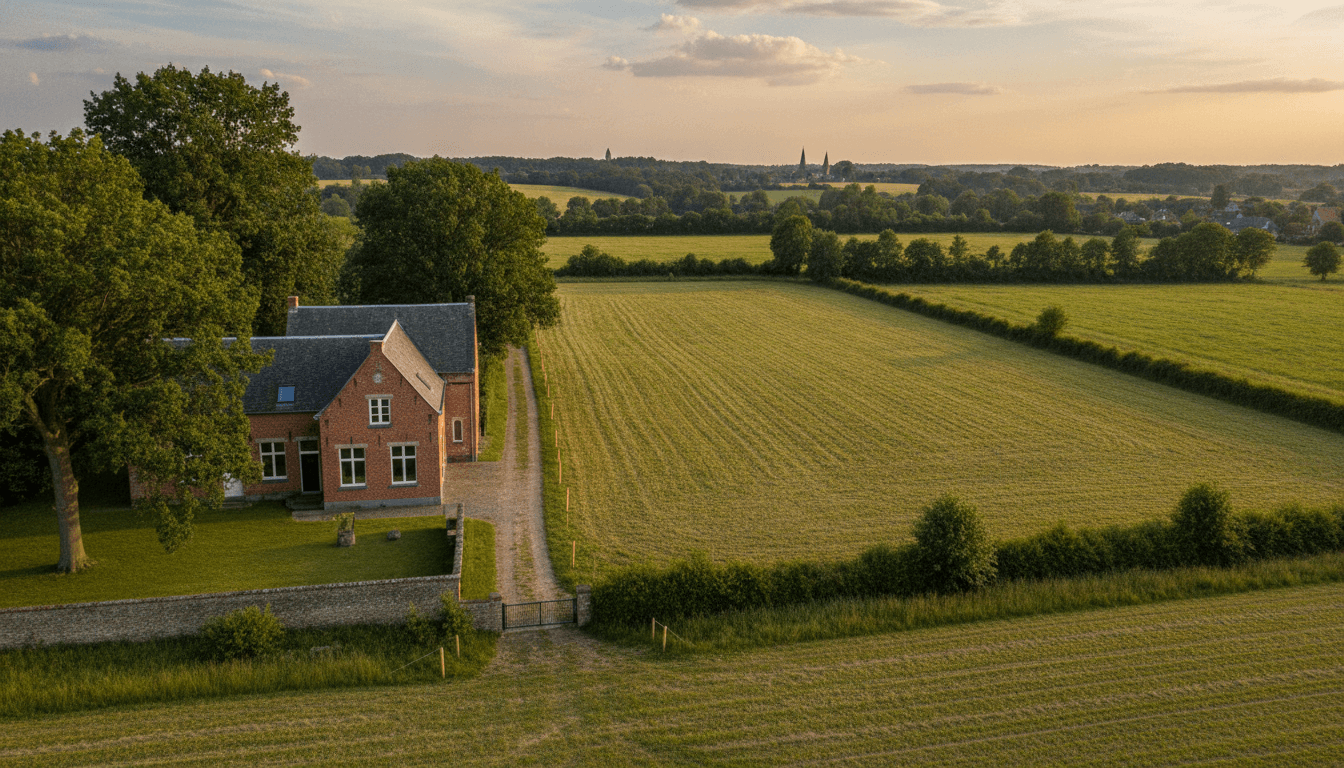
The extra land is not just a bigger garden. It is potential: a buyer could build a second home on it, then sell it or rent it out. That potential has a value, but only if several conditions are met. The land must lie in a residential zone on the plan de secteur (Wallonia), the gewestplan or a spatial implementation plan (Flanders), or in the right zone of the PRAS in Brussels. It also needs access to a fully serviced road, with sewer, water and electricity close by.
Two houses of the same size can therefore sell at very different prices. The one whose back garden can become a building plot is often worth more, provided the buyer can check that this plot really exists in planning terms. An agent who overlooks this potential may undervalue your property. An agent who overstates it costs you months with a price nobody will accept.
Selling as one lot or dividing the land: two different calculations
The first question is simple: are you selling everything together, or dividing the plot before the sale?
✦ 100% free & No obligation
Sell your property with the best agent
Compare the top 3 agents in your region for free and save on commission.
Compare agents →As one lot, the buyer pays for the house and the potential of the land. They handle the division or building process themselves. The price therefore reflects only part of the land's value, because the buyer factors in the risk, the time and the costs. This scenario mainly attracts families who want a large garden, or investors who know the procedure.
As two lots, you sell the house with a smaller garden and, separately, a building plot. The total can be higher, but three things come off it:
- the loss of value on the house, which keeps less garden and sometimes less privacy if a new home goes up next door;
- the cost of dividing the plot: chartered surveyor, permit application, any utility connections and extra notary fees;
- the time involved: a permit procedure takes several months and the outcome is not guaranteed.
A serious valuation gives you both figures, with a breakdown of what is deducted. You then compare a net price, not a gross one.
How an agent values the building plot
For the buildable part, the estate agent also starts from reference sales, but of comparable building plots in the municipality. The price per square metre of land varies a lot depending on a few concrete criteria:
- the frontage width along the street, which determines the type of house possible (terraced, semi-detached or detached);
- the depth and shape of the plot;
- the orientation of the future garden;
- the road services and the cost of connections;
- local regulations: building size, placement, number of homes allowed, any easements.
For a plot that mainly interests developers, some agents also use the residual method. It starts from the likely sale price of what can be built, then subtracts the construction costs, fees and the developer's margin. What is left is the price a developer can pay for the land.
The house itself is then valued as a normal home, but with the garden it would keep after the division. This is often where valuations differ most. If you receive several opinions, read our article on how to compare property valuations from several agencies.
What planning and dividing the plot mean for the seller
Before putting a price on the building potential, ask your municipality for the planning information on the plot. The notary will request it for the sale anyway. It shows the zoning, the plans that apply, permits already granted and any breaches.
Dividing a plot to create a building lot needs a permit in most cases: a permis d'urbanisation in Wallonia, an omgevingsvergunning voor het verkavelen in Flanders, a permis de lotir in Brussels. The rules and exceptions vary by region and by the situation of the plot. The planning department of your municipality can tell you what applies to you.
There is also a tax point. A capital gain on the sale of undeveloped land can be taxed when the sale takes place less than eight years after it was acquired. If you have owned the house for a long time, that period has usually passed, but have your notary check your situation, as they know the current rates and conditions. For the steps involved in selling land on its own, see our guide on selling a building plot as a private individual.
How to get a reliable valuation of your property
An online tool gives a first rough figure for the house, but it cannot see the potential of a buildable back garden. You can start with a free online valuation, then ask for the opinion of agents who know land sales in your municipality.
Ask each agent to put figures on both scenarios, selling as one lot and selling as two lots, with costs and time deducted. Also ask which reference sales they use for the land. An agent who cannot name recent comparable transactions in your area is less well placed to defend your price to a buyer.
On ImmoMakelaarVergelijker.be, you can compare up to three accredited estate agents active in your area, free and with no obligation. That gives you several readings of your property and its potential before you choose a sales strategy.
Frequently asked questions
Does a large garden always make my house more expensive?
No. A large garden mainly adds value if it can take a permitted build or meets local demand. Without building potential, a very large plot can even put some buyers off because of the upkeep.
Should I divide the land before selling?
Not necessarily. Dividing can bring in more, but it takes a permit, costs and several months. Compare the net price of both scenarios before you decide.
Who can confirm that part of my land can be built on?
The planning department of your municipality, based on the planning information and the plans that apply. A chartered surveyor can then prepare a division plan.
Is a capital gain on land taxed in Belgium?
It can be if undeveloped land is sold less than eight years after it was acquired. Your notary checks whether this rule applies to your situation.
In summary
A house with building land is not valued like an ordinary house. Have someone check what planning rules allow, calculate the sale as one lot and as two lots, and deduct costs and time to compare net amounts. To weigh up several professional opinions, compare up to three estate agents for free in your municipality.
"Real estate expert focused on quality control and strategic partnerships."