
Land survey plan when selling your home in Belgium: when do you need one?

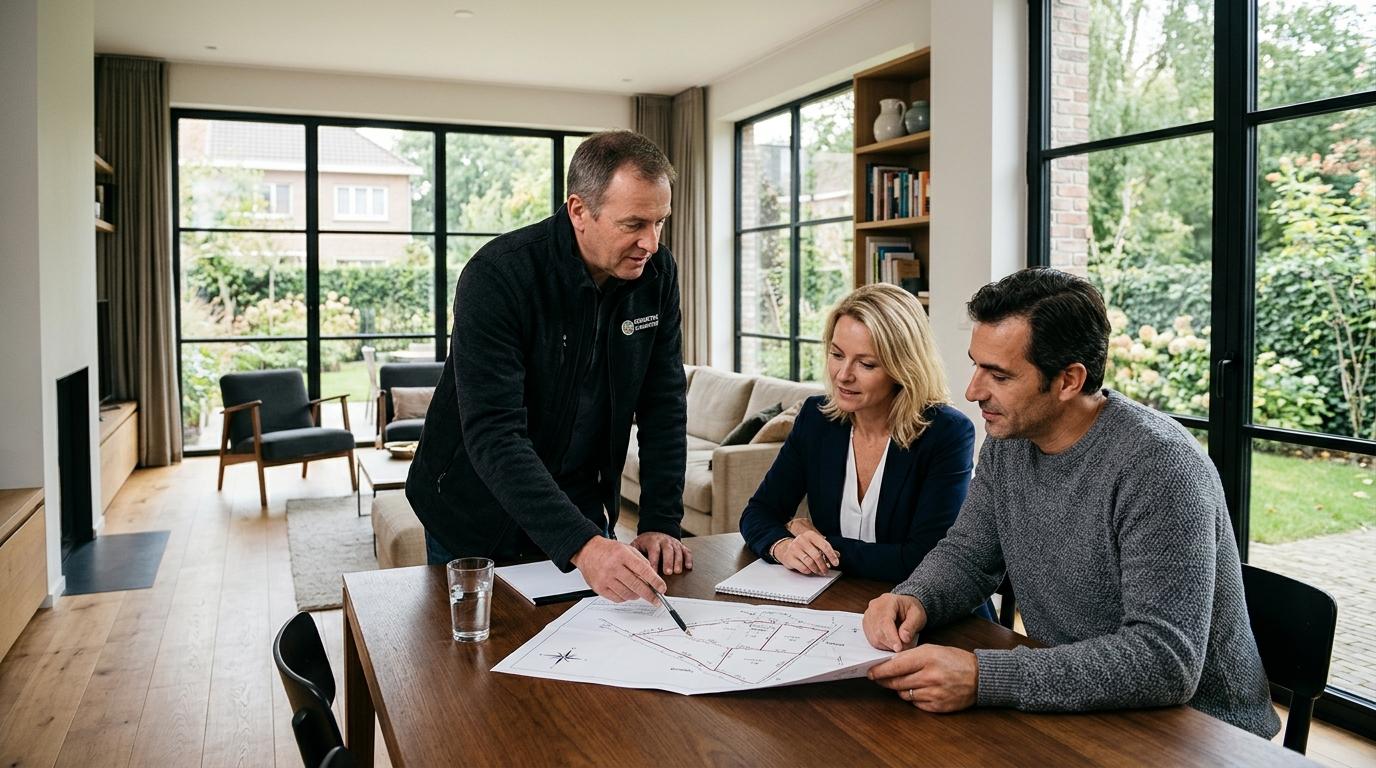
Land survey plan when selling your home in Belgium: when do you need one?
A land survey plan from a surveyor when selling your home is not always required. If you sell an entire plot with clear boundaries, the cadastral description in the deed is usually enough. If you only sell part of your land, or if there is doubt about where your plot ends, the notary will ask for a plan. Below you can read when, why and how to arrange it in good time.
What is a survey plan and who may draw it up?
A survey plan is a technical drawing of a plot showing the exact boundaries, the surface area and the position of the buildings. It is drawn up by a land surveyor (landmeter-expert / géomètre-expert). This is a protected profession in Belgium: only people registered on the roll of the Federal Council of Land Surveyors may use the title and sign plans that are attached to a notarial deed.
The difference with the cadastral plan matters. The cadastre is first and foremost a tax register. The cadastral plan gives a good picture of the location, but it is not proof of the correct property boundaries. Many sellers assume that the surface area on their tax assessment or in the cadastre is the real surface area. In practice it is sometimes a few to several dozen square metres off. You can read more about how the cadastre works in our article on how cadastral income is calculated.
A surveyor measures the land with their own equipment, compares the result with old deeds and plans, and records where the boundaries are. The result is a plan with a unique reference number that the notary can include in the deed.
When do you need a survey plan when selling?
In three situations you can hardly avoid it.
✦ 100% free & No obligation
Sell your property with the best agent
Compare the top 3 agents in your region for free and save on commission.
Compare agents →You are selling part of your plot. This is the most common reason. Think of a strip of garden you sell to the neighbours, a building plot at the back of your land or a house you split off from an adjoining meadow. A new plot is then created that does not yet exist in the cadastre. Without a plan, the notary cannot describe exactly what is being sold.
The boundaries are unclear or disputed. If the hedge is not on the real boundary, the neighbours' driveway partly sits on your land or the boundaries were never formally marked out, a survey is the safest route. A buyer who discovers a boundary dispute after the deed can turn against you.
The buyer or their bank asks for it. With older properties that have vague descriptions in the title deed, a buyer sometimes asks for a plan to be sure of what they are buying. This is not a legal obligation, but it can make the sale go more smoothly.
If you are selling an apartment, a survey plan of the plot is rarely an issue. There, the basic deed of the co-ownership and its plans play the main role.
Pre-cadastration: why timing matters
When a sale creates a new plot, the surveyor's plan must be registered in advance with the General Administration of Patrimonial Documentation (the service that manages the cadastre). This is called pre-cadastration. The administration checks the plan and assigns it a reference and provisional plot numbers. Only then can the notary use the plan in the deed.
This step takes time. First the surveyor has to measure the land, then draw up and submit the plan, after which you wait for the registration. So do not count on a few days. It is best to start before you put the property on the market, especially if you are selling part of your land. That way you avoid having to postpone the signing of the deed because the plan has not yet been registered.
If you are splitting off land so a house can be built on it, you may also need a subdivision permit (in Flanders an omgevingsvergunning voor het verkavelen; the other regions have their own equivalent). Your notary and the municipality can tell you whether this applies in your case. That procedure also takes time and must be completed before you sell the land as building land.
Survey and boundary marking: what is the difference?
The two terms are often used interchangeably, but they mean different things.
In a survey, the surveyor measures your plot and draws it up. This can be done unilaterally, on your instructions as the owner.
In a boundary marking (afpaling / bornage), the boundaries between two plots are fixed together with the neighbours, and often also marked with posts on the land. If both owners agree, they sign an official record of the boundary marking. That document carries more evidential weight than an ordinary survey, because the neighbours have also recognised the boundary. If the neighbours cannot agree, the justice of the peace can order the boundary marking.
For an ordinary sale of an entire plot, boundary marking is not mandatory. But if you know there is doubt about a boundary, it pays to resolve the issue before the sale. A buyer would rather pay a fair price for a clearly defined plot than for a property with an open question.
What does a survey plan cost and who pays?
Surveyors set their own prices. The cost depends on the surface area, how accessible the land is, the number of boundaries to be determined, the research in old deeds and whether boundary marking with the neighbours is added. So always ask for a quote in advance and feel free to compare two or three.
Who pays is a matter of agreement between seller and buyer. In practice the seller usually bears the cost when selling part of their land, because they need to be able to describe the new plot. If the buyer explicitly asks for a plan when buying an entire plot, both parties can agree that the buyer pays or that the cost is shared. Record this in the sale agreement (compromis).
The survey plan comes on top of the other documents you need to gather as a seller, such as the energy performance certificate and, depending on the region, certificates on asbestos and soil. You will find a full overview in our article which documents you need to sell your home.
The role of your estate agent and notary
An experienced estate agent can often tell at the first visit whether a survey will be needed. A garden that runs into a meadow, a shared driveway or a plot that was once split: these are signals they recognise. They can refer you to a surveyor and plan the sale around it, so the deed is not delayed unnecessarily.
The surface area also affects the asking price. Especially for land in a sought-after area, every square metre counts. So have the value of your home estimated on the basis of correct data. Our free valuation gives you a first indication.
Want to know which agent in your area knows this kind of case well? On ImmoMakelaarVergelijker.be you can compare up to 3 BIV-registered estate agents for free in your region. You then receive a proposal from agents who know the local market and its practical pitfalls.
Frequently asked questions
Is a survey plan mandatory for every house sale?
No. When selling an entire plot with clear boundaries, the cadastral description in the deed is usually enough. A survey plan is needed when you sell part of your plot or when the boundaries are unclear.
Is the surface area in the cadastre legally binding?
No. The cadastre is a tax register. The cadastral surface area gives an indication, but does not prove where your property boundaries lie. Only a survey by a land surveyor, and preferably a boundary marking with the neighbours, gives certainty on that.
What is pre-cadastration?
Pre-cadastration is the registration of a surveyor's plan with the General Administration of Patrimonial Documentation before the deed is executed. It is mandatory when a sale creates a new plot, for example when a piece of land is split off.
How long does it take to have a survey plan drawn up?
That depends on the surveyor's schedule, the complexity of the land and the registration with the administration. Allow a few weeks, so it is best to start before you put the house or land on the market.
In conclusion
For most sellers of an entire house, a survey plan is not an obligation. If you are selling part of your land, or if you have doubts about the boundaries, a timely survey saves you delays and discussion at the deed. Book the surveyor early, make sure the pre-cadastration is done on time and agree in the sale agreement who bears the costs. Would you like guidance from an agent who handles such cases smoothly? Then compare estate agents in your region with no obligation.
Frequently asked questions
Is a land survey plan required for every home sale in Belgium?
No, not for every sale. When selling an entire plot with clear boundaries, the cadastral description in the deed is usually sufficient. A survey plan is mainly needed when you sell part of your plot or when the boundaries are unclear or disputed.
Is the surface area listed in the cadastre legally accurate?
No. The cadastre is a tax register, not a legal proof of property boundaries. In practice, the cadastral surface area can be off by a few to several dozen square metres compared to the real measurements.
What is pre-cadastration and when is it required?
Pre-cadastration is the registration of a surveyor's plan with the General Administration of Patrimonial Documentation before the deed is signed. It is required when a sale creates a new plot, for example when a piece of land is split off from a larger property.
How much time should I allow for a survey plan before selling?
Allow at least a few weeks, as the process involves measuring the land, drawing up the plan and registering it with the administration. It is best to start before you put the property on the market to avoid delays at the signing of the deed.
Who pays for the survey plan - the buyer or the seller?
This is a matter of agreement between both parties. In practice, the seller usually pays when selling part of their land, since they need a plan to describe the new plot. If the buyer requests a plan for an entire plot, both parties can agree to split the cost or have the buyer pay - this should be recorded in the sale agreement.
Follow us on Google
Pick Immomakelaar Vergelijker as a preferred source and you will see our articles more often in Google, including in AI answers.
Redactie ImmoMakelaarVergelijker
"We write about selling, valuing and costs in Belgium. Articles are drafted with the help of AI from official sources and checked by our team."