
Renovate or move house in Belgium in 2026: how to decide

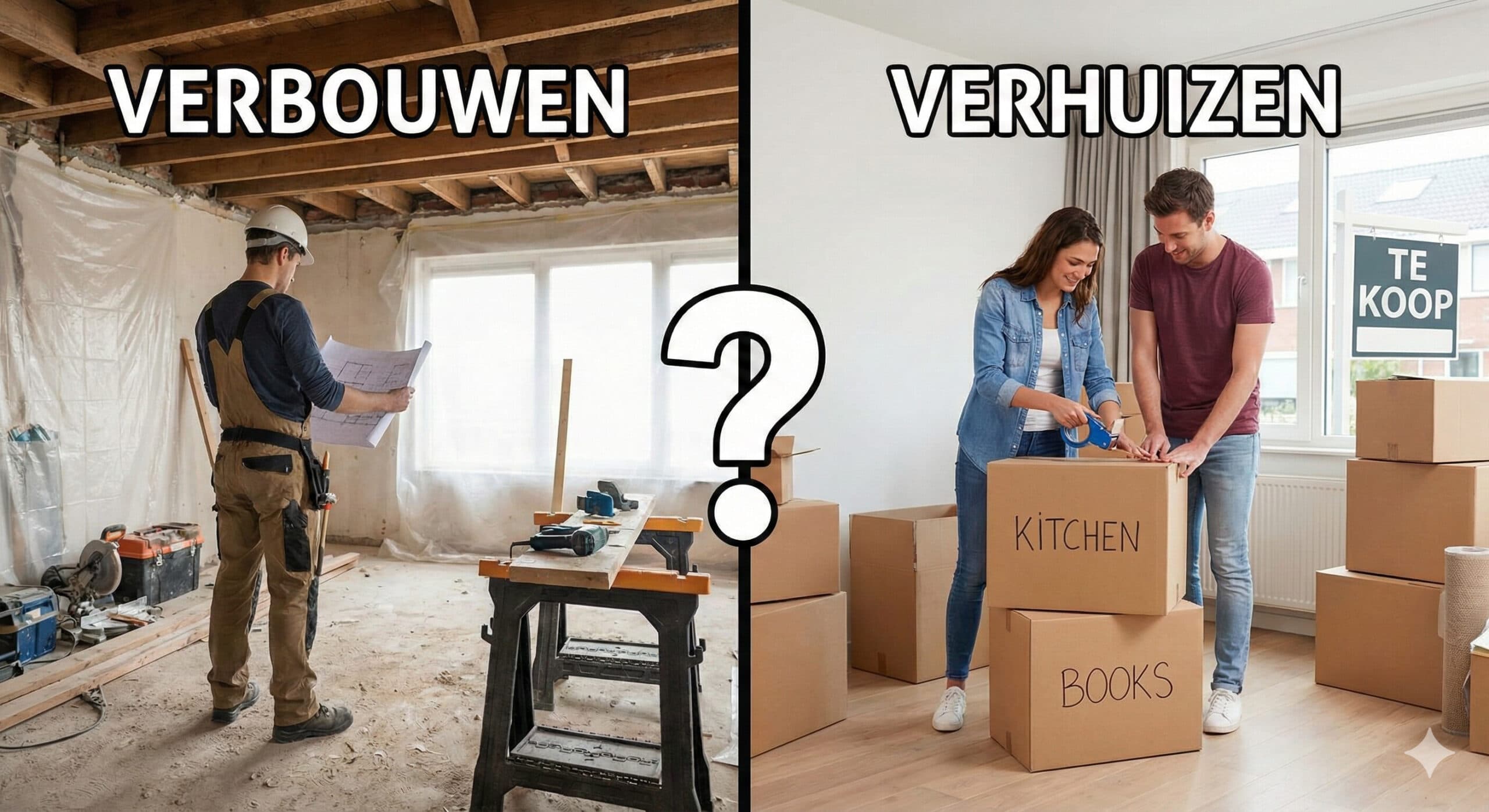
Your home no longer fits. Too small for the family, too big now the children have left, expensive to heat or simply dated. Sooner or later the question comes up: renovate or move? There is no one-size-fits-all answer, but you can work through the decision step by step, using the rules that apply in Belgium in 2026.
Start with what your home no longer gives you
The first question isn't financial. Can a renovation actually solve your problem?
- The problem is the house itself: poor insulation, an old kitchen or bathroom, an awkward layout. A renovation can usually fix this.
- The problem is location or size: too far from work or school, no garden, too many stairs, a plot where you are not allowed to extend. A renovation changes little or nothing here.
If a renovation only solves part of the problem, you pay a lot for half a solution. In that case it is worth costing out a move properly.
What does moving cost?
Moving means selling and buying. Both sides have costs you never get back.
Costs when you sell
- the estate agent's fee, if you use an agent;
- the mandatory certificates, such as the energy performance certificate (EPC), the electrical inspection and, depending on the region, other certificates such as the asbestos certificate in Flanders for buildings from before 2001;
- the cost of repaying a mortgage early, such as the reinvestment fee and the removal of the mortgage registration.
A full overview is in the costs of selling a house.
✦ 100% free & No obligation
Sell your property with the best agent
Compare the top 3 agents in your region for free and save on commission.
Compare agents →Costs when you buy
The biggest item is usually registration duties:
| Region | Only own home | Other purchases |
|---|---|---|
| Flanders | 2% | 12% |
| Wallonia | 3% | 12.5% |
| Brussels | 12.5% with an exemption on the first 200,000 euros, if the price is no more than 600,000 euros | 12.5% |
Buy a 400,000 euro home in Flanders as your only own home and you pay 8,000 euros in registration duties. If you still own your current home when you buy, you can usually still get the reduced rate, provided you sell the old home in time. Since 1 January 2026 the Flemish conditions are stricter. You must buy in full ownership, register at the new address within three years and live there for at least one year without interruption. Details are in registration duties in Flanders.
On top of that come notary fees, the cost of a new mortgage, the move itself and whatever you want to change in the new home straight away.
Watch out for homes with a poor energy label
If you buy a home with label E or F in Flanders, you must renovate it to at least label D within six years of the deed. The deadline was extended from five to six years at the end of 2025, also for earlier purchases. A cheaper home can end up costing more than it seems. In Wallonia, a draft plan proposes a similar obligation for purchases from 2028, but it is not law yet. What such a renovation costs is covered in the cost of renovating an EPC F property.
What does renovating cost?
A renovation has no registration duties, but it has its own costs and risks:
- The works themselves, with a buffer for surprises. In older houses they are common.
- VAT: renovation of a private home older than ten years qualifies for the reduced 6% rate under certain conditions. Otherwise you pay 21%.
- Permits and design: an extension or structural work usually needs a planning permit and an architect.
- Living elsewhere: renting somewhere else, or living on a building site for months.
- Financing: a renovation loan or an increase of your existing mortgage.
Grants can cover part of energy-saving work, but the rules differ by region and change regularly. Wallonia, for example, is replacing renovation grants with loans. See the current schemes in renovation grants in Belgium.
The comparison that matters: what you lose and what you get back
Comparing one headline figure with another is misleading. Say moving costs you 35,000 euros in transaction costs: that money never comes back. An 80,000 euro renovation usually adds value to your home, though rarely the full amount. Ask the same three questions for both options:
- Which costs are lost? Registration duties, notary, agent and removal costs if you move. Rent during the works and unexpected costs if you renovate.
- What will your home be worth afterwards? A renovated home in a sought-after area gains value. An expensive renovation in a street where prices are low rarely pays for itself. How buyers view recent work is covered in the impact of renovation work on your valuation.
- Does it solve your problem? A cheap solution that doesn't work is the most expensive choice.
When renovating makes sense
- You like the area and the location fits your future.
- The plot and planning rules allow the changes you want.
- The house is structurally sound.
- You can manage the period of the works, practically and financially.
When moving makes sense
- Your problem is location, size or accessibility.
- The necessary works cost more than the home will be worth afterwards.
- Your household is changing, for example because the children have left.
- You have built up a lot of equity and can get the reduced rate as a buyer.
- You are likely to leave Belgium within a few years, so a long renovation would not pay off.
A middle way: selling without renovating first
Many owners wonder whether to renovate before selling. It doesn't always pay. Buyers of a home with a weak energy label factor the renovation into their offer, but often prefer to choose the work themselves. Read selling a house with a poor EPC rating before you start any work.
Start with the value of your current home
Every calculation starts from one number: what your home would sell for today. It decides how much you can put into a new home, and whether a renovation can pay for itself. Request a free valuation of your home. Leaning towards moving? Compare estate agents in your area. You get at most three verified agencies and can then decide in your own time.
Already know you're selling? Find the right agent for your home.
Frequently asked questions
How much registration duty do I pay when I move in Flanders?
For your only own home you pay 2% in Flanders, and 12% for other purchases. On a 400,000 euro home that is 8,000 euros. Since 2026 you must buy in full ownership and stay registered at the address for at least one year without interruption.
Do I have to renovate a home with label E or F after buying it?
In Flanders, yes. A buyer of a home with label E or F must renovate it to at least label D within six years of the deed. In Wallonia a draft plan proposes a similar obligation for purchases from 2028, but it is not law yet.
Does a renovation increase the sale price of my home?
Usually, but rarely by the full cost of the work. The return depends on the area, the price level in your street and the type of work. Energy improvements and a better layout often matter a lot to buyers.
How do I know whether moving is financially feasible?
Start with the value of your current home. Subtract the outstanding mortgage and selling costs, then add the costs of buying. A free valuation gives you the figure to work with.
"Tech entrepreneur and strategist focused on digital transformation in the real estate sector."