
Selling an apartment with a lift: what it means for your price and your sale

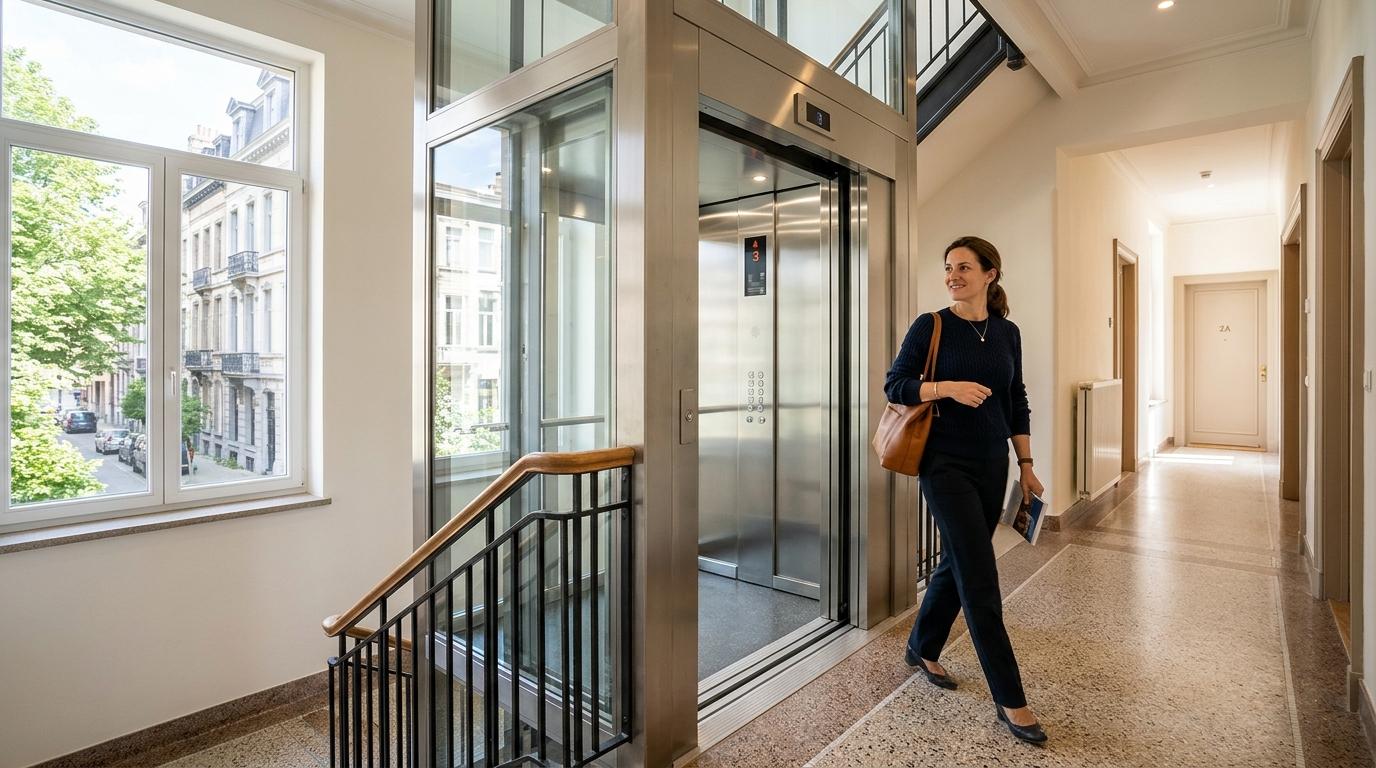
If you want to go about selling an apartment with a lift, you hold an asset that buyers notice straight away, but you will also face a few questions about maintenance, inspections and planned works. A lift widens the pool of potential buyers and counts towards the price. At the same time, a buyer will want to know what condition the lift is in and what it will cost them over the coming years. This article explains how to handle that as a seller.
Why a lift counts towards the price of an apartment
Two apartments in the same building rarely differ in floor area alone. The floor, the terrace, the orientation and the accessibility all play a part. A lift carries a lot of weight here, especially from the second or third floor up. Without a lift, an apartment on the fourth floor is simply out of reach for part of the market: families with a pushchair, people with limited mobility and buyers who are thinking about later in life drop out.
With a lift, that turns around. A high floor then often means more light, less street noise and a better view, and those benefits become a selling point instead of a drawback. That is why the higher floors in a building with a lift usually sell for more than the same floors in a building without one.
How big that difference is depends on the city, the type of building and the target buyer. There is no fixed percentage. So compare your apartment with units sold in similar buildings, with and without a lift, rather than relying on rules of thumb. A free valuation gives you an independent starting point that already takes the lift and the floor into account.
Who a lift makes the difference for
A lift appeals mainly to three groups of buyers, and it pays to tailor your sale to them.
✦ 100% free & No obligation
Sell your property with the best agent
Compare the top 3 agents in your region for free and save on commission.
Compare agents →The first group is older people selling the family home and moving somewhere smaller. They deliberately look for an apartment that will still be accessible in ten or twenty years. For them it is not just the lift that counts, but the whole route: is there a step at the entrance, does the lift stop at the level of the car park, and is the car big enough for a walking frame?
The second group is young families. Carrying shopping, a pushchair and a bike upstairs is no fun, and a lift removes that problem. The third group is investors. An apartment with a lift is easier to let to a wider range of tenants, which keeps vacancy down.
Spell out those benefits in your listing. Don't just write "lift available", but say whether the lift goes down to the basement or garage, whether the building is step-free and how recently the lift was modernised. An estate agent who sells apartments often knows which details buyers in your area want to read. If you want to see how different agencies approach it, compare up to three BIV-registered estate agents for free.
Inspection and maintenance: the documents a buyer wants to see
Lifts in buildings in Belgium fall under their own safety regulations, the Royal Decree of 9 March 2003 on lift safety. Among other things, those rules require a periodic inspection by an accredited external technical inspection body, a maintenance contract with a lift maintenance company and a risk analysis that can lead to compulsory modernisation works. The exact deadlines and conditions are available from the FPS Economy, which organises the supervision.
As the seller of a single unit, it is the association of co-owners (VME) that is responsible for the lift, not you personally. The building manager (syndic) handles the maintenance contract and keeps the inspection reports. A buyer will still want to see those documents, because they say something about future costs. So ask the syndic in good time for:
- the latest inspection report on the lift, with any remarks or breaches;
- the details of the maintenance contract and its annual cost;
- the results of the latest risk analysis and the modernisations that followed from it;
- the minutes of the general meetings where the lift was discussed.
An inspection report without remarks and a recent modernisation are strong selling points. A report with outstanding breaches is not, but keeping quiet about it does not help: the buyer or the notary will see it anyway in the syndic's documents. If you explain it honestly yourself, you stay in control of the negotiation.
Planned lift works and who pays for them
A lift renovation or the replacement of a complete installation is one of the bigger expenses in an apartment building. If such a project is on the table, the question is almost certain to come up during the negotiation.
The law sets a default rule. If the general meeting decides on works before the transfer of ownership, but the syndic only calls for payment afterwards, the buyer in principle bears that cost. Whatever the syndic has already called for before the transfer stays with the seller. You can also agree a different split with the buyer, as long as it is clearly set out in the sale agreement. To see how that mechanism works for all common charges, read our article on co-ownership charges when selling an apartment.
In practice, buyers often ask for a price reduction or want the seller to cover the approved lift works. Their reasoning is that the price of the apartment should already have reflected those works. Prepare for that conversation: know the amount that falls on your unit, based on the allocation key in the deed of division, and decide in advance how much room you are willing to give.
A healthy reserve fund helps here. If money has already been set aside for the lift, the call for funds will be lower and the buyer's argument loses some of its force.
How lift costs are split in the deed of division
Not every co-owner pays the same amount for the lift. The allocation key is set out in the deed of division or the co-ownership rules, and it can differ from the usual split based on ownership shares. In some buildings, the ground-floor residents pay nothing or less for the lift, because they do not use it. In other buildings, the upper floors pay a larger share.
For a buyer, that makes a real difference to the monthly charges. An apartment on the top floor can therefore have higher common charges than an apartment of the same size lower down in the building. Put the actual monthly service charge in your listing or hand it over at the first viewing, with an explanation of why it is high or low.
If you are selling a ground-floor apartment in a building with a lift, you can actually use that arrangement as an advantage: the buyer enjoys a well-maintained building without carrying the full share of the lift costs.
Selling an apartment without a lift
An apartment on a higher floor also sells without a lift, but the approach is different. Target buyers for whom the stairs are no obstacle, such as young single people, first-time buyers and students or their parents. Put the emphasis on what the floor does offer: light, peace and quiet, a view and often a lower price per square metre than comparable apartments with a lift.
Be realistic about the asking price. An apartment without a lift that is priced as if it had one stays on the market for months and ends up selling below its value. If there is a proposal at the VME to install a lift, mention it honestly, with the status of the decision and the estimated cost. If you would rather sell your apartment yourself, you will find the steps in our article on selling an apartment without an estate agent.
In conclusion
A lift makes your apartment accessible to more buyers and supports a higher price, particularly on the upper floors. That asset works best when your documents are ready: the inspection report, the maintenance contract, the allocation key and a clear answer to the question of who pays for planned lift works. So start early with the syndic. Would you like help with pricing and selling? Compare up to three BIV-registered estate agents near you, free and without obligation.
Follow us on Google
Pick Immomakelaar Vergelijker as a preferred source and you will see our articles more often in Google, including in AI answers.
Redactie ImmoMakelaarVergelijker
"We write about selling, valuing and costs in Belgium. Articles are drafted with the help of AI from official sources and checked by our team."