
Selling a house with a veranda: permit, EPC and sale price

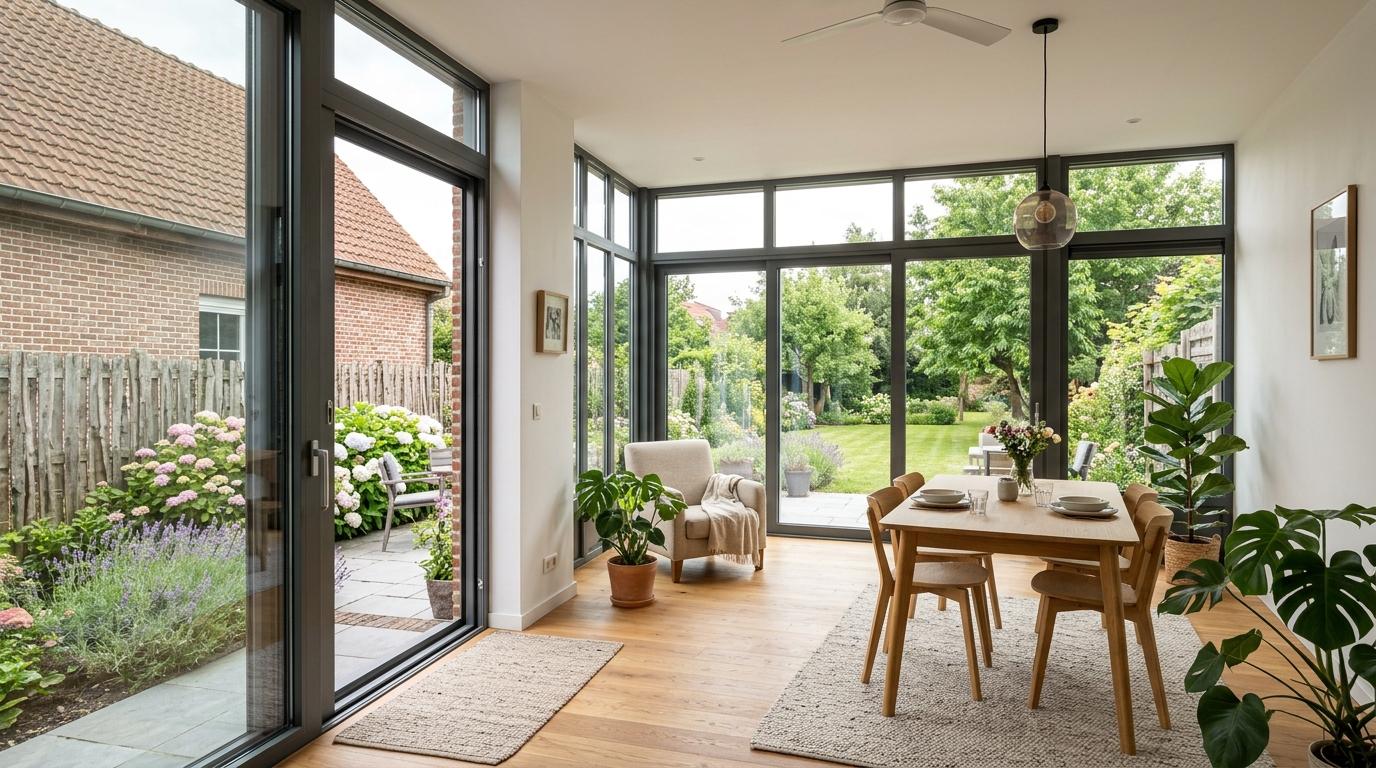
Selling a house with a veranda: permit, EPC and sale price
If you want to sell a house with a veranda, you often hold an extra card: more light, more living space and a room that appeals to buyers straight away. Still, a veranda also raises questions. Does it have a permit? Does it count in the EPC? And how much does it really add to the price? In this article you will read what to look out for as a seller, so the veranda stays a selling point and does not become a point of discussion at the notary's office.
Does your veranda have a permit? Start here
The first question a buyer, their bank and the notary will ask is whether the veranda was built legally. A veranda is an extension and therefore falls under planning rules. Depending on its size, its position against the house and the rules of your region and municipality, it needed a planning permit, a simple notification was enough, or the extension was exempt from a permit.
These conditions differ between regions and have changed over the years. So do not pass figures from memory on to a buyer, but check them in black and white. In Flanders you can look up in the Omgevingsloket which permits were issued for your address. In Brussels and Wallonia you ask the planning department of your municipality.
When you sell, the notary requests the planning information. If it shows that the veranda never received a permit although one was required, this has to be stated in the sale agreement. That puts buyers off and can push the price down. If the veranda has been there for a very long time, in some cases it can be deemed to be permitted. Whether that applies to your situation is decided by the municipality, not by the seller.
Unsure about a renovation done without a permit? Then also read our article on selling a house without a planning permit for a renovation. It sets out the possible routes, from regularisation to selling in its current state.
✦ 100% free & No obligation
Sell your property with the best agent
Compare the top 3 agents in your region for free and save on commission.
Compare agents →What does the veranda mean for your EPC?
When you sell a home, a valid energy performance certificate is mandatory. The energy assessor decides which spaces belong to the protected volume, meaning the part of the home that is heated or that is openly connected to heated rooms.
A veranda that is fully open to the living area or has its own heating is usually included by the assessor. The glazing, the roof and the insulation of the veranda then play a part in the score. Old single glazing or a poorly insulated polycarbonate roof can then pull the label down noticeably.
If the veranda is closed off with a door and is not heated, it often falls outside the protected volume. The wall or door between the house and the veranda then counts as an external wall. If in doubt, ask the energy assessor how they included the veranda, so you can give a buyer a correct answer. The EPC weighs on many buyers' calculations, partly because in Flanders a renovation obligation applies after buying a home with a poor label.
How much extra value does a veranda add?
A veranda does not automatically raise the value of a home by what it once cost. Buyers pay for usable, comfortable space, not for the builder's invoice. A recent, well-insulated veranda that serves as living space all year round counts for far more than a cold glass extension that is only usable in summer.
What mainly determines the value:
- Use in winter: insulating glass, an insulated roof and heating turn it into a real room.
- Condition of the materials: leaking gutters, damaged frames or yellowed roof panels cost the buyer money, and they will deduct that from their offer.
- Integration with the house: a veranda that connects naturally to the kitchen or living room feels bigger than a separate extension.
- Orientation: a south-facing veranda can get too hot in summer without sun shading. Buyers who notice this will factor in the cost of shading.
- Permit status: a permitted veranda counts in full, while buyers and banks often value an unpermitted one at a discount.
Want to know what your house with a veranda is worth today? Request a free valuation. An agent who knows the local market can estimate how buyers in your area value this kind of space.
Do not forget cadastral income and insurance
A veranda that makes the home larger can affect its cadastral income. Owners have to report such changes to the General Administration of Patrimonial Documentation of the FPS Finance. If that never happened, it can still come up during a sale. You will find more on how this income is set in our article on calculating cadastral income.
Your fire insurance must also cover the veranda. As a seller this matters until the day of the deed, because until then you carry the risk. Check that the veranda is included in your policy and that the insured amount is still right.
Showing the veranda at its best
A veranda is often the room buyers picture themselves in fastest. Make use of that, but do not overdo it. A few tips:
- Have the windows and roof cleaned before the photos. Green deposits on a glass roof stand out immediately.
- Furnish the veranda with a clear purpose: a dining corner, a reading corner or a play area.
- Take photos in daylight and also show how it connects to the rest of the house.
- Have the permit, the invoice and any warranty documents ready. A buyer who asks when the veranda was built then gets a precise answer straight away.
- State correctly in the listing whether the veranda is heated and part of the living space. A description that is too flattering and does not match the visit costs trust.
An experienced agent knows how to present a space like this without making promises that do not hold. Through ImmoMakelaarVergelijker.be you can compare up to 3 agents in your area, free and without obligation.
Frequently asked questions
Do I have to show a permit for my veranda when I sell?
You do not have to hand over a permit, but the notary requests the planning information. That shows whether the veranda has a permit. A veranda that needed a permit but does not have one must be stated in the sale agreement.
Does a veranda count towards the habitable floor area?
That depends on whether the veranda is heated and used as living space. An insulated, heated veranda usually counts. A cold glass extension is often listed separately. Be clear in the listing about which floor area you mean.
Does an old veranda lower my EPC score?
It can, if the energy assessor includes the veranda in the protected volume. Single glazing and a poorly insulated roof then weigh on the calculation. If the veranda falls outside the protected volume, the impact is smaller.
Is it worth renovating a veranda before selling?
Small repairs such as leaking gutters or dirty roof panels usually pay off. You will rarely earn back a full renovation in the sale price. Let an agent assess what buyers in your area expect before you take on big costs.
Conclusion
A veranda can make your home more attractive, provided the paperwork is in order and its condition matches what you promise. Check the permit, ask how the veranda was included in the EPC and make sure your insurance and cadastral income reflect reality. That way you avoid discussions at the sale agreement. Want to know how best to bring your house with a veranda to market? Compare agents in your area and choose the partner who knows your region and your type of home.
Frequently asked questions
Do I need a permit for my veranda when selling my house?
You do not need to hand over a permit yourself, but the notary will request the planning information during the sale. If your veranda required a permit but never received one, this must be stated in the sale agreement, which can put buyers off and push the price down.
Does a veranda affect my EPC score?
It depends on whether the energy assessor includes the veranda in the protected volume. If the veranda is heated or openly connected to the living area, old glazing or a poorly insulated roof can pull the EPC label down noticeably.
Does a veranda count towards the habitable floor area of my home?
Only if it is heated and used as living space - an insulated, heated veranda usually counts. A cold glass extension that is not heated is often listed separately, so be clear in your listing about which floor area you are referring to.
How much value does a veranda add to my sale price?
A veranda does not automatically add what it originally cost to build. Buyers pay for usable, comfortable space, so a well-insulated veranda with heating that can be used year-round counts for far more than a cold glass extension that is only usable in summer.
Is it worth renovating my veranda before selling?
Small repairs like fixing leaking gutters or cleaning dirty roof panels usually pay off, but you will rarely earn back the cost of a full renovation in the sale price. Have an agent assess what buyers in your area expect before taking on major work.
Follow us on Google
Pick Immomakelaar Vergelijker as a preferred source and you will see our articles more often in Google, including in AI answers.
Redactie ImmoMakelaarVergelijker
"We write about selling, valuing and costs in Belgium. Articles are drafted with the help of AI from official sources and checked by our team."