
Selling a house with air conditioning: permits, documents and sale price

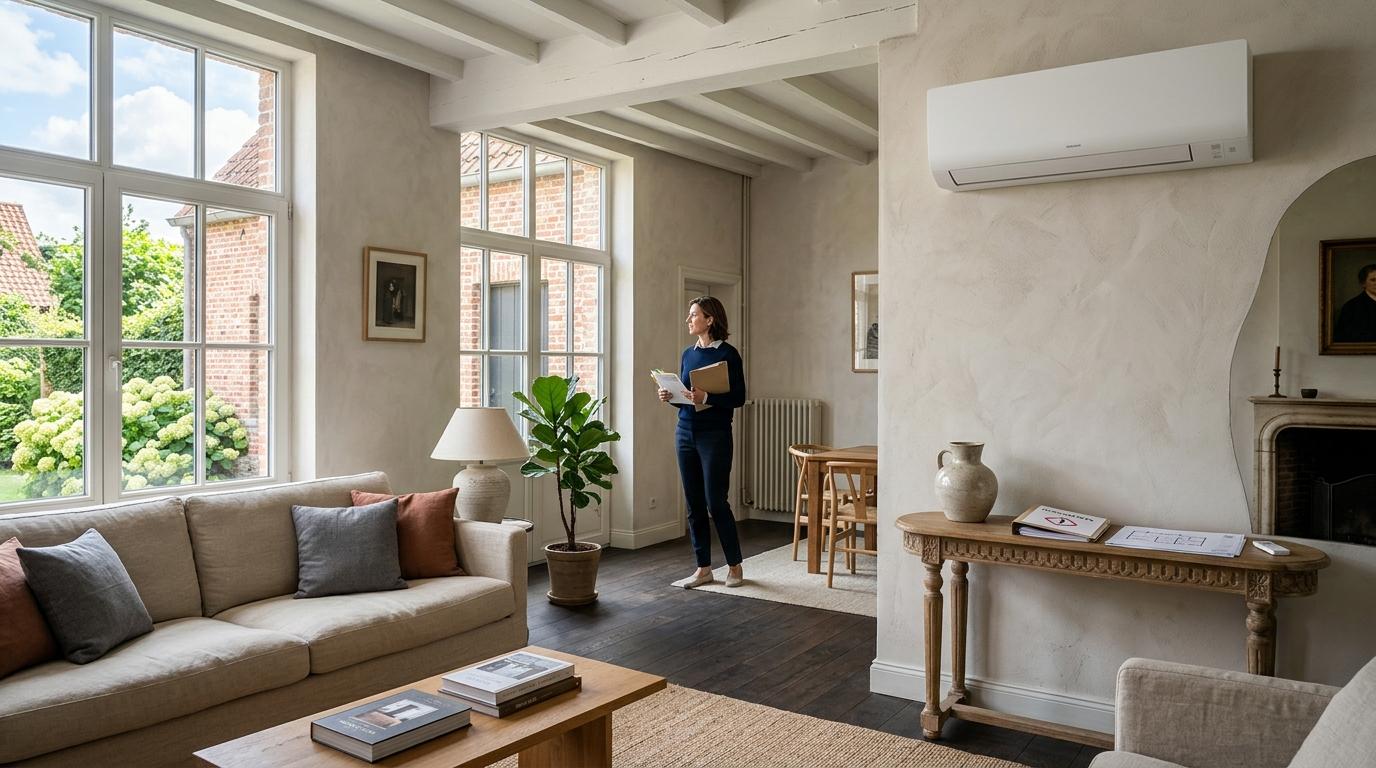
Planning to sell a house with air conditioning? Then you will face different questions than with an ordinary heating system. Does the air conditioning go with the house, did the outdoor unit need a permit and which papers will a buyer expect? This article covers split and multi-split units that mainly cool and sometimes also heat. If a heat pump is your main heating, also read our article on selling a house with a heat pump.
Is the air conditioning part of the sale?
A fixed air conditioner, with an indoor unit on the wall, an outdoor unit on the facade or roof and fixed pipes between them, generally belongs to the property. The installation is attached to the building and is therefore included in the sale price. You cannot simply have it removed after the sale.
A mobile air conditioner on wheels is a different matter. Such a unit is a movable item and you would normally take it with you, just like a standing fan. In between there are borderline cases, such as a unit that only sits in a window opening.
Avoid disputes and state in the sales agreement (compromis) which units stay in the house. List per room which units are installed, whether the remote controls are included and in what condition you hand them over. If someone explicitly buys a house with air conditioning, they expect working units at handover. A short test together with the buyer before the handover prevents surprises.
Permit for the outdoor unit: check it before the sale
The indoor unit is rarely a problem. The outdoor unit can be, because it hangs on a facade, stands on a flat roof or in the garden and is sometimes visible from the street. Whether a permit was needed depends on the region, the location of the unit and local rules. In Flanders, certain small works are exempt from an environmental permit (omgevingsvergunning), but not always and not everywhere. Brussels and Wallonia have their own planning rules. In an apartment building, the association of co-owners often also has a say in what is allowed on the facade or roof.
✦ 100% free & No obligation
Sell your property with the best agent
Compare the top 3 agents in your region for free and save on commission.
Compare agents →Why does this matter in a sale? The notary requests planning information from the municipality, and a buyer will ask questions about a unit that does not appear to be permitted. So check in advance whether you have a permit, a notification or the approval of the co-owners' association. If in doubt, ask the planning or environment department of your municipality, or in Flanders consult the Omgevingsloket. An uncertainty you raise yourself costs less trust than one the buyer finds on their own.
Also pay attention to noise. An outdoor unit right next to the property boundary that can be heard at night sometimes leads to complaints from neighbours. A buyer who hears it during a viewing will ask about it.
Which documents do you give the buyer?
With a technical installation, buyers want to see proof. A complete file builds trust and saves you questions during the negotiations. Ideally, gather:
- the installation invoice, with the date, brand, type and number of units;
- the installer's details;
- the manuals and the remote controls;
- the warranty conditions and the remaining warranty period;
- the maintenance reports and, where applicable, the leak check reports;
- a permit, notification or approval from the co-owners' association for the outdoor unit, if one was needed.
Air conditioning should be installed by a certified technician, because the work involves refrigerant. An invoice from such a company therefore also shows that the installation was done correctly. If you installed it yourself or had an acquaintance do it, say so honestly. Defects you knew about and kept quiet can still come back to you after the sale.
Refrigerant, maintenance and inspections
Every air conditioner works with a refrigerant, a fluorinated gas. Above a certain quantity of refrigerant, a periodic leak check by a certified technician is required. For most small residential units this does not apply, but for larger or multi-split installations it sometimes does. Larger air conditioning systems may also be subject to a periodic energy inspection. You can find the exact rules at the Departement Omgeving in Flanders, Brussels Environment and the Service public de Wallonie.
Separately, an inspection of the electrical installation is mandatory when you sell a home. An air conditioner is often connected to its own circuit. Tell the inspector there are air conditioning units, so that part is checked as well.
If the last service was a long time ago, book one before the sale. Cleaned filters, a check that everything works and a short report cost little and show that the units are in good order.
Air conditioning and the EPC
To sell, you need a valid energy performance certificate (EPC). How an air conditioner counts in it depends on the type of unit and on how the energy assessor enters the installation. A unit that only cools is assessed differently from a reversible unit that also heats. So give the energy assessor the technical details: brand, type, capacity and whether the unit is also used for heating. Without that data, the assessor works with default values, and those rarely work in your favour.
If you already have a valid EPC from before the installation, that certificate in principle remains usable. If the air conditioning also heats and you expect a better score, ask an energy assessor whether a new EPC makes sense.
What is air conditioning worth in a sale?
Air conditioning does not automatically raise the sale price by what you paid for it. A buyer looks at what the installation does for them. In a top-floor apartment, a house with a lot of south-facing glass or a bedroom under the roof, cooling is highly valued during hot summers. In a well-shaded terraced house, it carries less weight. Age and condition also matter: a recent unit still under warranty is worth more than a fifteen-year-old unit that is due for replacement.
An estate agent who knows the local market can estimate how much buyers in your area are willing to pay for cooling. A free valuation gives you a first idea of the value of your home, installation included.
In the listing, stick to the facts. Mention in which rooms a unit is installed, whether the units also heat and when they were installed. If you also have solar panels, mention that, because you then partly cool with your own electricity. Do not promise savings you cannot prove. On ImmoMakelaarVergelijker.be you can compare estate agents who know how to market strengths like these.
Conclusion
When you sell, air conditioning is mainly a matter of clarity. Put in writing which units stay in the house, check that the outdoor unit complies with the permit rules and gather invoices and maintenance reports. Give the energy assessor and the inspector the right details. That way you avoid disputes at the sales agreement and the handover, and a buyer sees the air conditioning as a plus rather than a question mark.
Want to know which estate agent suits your home best? Compare up to 3 recognised estate agents in your area, free and without obligation.
Frequently asked questions
Does a fixed air conditioner stay in the house when I sell it?
Yes, a fixed air conditioner with a wall-mounted indoor unit, outdoor unit and fixed pipes is attached to the building and is included in the sale. You cannot have it removed after the sale. Mobile units on wheels are different - those you can take with you.
Did my outdoor air conditioning unit need a permit?
It depends on the region, the location of the unit and local rules. In Flanders, some small works are exempt from an environmental permit, but not always. Check with your municipality or consult the Omgevingsloket in Flanders to be sure before you sell.
What documents should I give the buyer about my air conditioning?
Gather the installation invoice with the brand and type, the installer's details, manuals and remote controls, warranty conditions, maintenance reports and any permit or approval for the outdoor unit. A complete file builds trust and reduces questions during negotiations.
Does air conditioning affect the EPC when selling my home?
Yes, how the unit is counted depends on whether it only cools or also heats. Give the energy assessor the technical details - brand, type, capacity and heating use - otherwise they work with default values that rarely work in your favour.
Does having air conditioning increase the sale price of my home?
Not automatically and not by what you paid for it. It is most valued in top-floor apartments, homes with a lot of south-facing glass or bedrooms under the roof. Age and condition also matter - a recent unit under warranty adds more value than an older one due for replacement.
Follow us on Google
Pick Immomakelaar Vergelijker as a preferred source and you will see our articles more often in Google, including in AI answers.
Redactie ImmoMakelaarVergelijker
"We write about selling, valuing and costs in Belgium. Articles are drafted with the help of AI from official sources and checked by our team."