
Rainwater tank when selling a home: what do sellers need to know?

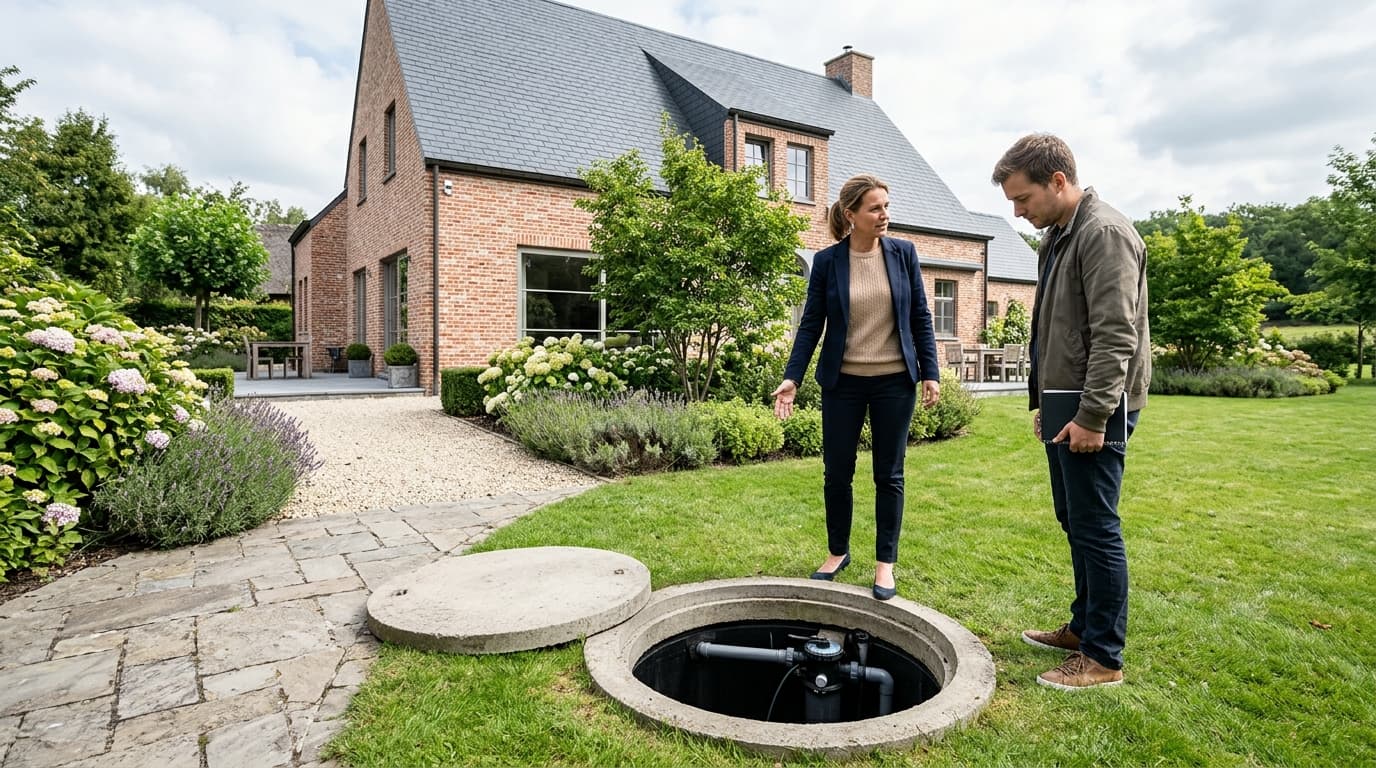
A rainwater tank when selling a home raises questions that go beyond the sewer inspection itself. Is the tank mandatory? What if it leaks, or the pump no longer works? And do you have to tell the buyer how the rainwater is used? In this article we look only at the tank and everything that comes with it. For the mandatory inspection of the complete drainage system, see our article on the sewer inspection when selling a home.
Is a rainwater tank mandatory when you sell?
No. The sale itself does not require you to install a rainwater tank. An existing home without a tank can be sold perfectly well. The obligation to provide a tank comes from the Flemish rainwater regulation (hemelwaterverordening), which applies to new builds, rebuilds and certain extensions or renovations that require an environmental permit (omgevingsvergunning). Whether a tank was mandatory therefore depends on what was permitted at the time.
It is worth checking, though. If your home was built or extended recently, the rainwater tank was usually a condition of the permit. If it is missing, or smaller than permitted, a buyer or their notary may ask questions about it. So dig out the permit and the plans before you put the home on the market. If in doubt, your municipality's environment department can tell you which conditions applied. The exact rules, such as the minimum volume per roof surface, are published by the Flemish government under the regional urban planning regulation on rainwater.
What does the sewer inspection check on the rainwater tank?
Since 1 July 2025, selling a home in Flanders requires an inspection of the private drainage system. The inspector does not look at the volume or condition of your tank as a reservoir, but at how the water flows. Does the rainwater from the roof actually end up in the tank? Where does the overflow go? And is the rainwater circuit separated from the wastewater, as the sewer operator in your street requires?
In practice, the overflow is the sensitive point. In a street with a separate system, it must go to the rainwater pipe, an infiltration facility or a ditch, not to the wastewater pipe. An incorrect connection can lead to a negative certificate. That does not block the sale, but the buyer then has to have the situation corrected within a set period, and that carries weight in the negotiation. So have the inspection done early. That way you know in time whether work is needed, and you can choose to fix it yourself or factor it into the price. What the certificates cost together is explained in our overview of the costs of certificates when selling a house.
✦ 100% free & No obligation
Sell your property with the best agent
Compare the top 3 agents in your region for free and save on commission.
Compare agents →Leaking tank, broken pump or clogged filter
A rainwater tank lasts a long time, but not forever. Concrete tanks can crack, lids can break and the pump or filter will eventually need maintenance or replacement. Before you sell, it pays to have the tank checked or to inspect it yourself. If it empties noticeably fast after a dry spell, that may point to a leak.
You are not obliged to repair everything before the sale. You do have to be honest about what you know. A defect you are aware of and do not disclose can later be used against you as a hidden defect, especially if it was not visible during a viewing. A tank sits underground, so a buyer will not see a crack. State known problems in writing in the sales agreement (compromis). That protects you better than a general clause. You can read more about this liability in our article on hidden defects when selling a home.
A small repair, such as a new pump or a cleaned filter, is often cheaper than the discount a buyer asks for an installation they are not sure works.
Reusing rainwater: what the buyer wants to know
Many tanks are used for more than watering the garden. If you connect the toilet, the washing machine or an outdoor tap to rainwater, you have a second pipe network in the house. That circuit must be completely separate from the mains water. A connection between the two can contaminate the drinking water. That is why the water supplier can ask for an inspection of the indoor installation when an alternative water source is connected.
For the buyer, these are concrete questions. Which appliances run on rainwater? Is there a switchover to mains water when the tank is empty? Are the rainwater taps clearly marked? The more you can show on this, the less uncertainty a viewing creates. A simple diagram of the pipes and the pump manual make all the difference.
A well-functioning tank with reuse is a plus for many buyers. It lowers the water bill and fits the attention to water that municipalities ask for today. Present it factually in the listing, without turning it into a big selling point the buyer will not recognise later.
Putting together your rainwater tank file
A complete file prevents discussions during the negotiation and at the notary. Gather these documents before you put the home on the market:
- the certificate of the private drainage inspection;
- the environmental permit and plans, if the tank was a permit condition;
- the volume of the tank, if you know it, and its location on a plan or photo;
- invoices for the tank, the pump or recent repairs;
- an inspection report of the indoor installation, if there is one;
- a short description of which appliances run on rainwater.
Also agree in the sales agreement what happens to the pump and the filter. A pump fixed in the tank or the utility room normally stays with the home. If you want to take something with you, put it in writing. An estate agent who knows the local rules can review this file with you and knows which questions buyers ask in your municipality. Through ImmoMakelaarVergelijker.be you compare estate agents in your region and choose who will present your home best.
In conclusion
A rainwater tank does not make the sale harder, as long as you know what is in the ground and how it is connected. Have the sewer inspection done in time, disclose known defects in writing and give the buyer a clear picture of the reuse. Want to know what your home is worth first? Request a free valuation. ImmoMakelaarVergelijker.be puts you in touch with up to three BIV-accredited estate agents in your region, free and without obligation. Compare estate agents near you and go to market well prepared.
Follow us on Google
Pick Immomakelaar Vergelijker as a preferred source and you will see our articles more often in Google, including in AI answers.
Redactie ImmoMakelaarVergelijker
"We write about selling, valuing and costs in Belgium. Articles are drafted with the help of AI from official sources and checked by our team."