
Renting a skip to clear a house in Belgium

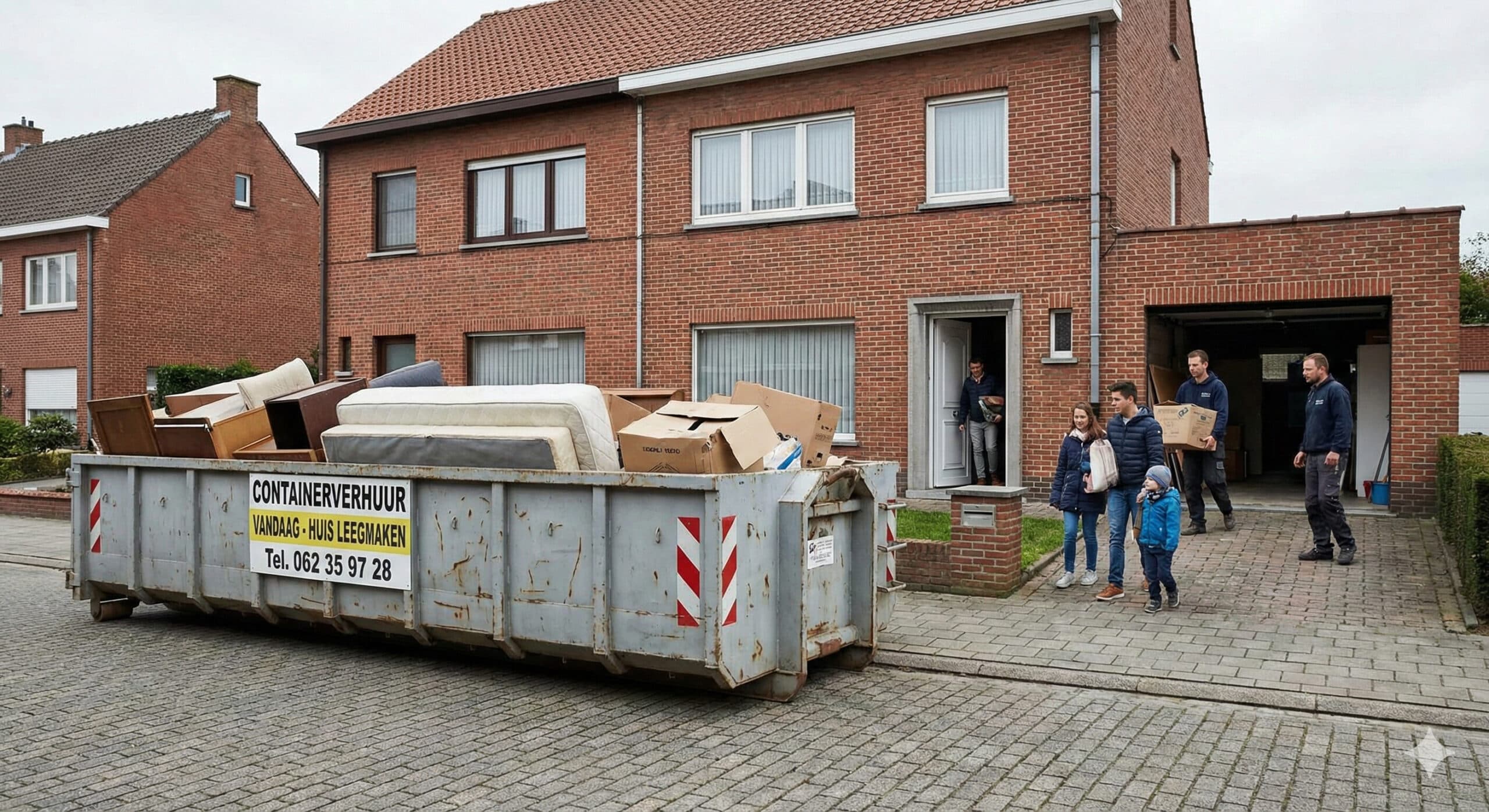
Clearing a house in Belgium goes faster with a skip at the door than with ten trips to the recycling centre. The questions are which size you need, what the price actually covers, and whether you need a permit to put it on the street. This article covers those three points, so that in 2026 the final invoice holds no surprises.
What size skip do you need?
Skips for furniture and bulky waste generally run from about 3 cubic metres to 20 cubic metres. A studio or an apartment you are simply tidying usually fits in the smaller sizes. For a whole home of 80 to 100 square metres, hire companies in practice work with a skip of around 10 cubic metres, and for a house with a full cellar, attic and garage you are closer to 15 to 20 cubic metres.
A useful rule of thumb is that a well filled room quickly amounts to two or three cubic metres once you dismantle the furniture. If you are hesitating between two sizes, describe room by room what has to go. The hire company makes that estimate every day and has no interest in a skip coming back half empty.
Do not cut it too fine. A second transport for the last cubic metre costs more than taking the next size up straight away, because you pay again for delivery and collection.
What really drives the price
The price of a waste skip always has three parts: transport there and back, the hire period, and processing whatever is inside. That last part is charged by the tonne and is usually the largest share of the invoice. An advertisement that shows only an amount per skip therefore never tells the whole story.
✦ 100% free & No obligation
Sell your property with the best agent
Compare the top 3 agents in your region for free and save on commission.
Compare agents →Sorted waste costs less than mixed waste. If you set aside clean rubble, wood or metal, the rate per tonne drops noticeably. If you throw everything in together, the processing plant pays someone to sort it and you see that in the final account. For a house clearance with plenty of furniture, mattresses and carpet you are in the most expensive category anyway, because that is mixed non recyclable waste.
So ask three things of every quote. How many tonnes are included in the price, what each additional tonne costs, and how many days the skip may stay before standing charges start. With those three figures, two quotes finally become comparable.
The permit for the public road
If the skip stands on your own drive, you need nothing. If it takes up the pavement, a parking space or the carriageway, it occupies public space and your municipality issues a permit for that, usually called an occupation of the public domain.
Apply at least one or two weeks ahead, because some departments work with fixed processing times. One municipality charges nothing, another applies a rate per day or per parking space. The permit often comes with road signs you have to put up, sometimes a few days in advance, so that parked cars are gone in time. Many skip companies handle the application and the signage for a fee. Ask explicitly, because without a permit you risk a fine or a removed skip.
What cannot go in
Asbestos never belongs in an ordinary skip. Suspect material, such as old corrugated sheets or slates, goes through a separate closed collection with its own rules and its own rates. The same applies to paint, oils, chemicals, batteries and gas bottles: that is small hazardous waste and it goes to the recycling centre.
Electrical appliances and fridges also fall outside the ordinary skip. They go through the take back scheme to an approved collection, often free when you buy a replacement or via the recycling centre. Put them in the skip anyway and a surcharge appears on your invoice.
For small volumes the recycling centre remains the cheapest route. A skip only starts to pay off once you have several trailer loads, or if you have no car with a tow bar.
Skip or a professional clearance?
Renting a skip means you carry everything yourself. That is the cheap option, but it costs time, aching muscles and usually a few extra pairs of hands. A clearance company does the work for you, takes everything out and hands the house back swept clean. You then pay for labour, not only for disposal.
What that second route costs and when it is worth it is set out in our article on what house clearance costs. For an estate or a sale with a deadline, it is often the more realistic choice.
Ordering without surprises
Call two or three companies in your region and describe the same job, otherwise you are comparing apples with pears. Say what type of waste is going out, whether there is asbestos in the building, where the skip will stand and how long you need it. Ask for the price in writing, transport included, with the tonnage included, the rate per additional tonne and the standing charges.
Then plan in this order: first get out what is still usable, through a sale, family or a charity shop, and only then order the skip. People who sort first regularly need one size less, and that counts for more than any haggling over the daily rate. If you are selling the property after the clearance, compare a few agents from your municipality, because an empty house photographs and sells better.
Frequently asked questions
What size skip do I need to clear a house?
For an apartment or a targeted clear-out the smaller sizes are enough. For a home of 80 to 100 square metres, hire companies work with about 10 cubic metres, and with 15 to 20 cubic metres for a house with a full cellar, attic and garage. Reckon on roughly two to three cubic metres per well filled room.
What does a skip cost to clear a house?
The invoice consists of transport, the hire period and processing by the tonne. That last part is the heaviest and depends on the waste type: mixed waste from a clearance falls in the most expensive category. Always ask how many tonnes are included, what an extra tonne costs and when standing charges start.
Do I need a permit for a skip on the street?
Yes, as soon as it takes up the pavement, a parking space or the carriageway. That is an occupation of the public domain, applied for at the municipality, preferably one or two weeks ahead. On your own drive nothing is required. Many skip companies handle the application and the road signs for a fee.
Can asbestos go in a skip?
Never. Suspect material goes through a separate closed collection with its own rules. Paint, oils, chemicals, batteries, gas bottles, fridges and electrical appliances do not belong in an ordinary skip either.
Is a skip cheaper than a clearance company?
For the disposal alone yes, but you do all the carrying yourself. A clearance company also charges labour and hands the house back swept clean. For an estate or a sale with a deadline, that is often the more realistic choice.
"Tech entrepreneur and strategist focused on digital transformation in the real estate sector."