
Selling a home with home automation: what to arrange as a seller

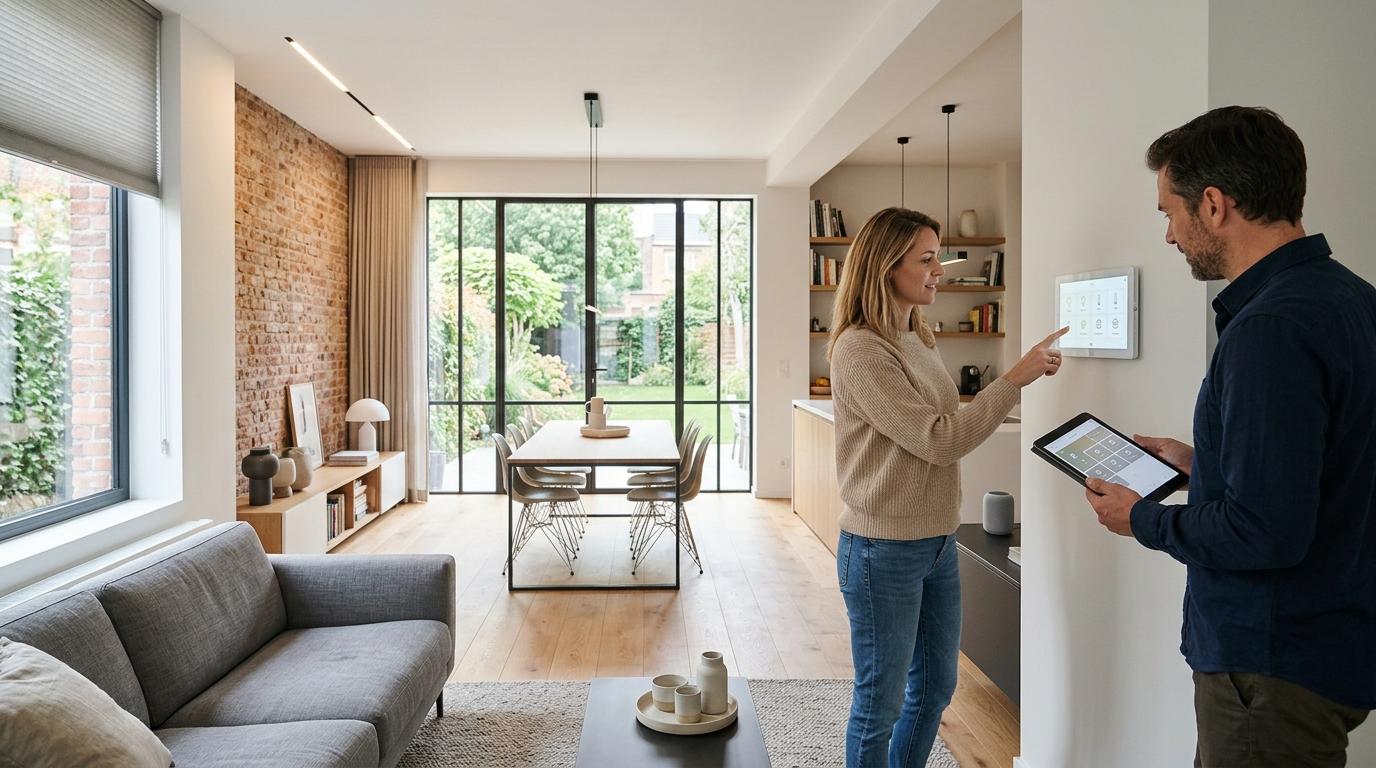
If you want to sell a home with home automation, you will notice from the very first viewings that buyers think two things at once. Handy, everything from the smartphone. And straight after that: what if it breaks, who can still repair it, and will the previous owner still have access to my front door? The better you answer those questions in advance, the more the system becomes a selling point. Below you can read what to arrange as a seller.
This article covers smart control of lighting, shutters, heating, access and cameras. If you have an EV charger, the rules for that are in our article on selling a home with an EV charger.
Is the home automation included in the sale?
A home automation system that is permanently built into the house is, as a rule, part of the building. Think of a wired system in the fuse box, built-in switches and touch panels, motorised shutters or central heating control. Unless agreed otherwise, all of that goes to the buyer, just like the kitchen or the boiler.
Standalone smart devices are a different matter. A smart speaker, bulbs you screw into an ordinary fitting, a separate hub plugged into a socket or a camera sitting on a shelf are movable goods. In principle, you take them with you. That is exactly where disputes arise after the sale: the buyer was counting on a "smart home" and finds ordinary switches and a few empty sockets at the handover of the keys.
So make a list in advance of what stays and what you take. Unsure about a device, for example a smart thermostat you installed yourself? Decide now and put it in writing. If you take something that had a fixed function, put an ordinary replacement back, so the buyer is not left without a thermostat or doorbell.
✦ 100% free & No obligation
Sell your property with the best agent
Compare the top 3 agents in your region for free and save on commission.
Compare agents →Handing over accounts, apps and access properly
With a traditional home, you hand over the keys and that is it. With home automation there is a second key: digital access. The system is often tied to your personal account, your email address and sometimes a cloud subscription. As long as that remains the case, you could in principle still switch lights, view the cameras or open the lock after the sale. A buyer rightly wants certainty about that.
So arrange the following before the key handover:
- Remove the home from your own app or account, or transfer the administrator account to the buyer as the manufacturer provides.
- Ask your installer how the installer code or the programming software is handed over. On some systems nobody can change anything without that code.
- Delete recorded footage, voice profiles and user data, and reset cameras and doorbells to factory settings if the buyer creates their own account.
- Pass on the PIN codes for locks and the alarm and have the buyer change them straight away.
- Cancel or transfer subscriptions, so you do not keep paying for a home that is no longer yours.
Record what you have done in a short document. That protects you if something goes wrong with access later on.
Electrical inspection and system documentation
A home automation system is part of the electrical installation. When a home is sold in Belgium, that installation is covered by the mandatory inspection, and the inspector works with the single-line diagram and the layout plan. With home automation, these must also show how modules, controls and circuits are connected. If those diagrams are missing or no longer match after later changes, that can lead to remarks. What exactly the seller needs to arrange is explained in our article on the electrical inspection when selling.
Besides the diagrams, it helps to prepare a file with:
- the brand and type of the system and the year of installation;
- the name and contact details of the installer;
- manuals, an overview of the programming and any scenes;
- invoices and current warranties.
A buyer who sees that the system is documented and that an installer can be reached worries much less about maintenance and repairs.
Does home automation raise the selling price?
That depends heavily on the system and on the buyer. A recent, well-working system from a common brand, with lighting, shutters and heating set up logically, is a comfort argument. It can help sell the home faster, especially in a higher segment where buyers expect that comfort.
An old or uncommon system can have exactly the opposite effect. If parts are no longer available or only a handful of installers still know it, a buyer factors in a replacement. A system that only half works, with switches that no longer respond or an app that is no longer updated, is also more likely to take money off the price than to add anything.
So do not assume that a smart home automatically fetches more. An estate agent who regularly sells comparable homes in your area can judge whether buyers there really pay more for it. You can get a first idea of your home's value with our free valuation. Want to know how different agents would market your home and the system? Then you can compare up to 3 estate agents.
Agreements in the sales agreement and during viewings
The more specific the sales agreement (compromis), the smaller the chance of disputes after the sale. Have it state which parts of the home automation are sold with the property, which devices you take and in what condition you leave the system. Also agree that you will hand over access and accounts at the key handover, possibly with a short handover session together with the buyer.
If part of the system no longer works, say so in advance. A defect you know about and keep quiet can lead to a dispute after the sale, even if the sales agreement contains a clause on hidden defects. Disclosing it honestly and adjusting the price if needed is almost always cheaper than a conflict afterwards.
During viewings it pays to show the system briefly. Show how the shutters and lighting respond, and mention that diagrams and an installer are available. Keep it simple. Most buyers want to know that everything works and that they can operate it themselves, not how every scene is programmed.
How to sell a smart home without surprises
Home automation can make your home more attractive, provided the buyer knows what they are getting. Make a list of what stays, prepare the documentation, arrange the digital handover and be open about what no longer works well. Then the system becomes an argument in the sale rather than a source of dispute.
An estate agent who knows the local market helps you present the system properly and set a realistic price. Through ImmoMakelaarVergelijker.be you can compare up to 3 BIV-registered estate agents in your region, free and without obligation.
Frequently asked questions
Does a built-in home automation system automatically transfer to the buyer when selling?
Yes, a home automation system that is permanently built into the house - such as wired modules in the fuse box, built-in switches or motorised shutters - is considered part of the building and transfers to the buyer by default. Standalone devices like smart speakers or shelf-mounted cameras are movable goods that you can take with you. Always put in writing what stays and what you take to avoid disputes.
What do I need to do with my apps and accounts before handing over the keys?
You need to remove the home from your personal account or transfer administrator access to the buyer, delete recorded footage and user data, reset cameras and doorbells to factory settings, and pass on PIN codes for locks and the alarm. It is also recommended to cancel or transfer any cloud subscriptions tied to the system. Write down what you have done in a short document to protect yourself if access issues arise later.
Does home automation increase the selling price of my home?
It depends on the system and the buyer. A recent, well-functioning system from a common brand can help sell the home faster, especially in a higher segment, but an old or uncommon system where parts are hard to find can actually lower the price. A system that only half works is more likely to reduce the value than to add to it.
Does home automation affect the mandatory electrical inspection when selling in Belgium?
Yes, home automation is part of the electrical installation and falls under the mandatory inspection. The single-line diagram and layout plan must also show how modules, controls and circuits are connected, and missing or outdated diagrams can lead to remarks during the inspection.
What should be included in the sales agreement regarding home automation?
The sales agreement should specify which parts of the home automation are sold with the property, which devices you are taking, and the condition of the system at handover. You should also agree on the digital handover of accounts and access, and disclose any known defects - keeping quiet about issues you are aware of can lead to disputes after the sale.
Follow us on Google
Pick Immomakelaar Vergelijker as a preferred source and you will see our articles more often in Google, including in AI answers.
Redactie ImmoMakelaarVergelijker
"We write about selling, valuing and costs in Belgium. Articles are drafted with the help of AI from official sources and checked by our team."