
What documents do you need for a property valuation? The complete checklist

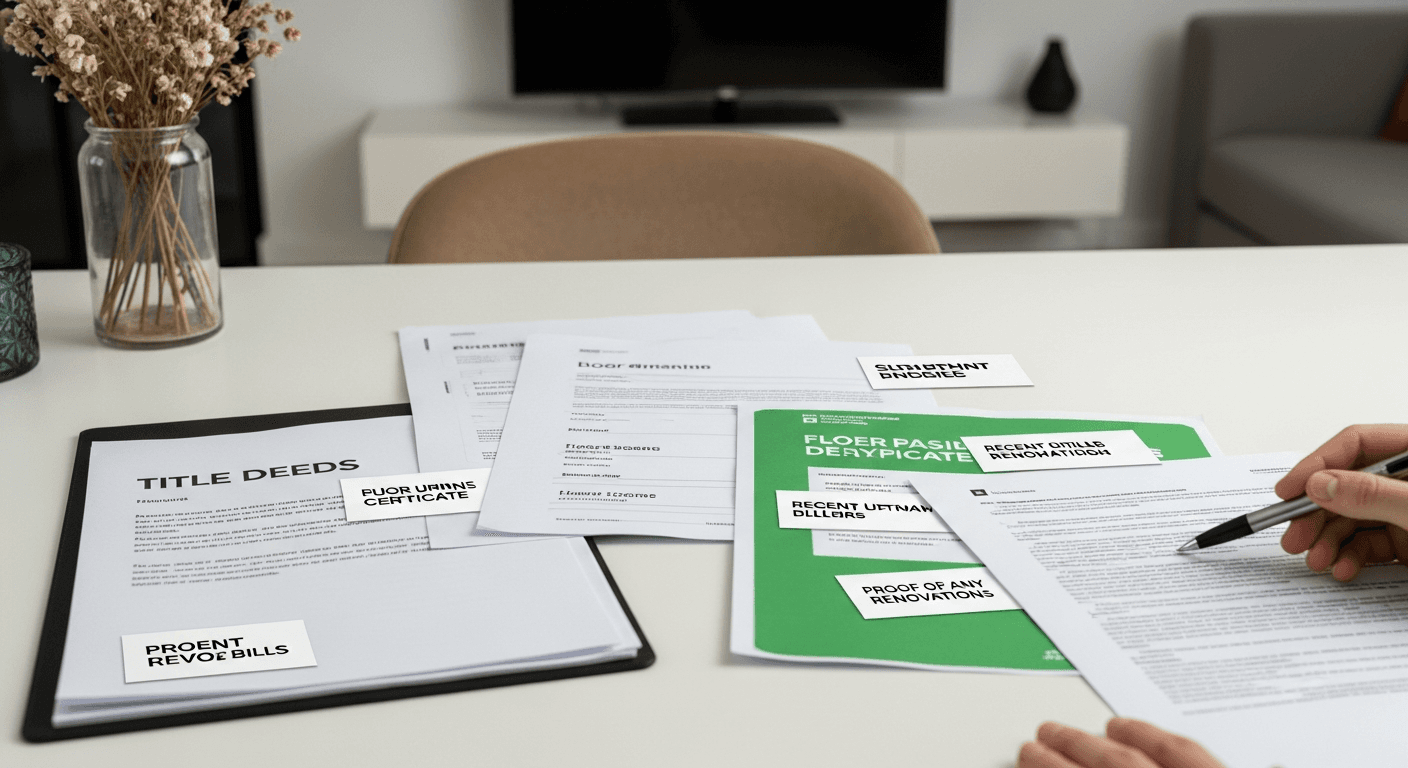
What documents do you need for a property valuation? The question comes up at every first appointment, and the answer has a direct effect on the figure you end up with. A valuer working without supporting documents reasons cautiously and widens the range. With a complete file, they defend a precise price, argument by argument. Here is the list to prepare, in the order in which it is actually used.
Why the valuer asks for paperwork before talking price
A valuation rests on three pillars: the comparison with recent sales in the neighbourhood, the actual condition of the property, and its legal and administrative situation. The first pillar the valuer handles alone. The other two depend on you.
Without documents, a valuer applies what the trade calls an uncertainty discount. They do not know whether the roof is twelve years old or two, whether the stated surface area matches the official measurement, whether the veranda was properly authorised. Every unknown pushes them towards the bottom of the range, because they put their professional liability on the line with that figure.
Be careful not to confuse two lists that look alike. The legal file you have to put together to sell your property is there to secure the transaction at the notary. The list below serves another purpose: giving the valuer something to justify a value with. The two overlap in part, but the timing and the objective differ.
The documents that prove what you are selling
Start with the papers that describe the property itself. They are the easiest to find and the most used during the visit.
✦ 100% free & No obligation
Sell your property with the best agent
Compare the top 3 agents in your region for free and save on commission.
Compare agents →- The title deed, in other words the notarial deed of purchase, inheritance or gift. It sets out exactly what belongs to you, including outbuildings and parts of the land.
- A recent cadastral extract, with the plot number, the surface area of the land and the cadastral income.
- The plans of the property, even old ones. A plan lets the valuer check the layout of the rooms and the logic of the volumes.
- The measurement report if you have one, or any document stating the habitable surface area.
- The statement of charges and taxes: property tax, any specific municipal levy.
The habitable surface area deserves particular attention. A gap of ten square metres between what you state and what the measurement confirms can represent several thousand euros in either direction. If you have no reliable surface document, say so openly instead of putting forward an approximate figure.
The energy certificate and the proof of your renovation work
This is where the file starts to pay off. Energy performance and the renovation history are the two levers that move a valuation the most in Belgium.
First prepare the energy performance certificate, the PEB, or the EPC if your property is in Flanders. The label and the specific consumption immediately steer the valuer thinking, because a buyer now factors the cost of upgrade works into their offer. A certificate remains valid for ten years, so check whether yours is still current.
Then gather the invoices for the work carried out: roof, window frames, insulation, boiler, solar panels, kitchen, bathroom, electrics. A dated invoice is worth more than a recollection. It proves the date, the scale and the quality of the work, and it allows the valuer to reason about the remaining service life of the equipment rather than about a theoretical average.
Add the guarantee certificates that are still running, the boiler maintenance certificate and, if you have one, the inspection report for the electrical installation. If you first want to place your property in a range before putting this whole file together, request a free valuation of your property and complete the missing pieces afterwards.
Apartment in a co-ownership: the syndic pack
For an apartment, the value does not depend on your four walls alone. It also depends on the financial health of the building. Ask your syndic for:
- the basic deed and the co-ownership regulations;
- the minutes of the general meetings of the past three years;
- the amount of the ordinary and extraordinary charges per financial year;
- the state of the reserve fund and of the working capital fund;
- the decisions on works that have been voted but not yet carried out.
That last point weighs heavily. A facade renovation or a lift replacement approved at a general meeting is a future debt attached to the unit. An informed valuer deducts it cleanly from the value; an uninformed valuer applies a far wider safety margin, or the valuation will be challenged as soon as the first serious offer comes in.
Planning, soil and easements
The last category concerns the legal status of the property. It is less visible during the visit, but it can reduce a value by tens of thousands of euros.
- The planning information from your municipality: the use of the plot, the permits granted, any infringements, heritage listing.
- The soil certificate: Brussels Environment in Brussels, the soil condition database in Wallonia, OVAM in Flanders.
- The flood risk information, which has to appear in your listing in any case.
- The known easements: right of way, a particular party wall arrangement, a pipe crossing the land.
- The post-intervention file for work carried out since May 2001.
An extension built without a permit remains the most frequent case, and the most expensive one. It is better to flag it to the valuer yourself than to let it surface later, when the prospective buyer has already made an offer and regularisation becomes a negotiating argument against you.
What happens if a document is missing?
Nothing final. A valuation is still possible with a partial file, but the result changes in nature: you get an indicative range instead of a defendable value. For a sale, that difference counts, because it is the substantiated figure that holds up against a counter-offer.
Here is a realistic order of priority if your time is limited. The energy certificate and the renovation invoices first: those are the ones that push the value up. The title deed and the cadastral extract next, because they frame what is being sold. The syndic pack and the planning information last, while knowing that the municipality often takes several weeks to reply. So start that request now, it will keep moving while you prepare the rest.
One last useful reflex: have your property valued by more than one professional. The methods and the sales references differ from one agency to another. Compare up to 3 licensed estate agents in your municipality and hand the same file to each of them. You will see straight away who justifies their figure with your documents and who settles for a neighbourhood average.
Your next step
Gather what you already have at home, order the energy certificate if it has expired, and request the planning information from your municipality in the same week. With that file in hand, a valuation becomes a conversation about facts rather than a cautious estimate. Compare the estate agents active in your municipality free of charge and set their valuations side by side on the basis of the same documents.
Frequently asked questions
What documents do I need for a property valuation in Belgium?
You need the title deed, a recent cadastral extract, property plans, an energy performance certificate (PEB/EPC), and renovation invoices. For apartments, you also need documents from the syndic such as meeting minutes and the state of the reserve fund. Planning information and soil certificates round out the file.
Does it matter if I am missing some documents for the valuation?
A valuation can still happen with a partial file, but you will receive an indicative range rather than a precise, defendable value. Valuers apply an uncertainty discount when documents are missing, which tends to push the figure towards the lower end of the range.
Why do renovation invoices matter for a property valuation?
A dated invoice proves the date, scale and quality of the work, allowing the valuer to reason about the remaining service life of the equipment rather than using a theoretical average. Without invoices, the valuer cannot account for improvements you have made, which can reduce the valuation.
What extra documents does an apartment owner need compared to a house owner?
Apartment owners need to request a syndic pack, which includes the basic deed, co-ownership regulations, minutes of the last three general meetings, charge statements, the state of the reserve fund, and any works that have been voted on but not yet carried out. Approved but unfinished works represent a future debt that directly affects the valuation.
What happens if my property has an extension built without a permit?
An unpermitted extension is the most frequent planning issue and one of the most costly. It is better to flag it to the valuer yourself upfront, rather than letting it surface after a buyer has made an offer, where regularisation can become a negotiating argument against you.
"Real estate expert focused on quality control and strategic partnerships."